


Three Volunteering Charts: And what they tell us about the Operational Resilience of US-based Volunteer Programs
The volunteer landscape is shifting beneath our feet. For the first time in over a decade, we are seeing a convergence of public interest, corporate demand, and a radical change in how individuals want to give their time.
At the heart of this shift is the need for Operational Resilience. It is no longer enough to just “have” a volunteer program; you must have an infrastructure that can withstand massive inbound pressure without breaking your team or compromising the volunteer experience.
In this article we are going to look at three charts that are changing the face of volunteering in the US. These latest Google Trends reports will help us explore how you can build a more resilient and future-proof volunteer program.
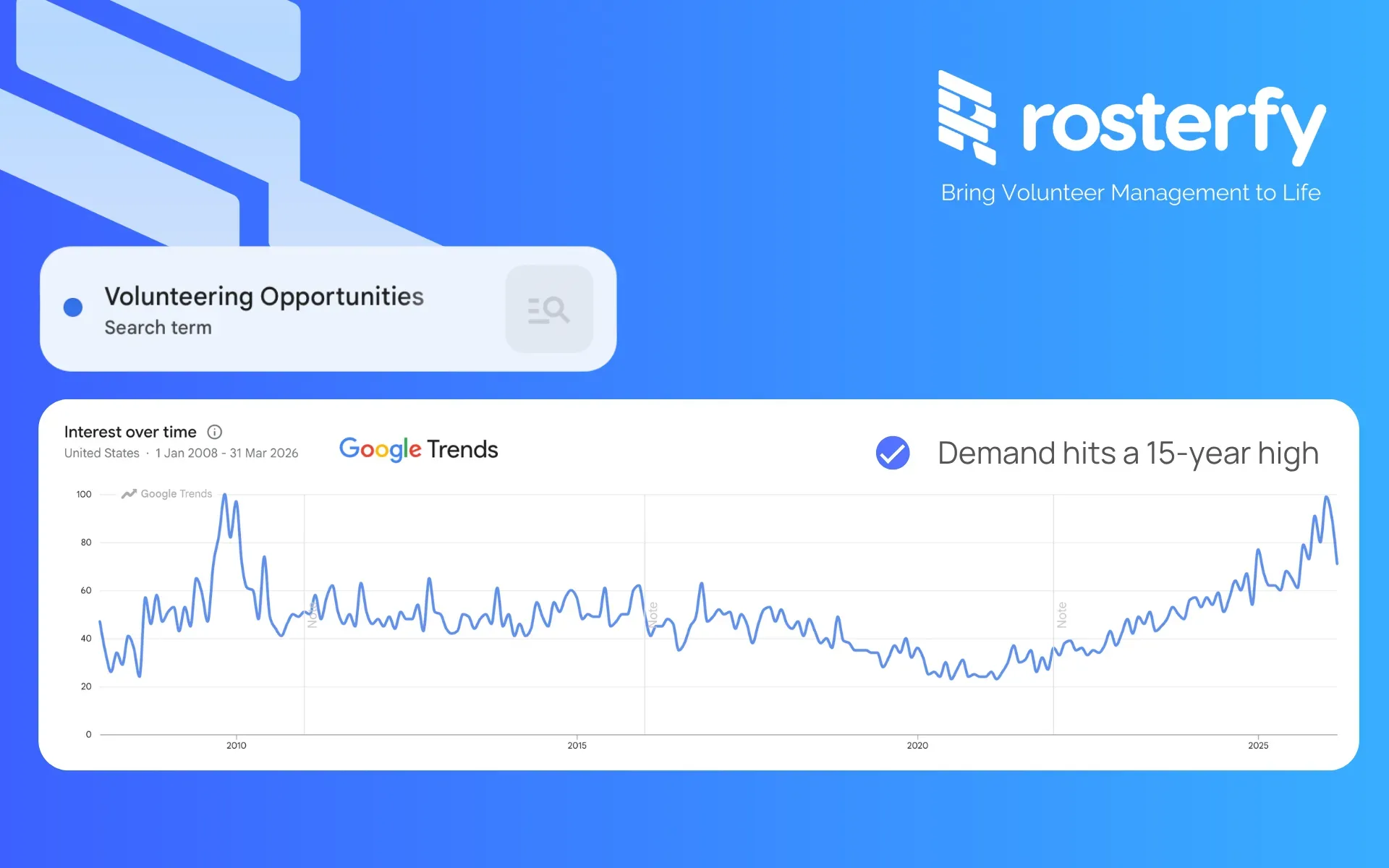
Google Searches for 'Volunteering Opportunities' have reached a 15 year high
1. The 15-Year High: Preparing for the admin crush
General search interest for “Volunteering Opportunities” in the United States has hit a milestone: a 15-year high.
Not since the economic necessity of 2009 has the public shown this level of intent to engage with community causes.
While this surge represents a massive opportunity, it carries significant institutional risk. With increased demand comes an inevitable spike in administrative weight. When manual processes meet high volume, bottlenecks form that can stall service delivery. More dangerously, a stretched team opens the door to human error – ranging from minor oversight to catastrophic data breaches, expensive compliance mistakes, and lasting PR damage.
Popular demand for your program is a good problem to have, as it is nearly impossible to deliver on your mission without a dedicated volunteer workforce. However, organizations must prioritize the welfare of their management teams. Burnout is a systemic threat, and the sector is already facing a significant exodus of skilled personnel.
To be operationally resilient, you must protect your staff from the administrative burden that leads to turnover.

Partner Perspective: Dataro
"We're seeing the same surge in our data. But what's interesting isn't just the volume - it's what volunteer engagement tells you about a donor's long-term relationship with your mission.
I've literally sat across the table from organizations where they tell me that more than half of their planned giving commitments came from volunteers who barely gave financially. These are cash-poor, asset-rich, and deeply committed donors and community members. That's a legacy donor profile hiding in plain sight.
The organizations that will make the most of this moment aren't just the ones with the smoothest intake process, but the ones with the data infrastructure to connect the dots across the full supporter journey."
Discover more
Visit Dataro.io to find out more.
Rosterfy has 'Recruitment' solved
Use Rosterfy’s Recruitment Engine to automate your application workflows, background checks, and communications. By removing manual friction, you ensure every volunteer gets a response in seconds while shielding your staff from the “admin-heavy” tasks that lead to burnout.
A great example of growth but not at the expense of the team is what we’ve seen with SXSW who – post Covid19 had to completely rebuild their volunteering community. With Rosterfy and increased demand – they have effectively gone from zero to 2000 volunteers. The most telling number is their 90% Volunteer Manager retention rate – this is an outstanding endorsement for how well they have managed the work load of their team.
Learn more about SXSW’s story here.
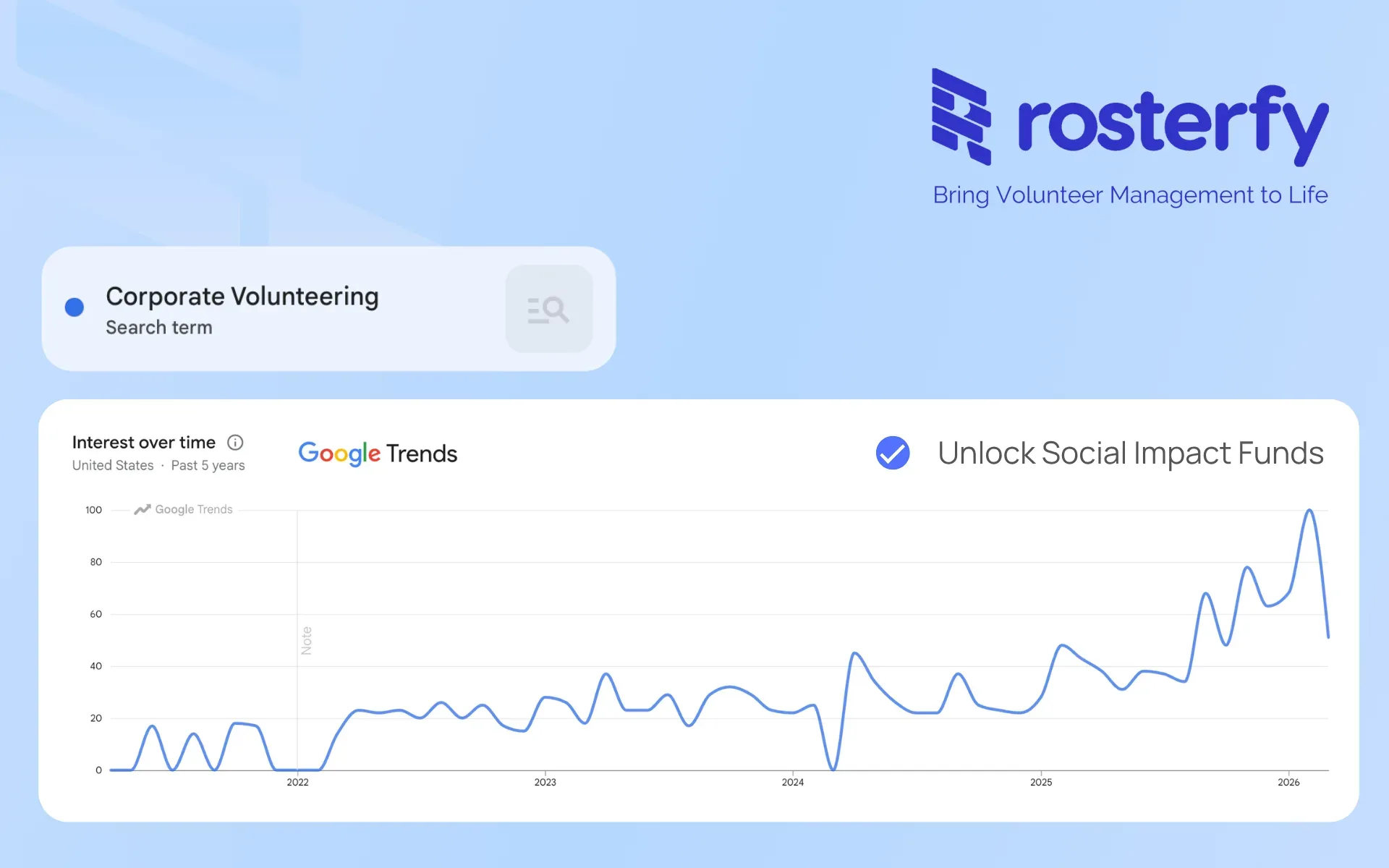
'Corporate Volunteering' searches peaked this year

Partner Perspective: SJ Consulting
“The data is spot on: Public interest in corporate volunteering is surging. However, with the widening funding gap, nonprofits can no longer afford to view corporate engagement as a simple ‘check-the-box’ exercise.
Successful partnerships need deep strategic alignment. In addition to a company achieving its CSR targets, you must ensure your core values are a mirror image of one another. True impact is only realized when there is rigorous 360-degree reporting and a feedback loop that proves the partnership is moving the needle for both the community and the corporation.
Discover more
Visit SJ Consulting to find out more.
Rosterfy has 'Corporate Solutions' solved
Build a Corporate Volunteering Powerhouse with dedicated, white-labeled portals and real-time reporting. This allows your partners to self-manage their involvement, ensuring the “chain” remains intact while significantly reducing your internal administrative burden.
There’s few better at building mutually beneficial programs between organizations and corporate partners than marathon event management teams – and there’s few more successful that the Chicago marathon team. We’ve invited CEM (Chicago Event Management) to share they have built a successful relationship with their partners which has supported a surge in corporate volunteering.
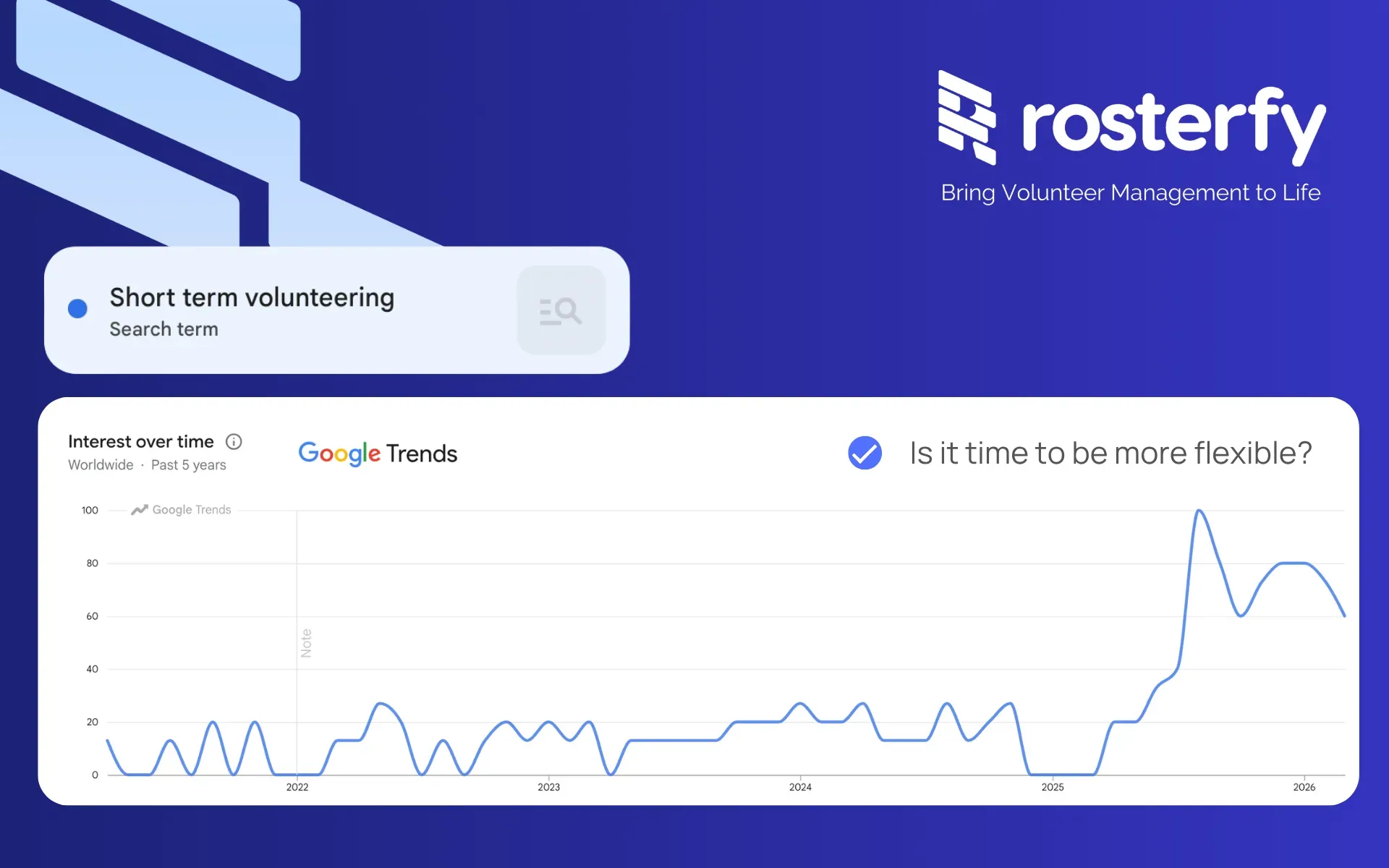
Does your program offer a variety of roles?
3. The Flexibility Mandate: Is it Time to be More Flexible?
The volunteer landscape is no longer defined by rigid, lifelong commitments. For years, we have seen that while the public’s desire to give back remains high, the way people fit volunteering into their lives has fundamentally changed. Just as the workforce has shifted toward hybrid and remote models to accommodate personal lives, volunteering must offer that same level of adaptability.
The Barrier: Operational Complexity
Historically, the greatest hurdle to flexibility hasn’t been a lack of will, but the sheer administrative weight of managing it. Coordinating “micro-shifts” or managing a constant flow of short-term volunteers creates a logistical puzzle that can easily break a manual system. However, modern, intuitive volunteer management software has simplified this complexity, allowing organizations to automate the “coming and going” of supporters without increasing staff workload.
The Two-Front Challenge
To build a truly resilient program, you are now being challenged on two distinct fronts:
-
Offer Variety in Roles and Shifts: You must move beyond traditional, long-term roles to include micro-volunteering and skill-based opportunities. If your system cannot handle these smaller “transactional” engagements, you risk losing the largest growing demographic of modern volunteers.
-
Simplify Data and Compliance: Offering more roles often means a massive spike in data collection—tracking specific skills, licenses, and background checks. This presents a significant administrative headache that can lead to staff burnout.

Partner Perspective: Omatic
"At Omatic, we're seeing how the shift toward flexible, on-demand engagement is fundamentally changing the way nonprofits need to think about their data. Supporters are no longer engaging through a single channel or in a linear journey.
They're volunteering, giving, attending events, and interacting across multiple systems, often in the same week.
But flexibility without integration creates fragmentation. When volunteer activity, donor data, and engagement touchpoints live in separate systems, organizations lose visibility and confidence in what they're seeing. And when you can't trust your data, you can't act on it.
The organizations leading in this next phase are investing in the data foundation that makes flexible engagement models work. Every interaction (a short-term volunteer shift, a one-time gift) needs to be captured accurately, connected across systems, and something teams can actually rely on. That's how you unlock a more complete view of your supporters and significantly increase their long-term value."
Discover more
Visit Omatic to find out more.
Rosterfy has 'Audience Segmentation' solved
By utilizing Skills-Based Segmenting, you can instantly match the right volunteer to the right micro-task based on their specific profile and availability. This removes the manual friction of vetting and placement, ensuring your team isn’t overburdened while providing the mobile-friendly, immediate experience that today’s supporters expect. Failing to evolve isn’t just an inconvenience; it’s a risk to the long-term value of your supporter relationships.
See for yourself – Book a demo
From insights to action: Building Your resilient future
The data is clear: interest in volunteering is at a 15-year high, corporate partnerships are becoming more complex, and the demand for flexibility is non-negotiable.
But as we’ve explored, a surge in engagement is a blessing and a curse. Without the right systems in place, “more volunteers” can quickly translate to “more admin, more burnout” for your internal team. Operational resilience isn’t just about surviving the wave of interest; it’s about having the infrastructure to ride it—turning administrative pressure into community impact.
The question is no longer if you should modernize your systems, but how.
Moving from manual spreadsheets or legacy tools to a dedicated Volunteer Management System (VMS) is the single most effective way to take the pressure off your team. By automating onboarding, streamlining corporate reporting, and offering self-service flexibility to your volunteers, you protect your staff while professionalizing the volunteer experience.
Take the next step: Your guide to choosing the right system
We know that the transition to new technology can feel daunting. To help you navigate this journey, we’ve developed a comprehensive white paper: “How to Choose Volunteer Management Software.”
This guide is designed to help you build a resilient foundation by:
-
Building the Business Case: How to communicate the need for investment to your stakeholders.
-
Calculating ROI: Understanding the tangible value—and time saved—by reducing operational strain.
-
Asking the Right Questions: A checklist of what to look for in a VMS to ensure it fits your unique mission.
-
Planning for Success: A roadmap for digital transformation that keeps the “human touch” at the center.
It’s time to invest in your community.
Download the White Paper: How to Choose Volunteer Management Software











REQUEST A DEMO
Unlock the potential of your volunteer programme
Book a short discovery call with our team to learn how Rosterfy can help you grow your volunteer community while supporting your team