

Key takeaways
- A volunteer coordinator recruits, schedules, supports and retains an organization’s volunteers, the operational link between a program’s mission and the people who deliver it.
- The role splits into six responsibility areas: recruitment, onboarding and training, scheduling, communication, recognition and retention, and reporting.
- A good volunteer coordinator is measured by their ability to retain volunteers, create a great experience and build an engaged community, not by how many hours they spend on admin. Automation takes care of the repetitive work so coordinators can focus on the outcomes that matter.
- Salaries vary by region and sector. This guide cites current figures for the US, UK and Australia from named public sources, checked in September 2026.
- Coordination is a career. Coordinator to volunteer manager to head of volunteering is now a recognized pathway in larger programs.
The most under-recognized job in the sector
Every volunteer program depends on someone keeping things running. Too often, that person is managing it all with spreadsheets, a shared inbox and not enough hours in the week. That person is the volunteer coordinator, arguably the most under-recognized job in the nonprofit and events sector. Few people are trained for it before they start. Most inherit the role’s systems from whoever had it last.
This guide is written for volunteer coordinators. Rosterfy builds volunteer management software used by programs ranging from local hospices to major national events. Drawing on that experience, we cover what a volunteer coordinator does, what a typical day looks like, salary expectations, the skills that matter and which tasks are best suited to automation. If you’re hiring for the role or considering it as a career, this guide covers that ground too.
Search for “volunteer coordinator” today and most results are job description templates from HR software companies. They’re written for the person hiring a coordinator, not the person doing the job. Almost none come from a company that works with hundreds of coordinators every day. This guide covers both audiences honestly. It includes a full role definition and responsibilities table for anyone writing a job description, plus an operational playbook for coordinators already in the seat.
In this guide: What is a volunteer coordinator · The six responsibility areas · A day in the life · Skills, training and qualifications · Salary by region · Writing the job description · What to automate vs keep personal · Career path · FAQ
What is a volunteer coordinator?
A volunteer coordinator is the person responsible for recruiting, onboarding, scheduling, supporting and retaining an organization’s volunteers, acting as the day-to-day link between a program’s mission and the people delivering it on the ground. The role typically reports to a volunteer manager, program director or nonprofit leader, depending on organization size. In smaller organizations, one person often does both the coordinator and manager job at once. In larger, federated or event-scale programs, coordination is its own specialized function supporting hundreds or thousands of volunteers at a time.
Volunteer coordinator vs volunteer manager: what’s the difference?
A volunteer coordinator runs day-to-day operations, while a volunteer manager sets the strategy those operations execute. Coordinators handle recruitment, scheduling, communication and on-the-ground support. Managers own budget, program design, staffing decisions and reporting to leadership. In organizations with fewer than a few hundred volunteers, these titles frequently blur into one role, and that’s normal, not a sign either title is being used incorrectly. As programs grow past that point, the split tends to become a formal, separately-hired distinction.
What does a volunteer coordinator do? The six responsibility areas
Volunteer coordination breaks down into six core responsibility areas: recruitment, onboarding and training, scheduling, communication, recognition and retention, and reporting. No two programs weigh these identically, but every functioning volunteer program needs all six covered by someone.
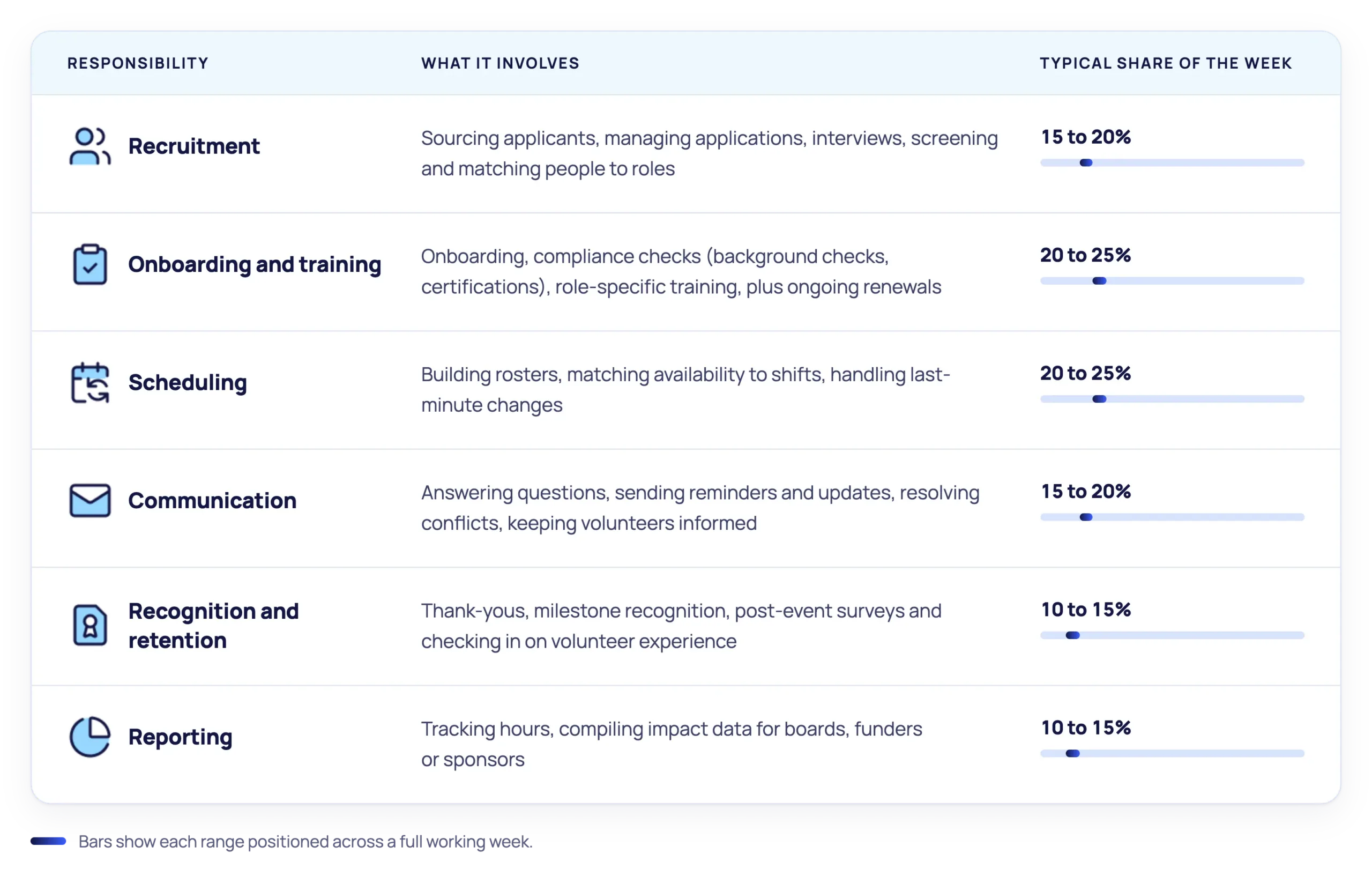
These ranges are illustrative of a typical mid-size program, not a single sourced figure. Actual time split varies significantly by program size, volunteer volume and how much of the lifecycle is automated versus manual.
These ranges are illustrative of a typical mid-size program, not a single sourced figure. Actual time split varies significantly by program size, volunteer volume and how much of the lifecycle is automated versus manual.
Recruitment
Coordinators source applicants through community networks, partner organizations, social media and word of mouth, then screen and match them to the roles that fit their skills and availability, often using a structured set of interview questions rather than an ad hoc conversation. Recruitment done well also filters for the compliance requirements a role demands upfront, rather than discovering a gap after someone’s already on shift. Platforms with built-in recruitment and onboarding tools let a coordinator run branded application forms and initial screening in one flow, instead of juggling a job board, a spreadsheet and an inbox.
Onboarding and training
This is where most coordinator hours disappear. It’s also where the manual version of the job is hardest: chasing signed waivers, background check confirmations and completed training modules, one volunteer at a time. A well-built onboarding sequence gets a new volunteer from application to first shift without a coordinator manually following up at every step.
This work doesn’t stop once a volunteer is on shift. Certifications expire, background checks need renewing on a schedule, and role-specific training gets refreshed as programs evolve. The strongest coordinators track renewal dates proactively, the same way they track new applications, rather than discovering a lapsed credential mid-shift.
Scheduling
Building and maintaining a roster that actually reflects volunteer availability, program needs and last-minute changes is often the single most time-consuming part of the job. Advanced scheduling tools exist specifically because manual rostering breaks down once a program grows past a few dozen active volunteers, letting volunteers see and claim open shifts themselves within rules the coordinator sets.
Communication
Answering questions, sending shift reminders, resolving scheduling conflicts and keeping volunteers informed as plans change all land on the coordinator, across whatever channel each volunteer prefers. This responsibility never fully goes away, but a coordinator with automated reminders spends this time on the conversations that actually need a human, not on repeating logistics.
Recognition and retention
The coordinators who keep volunteers coming back treat recognition as a system, not an afterthought: birthday and milestone messages, public thank-yous, and honest check-ins about how the experience is going. Losing a trained volunteer costs far more coordinator time than keeping one engaged. See volunteer management best practices for what this looks like at scale.
Reporting
Boards, funders and sponsors increasingly expect accurate data on volunteer hours and program impact, rather than a rounded estimate. Tracking volunteer hours accurately as volunteers check in turns this from a scramble at year-end into a byproduct of how the program already runs.
A day in the life of a volunteer coordinator
Note: this is an honest composite drawn from the range of programs Rosterfy supports, not a single named individual. A featured, cleared client coordinator quote will replace this once CS secures approval.
A volunteer coordinator’s day is shaped less by what’s on the calendar and more by how much of the admin underneath it has already been handled. The clearest way to see that is to picture two versions of the same Tuesday.
In the first version, a coordinator opens her inbox to forty unanswered messages: volunteers requesting shift changes, cancellations, requests to update personal information, and alerts about expiring background checks and outstanding training. By the time she gets to actually talking with a volunteer, the day is nearly over.
In the second version, a coordinator wakes up to an inbox that looks surprisingly in control. Shift reminders went out automatically overnight, and she has a clear picture of who is and isn’t available for their shift. An expired background check was flagged three weeks ago, with automated reminders already prompting the volunteer to update their credentials, and the roster updated itself when someone changed their availability. She spends the morning on the phone with a first-time volunteer who’s nervous about their first shift, not because a system forced that conversation, but because the admin that used to eat the morning is already handled.
That’s the honest difference automation makes. It doesn’t remove the job. It removes the parts of the job that were never really about the volunteers in the first place.
That pattern holds at any scale. Rosterfy works with coordinators running programs from local hospices supporting a handful of volunteers to major events including the past nine consecutive Super Bowls. The operational reality looks different at each end of that range, but the six responsibility areas above hold true throughout. For more on how coordinators are navigating the role day to day, The Engaged Volunteer Podcast [link] is an ongoing resource built from conversations with people doing this work.
Skills and qualities that actually matter
The skills that separate strong volunteer coordinators from struggling ones are organization, clear communication, empathy, delegation, comfort with data, and the willingness to set boundaries. Ranked roughly by how often working coordinators cite them as make-or-break:
- Organization. Juggling recruitment, scheduling and compliance simultaneously without anything falling through.
- Communication. Volunteers, staff and leadership all need different information delivered clearly and consistently.
- Empathy. Volunteers are giving their time for free. The coordinators who remember that build programs people stay in.
- Delegation. The best coordinators don’t do everything themselves. They build systems that let shift leads and team captains carry some of the load.
- Data habits. Comfort with tracking, reporting and using data to spot problems before they become crises.
- Boundary-setting. Burnout is real and common in this role. Coordinators who can’t say no to “just one more thing” burn out fastest, and that’s a program risk, not just a personal one.
Formal qualifications are rarely required. Most employers value direct experience and sector knowledge over a specific degree, though a background in human resources, nonprofit management or community engagement can help. Many coordinators come to the role the same way: they start out as a volunteer themselves, then move into coordination once that firsthand experience of the volunteer side becomes obvious value to the organization.
Training, courses and qualifications
There’s real, growing demand for structured training here. It’s currently one of the least served parts of the search for this role. Options for formalizing your skills include short volunteer management certificate courses through nonprofit sector associations and community colleges, sector-specific training through networks like the Points of Light Foundation, and on-the-job progression, still the most common route into the role. For the operational side, see volunteer management best practices. For ongoing conversations with coordinators and managers in the field, see The Engaged Volunteer Podcast.
Volunteer coordinator salary: US, UK and Australia
Volunteer coordinator salaries vary considerably by region, sector and program size, typically ranging from roughly $35,000 to $66,000 in the US, £24,000 to £40,000 in the UK, and higher in Australia, where reported sample sizes for this specific title are smaller.
- United States: the average volunteer coordinator salary is $47,187 a year, based on 697 salaries reported on job postings over the trailing 36 months. Source: Indeed US, accessed 2 September 2026. Other salary aggregators show figures from roughly $41,500 to $57,750, reflecting differences in sample and methodology.
- United Kingdom: the average volunteer coordinator salary is £27,531 a year in England. Source: Indeed UK, accessed 2 September 2026. London-based roles average somewhat higher, at £29,381 a year. Prospects.ac.uk puts the broader experienced range at £24,000 to £40,000.
- Australia: the average volunteer coordinator salary is AU$83,781 a year. Source: Indeed AU, accessed 2 September 2026. This figure is based on a small reported sample (25 salaries) and should be treated as directional rather than a firm benchmark.
Three factors move salary within those ranges, and they’re consistent across all three markets. Sector matters: education and healthcare-affiliated programs tend to pay more than grassroots nonprofits. Program size and complexity matter too. So does location: major-metro roles consistently pay above the national average in every market checked. Senior or “volunteer manager” titles also sit meaningfully higher than coordinator-level roles throughout.
Hiring one? The volunteer coordinator job description
A strong job description names the actual scope of the role, rather than defaulting to “other duties as required.” It should state the role’s purpose in one sentence. It should list all six responsibility areas from the table above, not just the ones that sound appealing. And it should name the skills that actually matter, with KPIs a coordinator can be evaluated against, like retention rate and shift fill rate, not just “hours logged.”
Copy-and-adapt job description block
Volunteer Coordinator Purpose: Lead day-to-day recruitment, onboarding, scheduling and support for [organization]’s volunteer program, acting as the primary point of contact for volunteers and the operational link to [program/department].
Responsibilities: Recruit and screen new volunteers · Manage onboarding, compliance checks and training · Build and adjust volunteer schedules · Communicate shift and program updates · Run recognition and retention initiatives · Track and report volunteer hours and outcomes
Requirements: [X] years’ experience in volunteer coordination, community engagement or a related field · Strong organizational and communication skills · Competent using volunteer management software to recruit, schedule and communicate with volunteers · [Add sector-specific requirements: background check clearance, driver’s license, etc.]
Success measures: Volunteer retention rate · Shift fill rate · Onboarding completion time · Volunteer satisfaction
For the surrounding process, see how to write a great volunteer job description.
The coordinator's toolkit: what to automate, what to keep personal
The highest-leverage automation for a volunteer coordinator covers reminders, rosters, hour tracking and credential renewals, while welcomes, check-ins and recognition moments are worth keeping personal. This is the platform-side view nobody writing a template job description is positioned to give: automating a task doesn’t remove the human element from the role, it protects the hours where the human element actually matters.
Automate: shift and task reminders, roster building and updates, hour tracking and verification, credential and background-check renewal alerts.
Keep personal: the first welcome message a new volunteer gets, informal check-ins about how someone’s experience is going, and public recognition of a specific contribution.
None of this means every program needs a full platform on day one. Smaller programs with a handful of volunteers can run manually for a long time. The toolkit starts to matter as volunteer volume, number of locations or compliance requirements grow past what one spreadsheet and one person’s memory can reliably hold. Rosterfy’s automations engine has driven reported reductions in manual coordinator workload of up to 75% for programs handling onboarding and scheduling together. See how to manage volunteers effectively for the full lifecycle view.
Career path: where volunteer coordination leads
Volunteer coordination is an established career path, typically progressing from coordinator to volunteer manager to head of volunteering or volunteer experience in larger organizations. Adjacent moves are common too: event workforce management, community engagement and corporate social responsibility roles all draw directly on the same skill set. Larger programs are increasingly building formal ladders for this path, a sign that volunteer operations are being treated as a skilled discipline, not administrative work anyone can absorb.
For coordinators who want to keep learning from people doing the work at scale, The Engaged Volunteer Podcast is a good ongoing resource to follow.
Where to go from here
If you’re doing this job right now, the honest truth is that the role is bigger than the sector usually admits, and the part that burns people out is rarely the volunteers. It’s the admin underneath them. That’s the part technology can actually carry. See how coordinators run their week with Rosterfy’s platform, or start with how to manage volunteers effectively for the operational detail. If you’re hiring for this role, the job description block above is ready to adapt.
About Rosterfy
Rosterfy is a leading volunteer and workforce management platform, helping organisations automate administration, strengthen compliance, improve volunteer experiences and scale their programs with confidence.
Trusted by charities, emergency services, sporting organisations, governments and major events, Rosterfy supports the entire workforce journey, from recruitment and onboarding through to scheduling, communications, training, compliance, recognition and reporting.
Through intelligent automation, configurable workflows and AI-powered tools, Rosterfy helps organisations spend less time on administration and more time supporting their people and communities.
Frequently asked questions
A volunteer coordinator recruits, onboards, schedules, communicates with, recognizes and reports on an organization’s volunteers. The role covers six core areas: recruitment, onboarding and training, scheduling, communication, recognition and retention, and reporting. In smaller organizations, one person typically owns all six areas, while larger programs may split them across a small team.
A volunteer coordinator handles day-to-day operations like scheduling and communication, while a volunteer manager owns strategy, budget and reporting to leadership. In organizations with fewer than a few hundred volunteers, the two titles often blur into a single role, a normal reflection of program size rather than a misuse of either title.
A volunteer coordinator needs organization, clear communication, empathy, delegation, comfort with data, and the ability to set boundaries, in that rough order of how often working coordinators cite them as make-or-break. Formal qualifications are rarely required. Employers weigh relevant experience and demonstrated skills more heavily than a specific degree or certificate, though short courses in volunteer or nonprofit management can help candidates new to the field.
A volunteer coordinator’s salary varies by region. In the US, the average is around $47,000 a year (Indeed, accessed September 2026). In the UK, the average is around £27,500 a year in England (Indeed, accessed September 2026). In Australia, average figures run higher but are based on a smaller reported sample for this specific title. Salary within each market depends heavily on sector, program size and metro versus regional location.
A good volunteer coordinator is measured by volunteer retention and experience outcomes, not by how much admin they personally absorb. The strongest coordinators combine genuine empathy for volunteers with systems and delegation that protect their time for the parts of the job that actually need a human.