


The most effective way to motivate volunteers is to consistently deliver four things: a clear sense of purpose, genuine recognition, a sense of community, and flexibility around their time. Volunteers who feel all four are far more likely to stay engaged and return, while a program missing even one of them tends to see enthusiasm fade after the first few shifts.
Key overview
- Purpose: connect each volunteer’s specific task to real, visible outcomes.
- Recognition: acknowledge individual effort by name, not just with a general thank you.
- Community: build relationships between volunteers, not just a shared task list.
- Flexibility: treat a volunteer’s time as genuinely limited, and schedule around that.
- Programs that deliver all four consistently see stronger retention than programs that rely on cause alone.
- The barrier is rarely understanding these drivers. It is delivering them consistently once a program grows past a handful of volunteers, which is where a volunteer management platform typically comes in.
Motivation is not a single lever you pull once during recruitment. It is something a volunteer program either builds into its everyday operations or slowly loses through neglect. Each of the four drivers below is something a volunteer manager can act on directly, without needing a bigger budget or more hours in the week. The sections that follow break down what each driver looks like in practice, followed by answers to the questions volunteer managers ask most often.
What actually motivates volunteers?
Volunteers give their time for different reasons than employees go to work. Research consistently shows that volunteers are motivated by factors such as contributing to a cause they care about, connecting with others and feeling valued for their contribution, rather than the financial incentives associated with paid work. The four-part framework above (purpose, recognition, community, flexibility) is a practical way to organize these intrinsic motivators for day-to-day program management, rather than treating motivation as something vague or unmeasurable.
The sections below cover each driver in detail and what it looks like in practice.
How do you give volunteers a sense of purpose?
You give volunteers a sense of purpose by connecting their specific task to a real outcome, as often and as concretely as possible, rather than relying on your organization’s mission statement to carry the weight on its own. A volunteer who packed 200 meals needs to hear that 200 meals reached 200 people, not just that the food bank is doing important work in general.
In practice, this means:
- Sharing short, specific impact updates after an event or shift, not just at year-end.
- Telling volunteers what their exact role contributed to, rather than a program-wide total only.
- Letting long-serving volunteers see how their contribution has compounded over months or years, not just one shift at a time.
How does recognition affect volunteer motivation?
Recognition affects volunteer motivation directly because it is the clearest signal a volunteer receives that their time mattered to someone. Volunteers who never hear a specific thank you, only a general one sent to the whole group, are measurably more likely to disengage than volunteers whose individual contribution is acknowledged by name.
Effective recognition does not have to be expensive or elaborate:
- A specific, personal thank you beats a generic mass email every time.
- Milestone recognition, marking a volunteer’s first shift, 50th hour, or one-year anniversary, gives long-term volunteers something to work toward.
- Small tangible rewards, certificates, e-badges, or a public shoutout, work best when they are tied to something the volunteer actually did, not handed out on a schedule.
If you want a deeper walkthrough of specific recognition ideas and gift options, see our full guide to rewarding and recognizing volunteers. For managing recognition at scale, see how Rosterfy automates milestone rewards and recognition.
Why does community matter for volunteer retention?
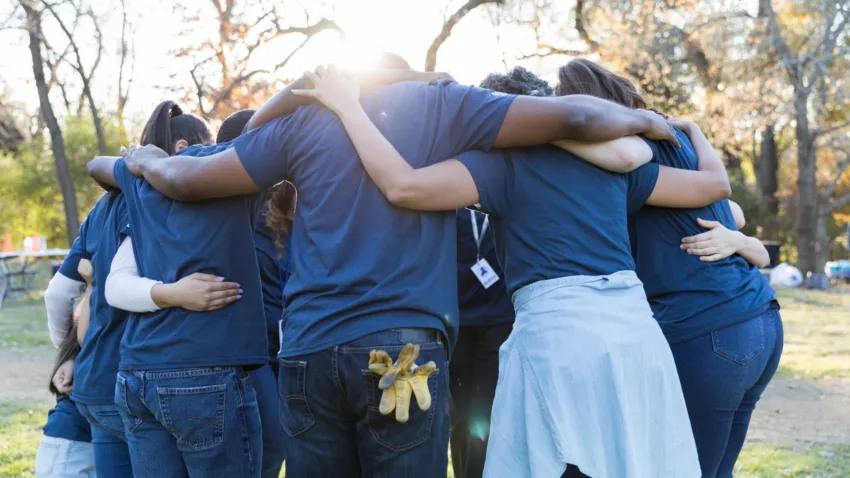
Community matters for volunteer retention because volunteers who have formed relationships with other volunteers or staff are far more likely to return, even when the work itself is repetitive or physically demanding. The task keeps them showing up the first time. The people keep them showing up the tenth time.
Ways to build this deliberately:
- Pair new volunteers with an experienced volunteer for their first few shifts.
- Create informal moments, a shared break, a pre-shift briefing, where volunteers interact rather than just execute tasks in parallel.
- Recognize volunteer groups and long-standing teams publicly, not only individuals.
How much flexibility do volunteers actually need?
Volunteers need enough flexibility that giving their time does not create the same friction as a second job. Rigid, inflexible scheduling is one of the most common reasons volunteers quietly stop signing up, even when they still care about the cause. Respecting a volunteer’s time as genuinely limited, rather than assuming unlimited availability, is itself a form of motivation.
In practice, this looks like:
- Letting volunteers set their own availability and preferences rather than being assigned shifts.
- Offering a range of commitment levels, from a single event to an ongoing weekly role.
- Making it easy to swap or release a shift without guilt or a lengthy approval process.
Frequently Asked Questions
The best way to motivate volunteers is to consistently deliver four things: a clear sense of purpose, specific recognition, a sense of community with other volunteers, and flexibility around their time. Programs that deliver all four see far stronger retention than programs relying on cause alone to keep volunteers engaged.
No. Most volunteer motivation research points to intrinsic drivers, purpose, connection, and recognition, as stronger predictors of retention than material rewards. Small tangible rewards like certificates or e-badges help, but they work best as recognition of a specific contribution, not as payment.
Volunteers should be recognized after specific contributions, not only at an annual event. Immediate, specific thank yous after a shift, plus milestone recognition at meaningful points like a first shift or a service anniversary, keep recognition tied to real effort rather than becoming a routine formality.
Volunteers most commonly lose motivation when they stop seeing the impact of their work, stop feeling personally recognized, feel disconnected from other volunteers, or find that scheduling has become inflexible or high-friction. Any one of these on its own can be enough to cause quiet disengagement, even among volunteers who still care about the cause.









REQUEST A DEMO
Ready to see these KPIs on one dashboard?
Rosterfy pulls recruitment, scheduling, retention, and hours data into one live dashboard, so board and funder reporting is a few clicks instead of a week of spreadsheet work. Book a demo to see it against your own program's numbers.