
Key takeaways
- Event volunteer management is a different discipline from ongoing program management. Surge recruitment, accreditation deadlines, multi-venue rostering and day-of operations break general-purpose tools.
- Five pressure points decide an event workforce: surge recruitment, compliance and accreditation, shift complexity, day-of check-in and contingency, and post-event legacy.
- Proof at scale matters more than a feature list. Rosterfy has powered volunteer programs for 10 consecutive Super Bowls, the Birmingham 2022 Commonwealth Games and SXSW’s post-COVID rebuild.
- No-shows are the silent event killer. Automated shift confirmations, waitlists and standby pools help large-scale events reduce volunteer drop-offs and keep shifts filled.
- The event isn’t the end. Flagship events can fuel the volunteer workforce for the rest of the year if organisers keep that pool engaged with multiple opportunities rather than starting from zero each time, the model behind TCS Sydney Marathon’s 500% volunteer base growth and Golf Australia’s year-round program.
Introduction
A large-scale event can process more volunteer applications in six weeks than most nonprofits see in a decade, against a date that cannot move. That single fact is why volunteer management software for major events is a different product category from the tools built for ongoing, year-round programs.
This piece is built around the five pressure points that actually decide whether an event workforce holds together: surge recruitment, accreditation and compliance, rostering complexity, day-of operations, and what happens after the closing ceremony. Each one is backed by a named event Rosterfy has run at world scale, not a hypothetical.
Why event volunteer management is different
Event volunteer management software is built for tight timelines, large volunteer numbers and credentialed access. These are needs that general scheduling tools often aren’t designed to manage. A community program can absorb a bad month and recover. An event has no such buffer. Recruitment, screening, training and rostering all have to be finished and working by a single fixed date, at a volume that arrives all at once rather than trickling in over a year.
What is volunteer event management software? It’s purpose-built software for recruiting, screening, rostering and coordinating large volunteer workforces against a fixed event date, rather than an ongoing calendar. Unlike general volunteer management tools, event volunteer software is built to manage high applicant volumes and complex shifts across multiple venues and days. It also supports credentialed access and real-time coordination for thousands of volunteers during an event.
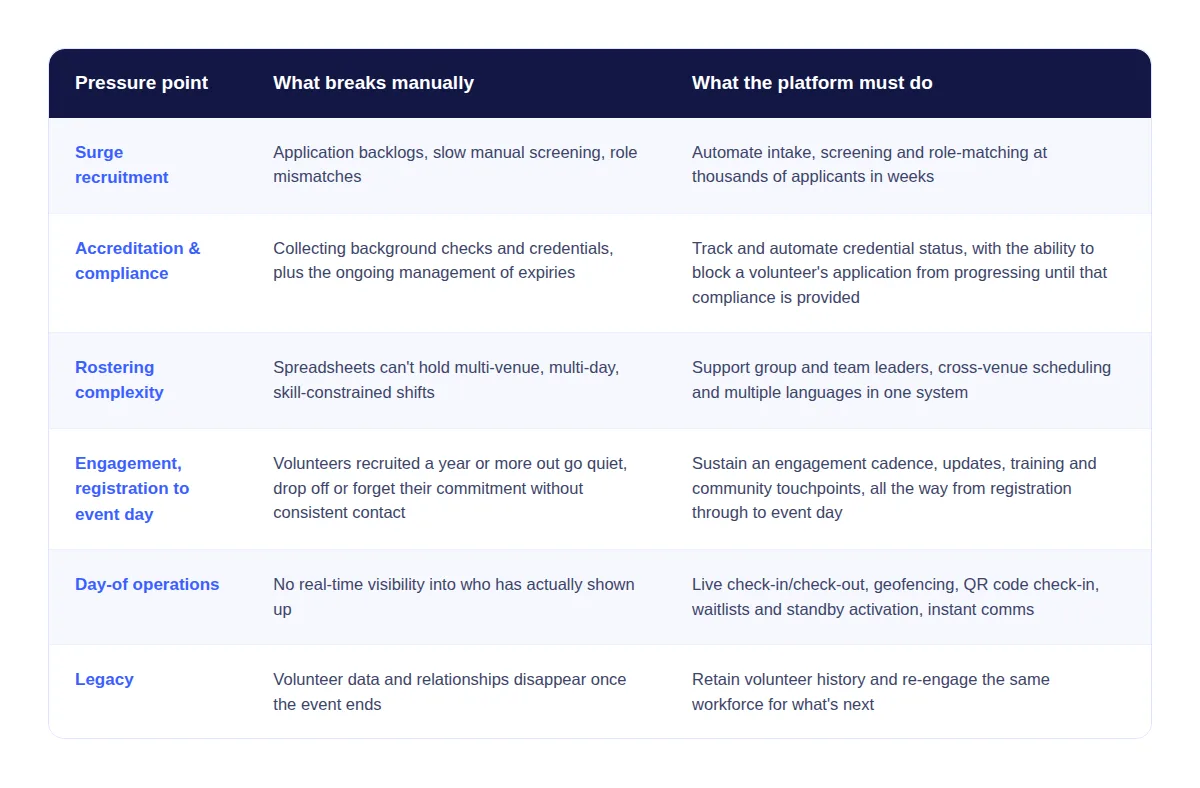
The table below maps each pressure point to what typically breaks under manual or general-purpose tools, and what the platform actually needs to do about it.
Pressure point 1: Surge recruitment and onboarding
A major event needs to process thousands of volunteer applications in a matter of weeks, not months: a volume that breaks manual screening. General-purpose scheduling tools weren’t built for a recruitment curve that goes from zero to thousands of applicants in a compressed window, then stops.
The fix is automation at the intake stage. Applications, initial screening and role-matching need to run without a human reviewing every form individually, so the recruitment team’s time goes to the applicants who need a judgment call, not data entry.
Two of Rosterfy’s own major events show what that curve actually looks like in practice. The Special Olympics World Games Berlin 2023 needed a workforce of thousands screened and rostered across 17 venues and more than 9,000 shifts. Expo 2023 Doha is a similar story on a smaller final workforce: more than 50,000 volunteer applications were screened and onboarded for a program that ultimately needed just over 2,000 volunteers, an applicant-to-role ratio the platform sorted through automatically rather than by hand.
Rosterfy has run this exact recruitment curve at the Super Bowl LV volunteer program too, part of what is now nine consecutive Super Bowls delivered on the platform.
Pressure point 2: accreditation, screening and compliance at deadline
Background checks, credential renewals and venue accreditation all have to be cleared by a single fixed date. There’s no “next cycle” to catch stragglers. At an ongoing program, an expired credential is an administrative follow-up. At an event, it’s a volunteer who can’t get through the gate on the day it matters.
That means the platform needs to track credential and background-check status against the event date itself, flagging anything at risk of not clearing in time automatically, not via a spreadsheet someone has to remember to check.
The Birmingham 2022 Commonwealth Games is the clearest example of this at scale: 14,000 volunteers, screened and accredited against the fixed opening-ceremony date.
Pressure point 3: rostering complexity across venues, days and roles
Multi-venue, multi-day events need rostering that accounts for role skill, shift patterns and venue location simultaneously, something a spreadsheet or general scheduling tool can’t hold together at scale. Group leaders and event shift group leaders give large events a layer of team structure between the platform and the individual volunteer, so a single coordinator isn’t personally managing thousands of shift assignments by hand. Advanced volunteer scheduling is what makes cross-venue, cross-day rostering possible without it collapsing into manual reconciliation.
Pressure point 4: day-of operations, check-in, no-shows and real-time comms
Day-of operations live or die on real-time visibility: who has actually checked in, who hasn’t, and what happens next if they don’t. A roster is a plan. Day-of operations is finding out whether the plan survives contact with reality, at gates, across multiple venues, often with thousands of people moving at once.
How do you reduce volunteer no-shows at events? A confirmation cadence in the days before the event, easy shift-swap options, and a standing waitlist or standby pool that can be activated the moment a no-show is detected are what keep attrition manageable at scale. Live check-in and check-out data is what makes that detection possible in the first place. Without it, a no-show isn’t caught until the shift is already short.
SXSW’s post-COVID rebuild of its volunteer community is a working example of an event standing this operational discipline back up from scratch.
Pressure point 5: legacy, what happens after the event
The event ending doesn’t mean the volunteer relationship should end with it. The Monday after is where most programs quietly lose the workforce they just built. A one-off event workforce, treated as disposable, is a wasted asset. Recruitment, screening and training cost the same the next time around if none of that history carries forward.
The TCS Sydney Marathon grew its volunteer base by 500% after building volunteer data continuity into its program rather than starting from zero each year, proof that retaining and re-engaging an event workforce compounds rather than just repeats. The power of event legacy and how to create one goes deeper on converting a one-event crowd into a standing community.
What to ask any vendor before a major event
Any organiser evaluating volunteer management software for an event should get a straight answer on the following before signing anything:
- What’s your largest reference event at our scale, and can we speak to that organiser directly?
- How does the platform behave under peak load, when thousands of applications or check-ins arrive in a short window?
- What does your accreditation and background-check workflow actually automate, versus what still needs manual follow-up?
- What does on-site or event-window support look like? Is it the same team we’ve worked with in planning, or a different one on the day?
- What happens to our volunteer data and history after the event ends?
Not every event needs enterprise-grade tooling for this. A 500-volunteer community festival may be well served by a lighter tool. See how to organize a music festival for guidance at that scale, or the volunteer management software buyer’s guide for the full comparison framework.
Ready to talk to the team that's running this at scale?
Event teams work backward from a date that doesn’t move. Talk to the major events team about what your event actually needs, or start with Rosterfy’s major events solution to see the platform built for this specific pressure. Book a demo.
About Rosterfy
Rosterfy is a leading volunteer and workforce management platform, helping organisations automate administration, strengthen compliance, improve volunteer experiences and scale their programs with confidence.
Trusted by charities, emergency services, sporting organisations, governments and major events, Rosterfy supports the entire workforce journey, from recruitment and onboarding through to scheduling, communications, training, compliance, recognition and reporting.
Through intelligent automation, configurable workflows and AI-powered tools, Rosterfy helps organisations spend less time on administration and more time supporting their people and communities.
Frequently asked questions
Volunteer event management software is software purpose-built for recruiting, screening, rostering and coordinating volunteer workforces against a fixed event date. It differs from general volunteer management software by handling surge-scale applicant volumes, multi-venue rostering, credentialed access and real-time day-of coordination, capabilities a year-round, steady-state platform isn’t built to prioritise.
Major events manage volunteers by treating five pressure points as a system: surge recruitment against a compressed timeline, accreditation and background checks cleared by a fixed date, multi-venue and multi-day rostering, real-time day-of check-in and contingency, and post-event data continuity. Rosterfy has powered volunteer programs for nine consecutive Super Bowls using this same operational framework.
Recruitment timelines scale with event size. Games-scale events typically need 12 or more months to complete recruitment, screening and accreditation. Birmingham 2022, for example, opened volunteer applications 14 months before the Games and had already closed the application window by 11.5 months out, with role offers going out from around six months before. Single-city festivals can often work on a shorter timeline, though screening and accreditation requirements, not recruitment itself, are usually what set the critical path: the more credentialing an event requires, the earlier recruitment needs to start.
Reducing no-shows at events comes down to a confirmation cadence before the event, easy shift-swap options so volunteers aren’t stuck if plans change, and a standby or waitlist pool that can be activated in real time. Live check-in data is what makes a no-show visible immediately rather than discovered mid-shift, which is what actually allows a standby response to work.
Yes. Purpose-built event volunteer software can manage rostering across multiple venues, days and role types simultaneously, using group-leader structures to organise teams underneath individual coordinators. The Birmingham 2022 Commonwealth Games is a working example of this kind of multi-venue rostering running at national-games scale.