

Good volunteer management doesn’t happen by accident. It comes from clear onboarding, consistent communication, regular recognition, and a system that tracks engagement instead of relying on memory, spreadsheets and unfit technology. Use the 12 rules below as a checklist, whether you’re refining an existing programme or building one from scratch.
Think of a busy supermarket with only one cashier open. Customers lose patience, lose trust, and start shopping elsewhere. Volunteer programmes work the same way. If people don’t get the support, clarity, or recognition they need, they disengage, and eventually they stop showing up. The good news is that most of the causes are fixable with the right process and the right tools.
The 12 volunteer management best practices
- Audit your current process before changing it
- Diversify your recruitment channels
- Build a clear, structured onboarding plan
- Communicate expectations clearly, across more than one channel
- Provide ongoing onboarding, training and mentorship
- Track engagement and volunteer data in one place
- Reward and recognise contributions consistently
- Monitor workload to prevent burnout
- Build a genuine sense of community
- Remove practical barriers to participation
- Create a safe, compliant environment
- Set a retention plan with clear metrics
1. Audit your current process before changing it
Start by taking stock of what you already do, not what you assume you do. Talk to your coordinators and manager directly involved in recruitment and onboarding, and ask where they see gaps. An anonymous survey or a short brainstorming session usually surfaces problems faster than guessing from the top down.
Also talk to current and past volunteers directly. They’re the ones experiencing your programme first-hand, and they’ll tell you what motivates them, what frustrates them, and what skills they’d like to use. A management style built around that feedback tends to keep people longer than one built around what worked five years ago.
2. Diversify your recruitment channels
Attracting volunteers gets harder every year. According to a major UK sector survey, 61% of voluntary organisations find it difficult to recruit volunteers, and competition for people’s time is high.
To improve your recruitment strategy:
- Write clear, compelling role descriptions so volunteers understand what’s expected of them and why it matters.
- Use more than one channel: social media, community boards, dedicated volunteer platforms, and your own website.
- Encourage referrals. Current volunteers are often your best ambassadors.
- Streamline the application step. A clunky sign-up process loses people before they’ve even started.
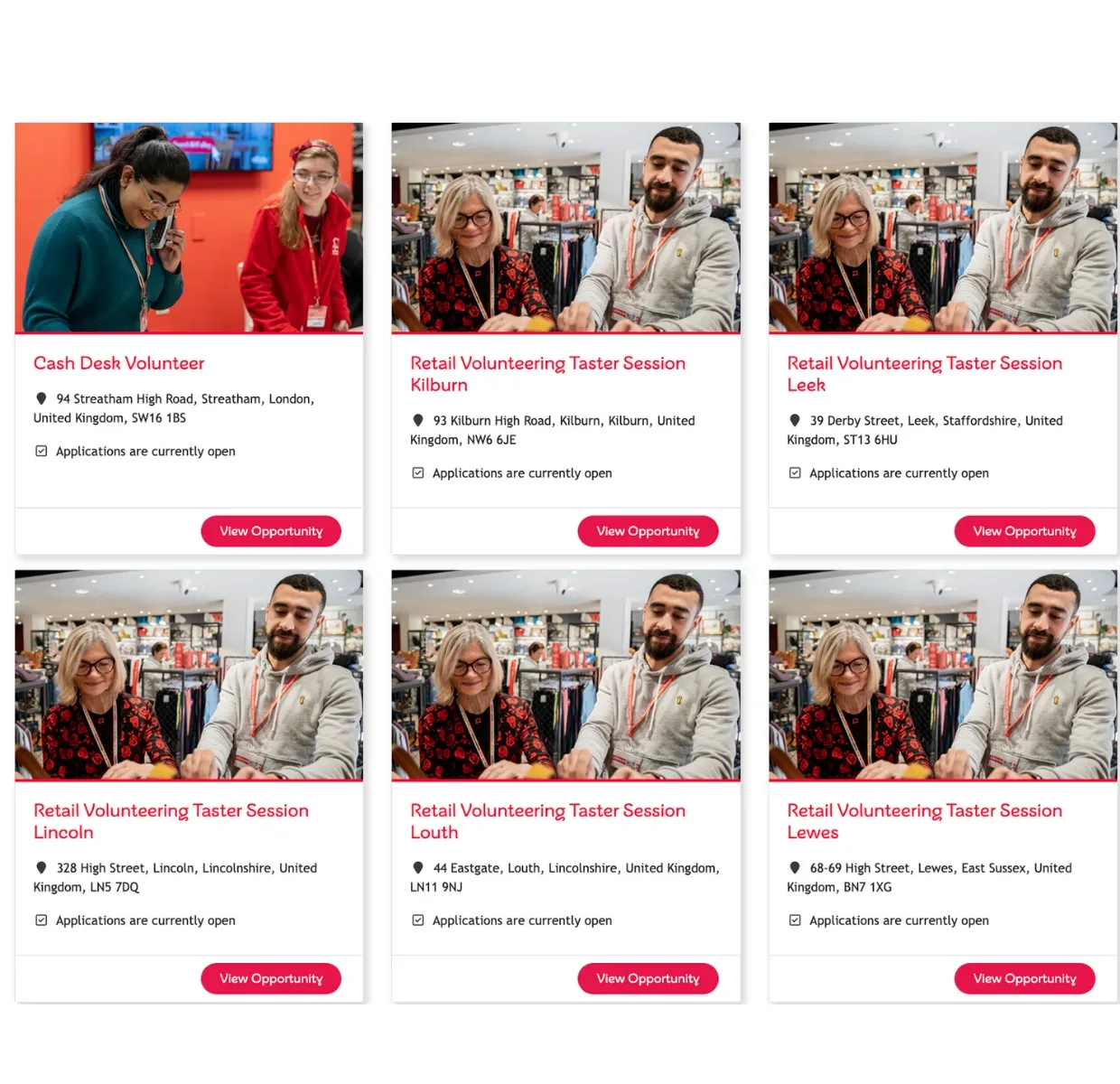
Example of British Heart Foundations public opportunities page on their website, allowing volunteers to see all available roles before they commit
3. Build a clear, structured onboarding plan
A strong onboarding plan is the single biggest lever for reducing early drop-off. Break the process down from first sign-up to first shift, and make sure every volunteer knows their expectations and responsibilities well before they arrive.
Golf Australia and the PGA of Australia used to run every tournament independently, relying on spreadsheets and roughly one full-time volunteer manager per event. Centralising onboarding and volunteer data with Rosterfy cut administrative time by 75%, from a full-time role down to a quarter of one, while bringing the work in-house. Read the Golf Australia and PGA case study.

World Scouting credit themselves as being 800% more efficient thanks to Rosterfy
4. Communicate expectations clearly, across more than one channel
Volunteers need to know what to bring, where to go, and who to report to, well before their shift starts. Use a mix of email, SMS, and in-app messaging to set expectations, and automate the routine reminders so nothing depends on one person remembering to send them.
World Scouting engages volunteers across nearly every country, spanning different cultures and time zones, and used to rely on fragmented manual processes to keep them informed. With Rosterfy, certificates, appointment confirmations, and scheduled updates now reach volunteers automatically and consistently, wherever they’re based. Read the World Scouting case study.
5. Provide ongoing onboarding, training and mentorship
Volunteers who feel prepared are far more likely to stay. Offer onboarding, inductions and training before the first shift, whether in person or online, and keep it interactive rather than a one-off document dump. Pair newer volunteers with experienced ones where you can. Mentorship builds confidence faster than training alone.
6. Track engagement and volunteer data in one place
A single, centralised view of your volunteer base makes patterns visible that spreadsheets hide. Track onboarding progress, training completion, and shift attendance in one dashboard, and use that data to spot drop-off patterns before they become a recruitment crisis.

London Youth Games manages 900+ volunteers across multiple locations
London Youth Games: How to grow your program, not your workload
London Youth Games manages 900+ volunteers a year across multiple locations using Rosterfy. As Ellie Reid, Head of Workforce Development, put it: “Operationally and logistically it is quite difficult and it requires a lot of volunteers. With Rosterfy it’s a much easier process and I don’t think we’d be able to do it manually.”
7. Reward and recognise contributions consistently
Recognition is one of the most effective, and most overlooked, retention tools. Automate small milestones (badges, shout-outs, a simple thank-you message) so recognition happens consistently rather than only when someone remembers to send it.

Literacy Pirates volunteers
Literacy Pirates: Beyond a thank you
The Literacy Pirates links volunteer milestones to digital and physical badges through Rosterfy. Volunteer Manager Angele Tilly explains why it matters: “It’s a special shout-out for our volunteers to say we’re really grateful for all the work you are doing with us. Volunteers really appreciate that. It’s a little something that really means a lot.”
8. Monitor workload to prevent burnout
Burnout is one of the fastest ways to lose good volunteers. The NCVO Time Well Spent Report found that 33% of recent volunteers felt too much of their time was taken up, and 27% felt unappreciated.
To reduce burnout:
- Keep workloads manageable and check in regularly, not just at the end of a season.
- Offer emotional support or access to a mentor for volunteers dealing with stress.
- Recognise contributions regularly, not only at the end of a project.
- Let volunteers take breaks without guilt.
The same NCVO report found 83% of satisfied volunteers said they were likely to continue, compared with just 31% of dissatisfied ones. Retention starts with experience, not just recruitment.

96% of WaterAid's volunteers said they felt like the belonged
9. Build a genuine sense of community
Volunteers stay longer when they feel like part of something, not just a rostered shift. Host social events, team-building activities, and give volunteers a way to connect with each other, not only with staff.
WaterAid uses Rosterfy to build relationships and share the impact of its fundraising directly with volunteers. In a WaterAid survey, 96% of volunteers said they felt they belonged. Read the WaterAid case study.
10. Remove practical barriers to participation
Cost and logistics stop good volunteers from signing up or staying. Set a realistic budget that covers background checks, recruitment, staffing, and recognition, and don’t forget a contingency for the unexpected. Where you can, offer travel reimbursements or the equipment volunteers need to do the role properly.
11. Create a safe, compliant environment
Volunteers need clear policies and a genuinely safe environment to work in, not just a handbook. Put a volunteer policy in place that sets expectations and accountability, and make sure the physical or virtual space they’re working in meets a real safety standard, not just a written one.
12. Set a retention plan with clear metrics
A retention plan turns good intentions into something you can actually track. Set specific goals, and measure progress against retention rate, average volunteer tenure, and satisfaction survey results. Review the plan regularly. What kept volunteers engaged last year may not work this year.
How to measure volunteer management success
Turnover is the obvious metric, but it’s not the only one. Pair it with direct feedback from coordinators and volunteers each season, and compare that against the hard data your system already collects. Centralising this in one volunteer management platform removes the manual admin that usually stops teams from looking at the data at all.
An April 2021 Independent Sector release valued the average volunteer hour at $28.54. That’s a useful number to keep in mind when making the case for investing properly in volunteer management, rather than running it as an afterthought.
About Rosterfy
Rosterfy is a leading volunteer management platform used by nonprofits, sporting organisations, cities, and major events worldwide. With powerful automation, compliance tools, onboarding workflows, and communication features, Rosterfy enables organisations to streamline operations and deliver exceptional volunteer experiences at scale.
Frequently Asked Questions
The most important volunteer management practices include structured onboarding, clear multi-channel communication, consistent volunteer recognition, centralised data tracking and active burnout prevention. Together, these practices can reduce volunteer dropout and support stronger long-term retention.
Retention is consistently the biggest challenge. The NCVO Time Well Spent Report found 83% of satisfied volunteers were likely to continue, compared with 31% of dissatisfied ones, showing that experience, not recruitment volume, is what keeps volunteer programmes running long term.
Prevent burnout by monitoring workloads so no one volunteer is overloaded, offering emotional support or mentorship, recognising contributions regularly rather than only at project end, and letting volunteers take breaks without guilt. Small, consistent recognition prevents burnout more effectively than occasional large gestures.
Measure success with a combination of turnover and retention rate, volunteer tenure, and satisfaction survey results, compared against direct feedback from coordinators each season. Centralising this data in one system makes patterns visible that manual tracking or spreadsheets typically hide.
A centralised volunteer management platform streamlines recruitment, onboarding, scheduling, communication, and recognition in one system, replacing manual spreadsheets and disconnected email threads. Rosterfy is one example, used by nonprofits, sporting federations, and major events to manage these processes at scale.
Explore additional blogs











REQUEST A DEMO
Unlock the potential of your volunteer program
Book a short discovery call with our team to learn how Rosterfy can help you better connect with, manage, and inspire your volunteers.