
That warning comes from Associate Professor Milad Haghani, of the University of Melbourne’s Urban Risk & Resilience program, writing in 2025. It’s a striking thing to hear about a country where, in 2023 alone, 14.1 million Australians aged 15 and over volunteered their time, contributing 3.2 billion volunteer hours between them, 11.1% of the population specifically for emergency support. On paper, Australia’s volunteer workforce still looks enormous.
But formal volunteering rates have been falling since the pandemic, even as demand for the services volunteers deliver keeps rising. For the leaders of St John, SES, RFS, CFA, Ambulance Victoria, the Red Cross and the dozens of smaller organisations that make up Australia’s emergency response network, that widening gap between supply and demand isn’t a statistic, it’s a live operational risk, showing up first in rostering gaps, then in slower mobilisation, then in exactly the kind of capability shortfall Haghani is describing.
Why the gap is opening up
Australia’s public sector and emergency service organisations are operating in increasingly volatile environments, climate driven disasters, rising demand for social care, tightening budgets, and public expectations that keep climbing. For mid and senior level leaders, the core challenge is mobilising volunteers safely, efficiently and in alignment with policy goals. Yet most organisations still face a set of systemic issues that get in the way.
The biggest of these is fragmentation. Across many departments, volunteer managers still rely on spreadsheets, manual sign up forms, and disconnected databases to do work that increasingly demands real time visibility. These fragmented systems create a predictable and unforgiving chain: fragmented tools lead to operational delays and data errors, which lead to increased administrative burden and compliance gaps, which lead to slower mobilisation, higher operational risk, and higher cost exactly when an organisation can least afford any of the three.
That’s not a hypothetical cost, either. Modelling based on Australian hourly replacement cost estimates ($58–$66 including standard on-costs) puts the value of 10,000 lost volunteer hours a year at approximately A$580,000 in replacement labour alone before counting the compliance exposure, the burnout driven attrition, or the slower service delivery that fragmented systems also produce. And the compliance side of that equation is not a minor footnote: manual record-keeping exposes organisations to real risk around data security and privacy legislation, Working With Children Checks, background checks, and safety certifications. Non compliance can stop programs, trigger investigations, or in the worst case put an unqualified volunteer in the field and data breaches can damage public trust as well as create legal and financial consequences.
Underneath all of this sits a resourcing reality that’s easy to overlook: volunteer managers and coordinators are almost always operating in small teams with limited administrative capacity. Without automation, staff spend hours on repetitive tasks instead of training, engagement or strategic planning and burnout increases, further affecting the retention this whole system depends on.
Four forces making this harder, not easier
Australia’s volunteer landscape is undergoing significant change, and four trends in particular are converging to increase pressure on public and emergency service organisations simultaneously:
Increasing complexity and crisis frequency: Climate events are growing in frequency and scale, impacting more people than ever across Australia. More frequent crises mean more agencies need to work together to deploy volunteers faster and match skills to need and manual processes simply aren’t built for that pace.
Cross agency collaboration and interoperability: National or large scale responses increasingly require different agencies to share data, including up to date credentials, and coordinate deployment across organisational boundaries. Digital tools that connect agencies without compromising volunteer privacy or compliance are becoming essential infrastructure rather than a nice to have.
Rising compliance and accountability expectations: Governments are now asking for outcomes based reporting before providing more funding or increasing capacity. Organisations need to show volunteer contributions, program reach and community impact, and that requires verifiable, real time data that manual systems simply cannot produce. This is now formal policy: the National Strategy for Volunteering 2023–2033, led by Volunteering Australia, explicitly calls for greater inclusion, accountability, and measurable impact across all sectors, particularly in government-funded and public service programs.
Changing volunteer expectations. Today’s volunteers particularly younger ones expect a seamless, digital first experience: mobile check ins, automated reminders, real time updates during crises, and visible recognition for their contributions. When agencies can’t deliver this, engagement declines, retention falls, and recruitment costs rise. It’s a widening expectation gap that translates directly into program instability.
Prefer to talk it through instead? Book 15 minutes with our team →
What good looks like in practice
It’s worth being concrete about what “digital transformation” actually changes for a volunteer powered agency, because it’s easy for the phrase to sound abstract. Picture a flood response scenario end to end on a modern, connected platform: a severe flood warning triggers an alert; the system automatically filters for volunteers with water rescue or first aid training within a defined radius; those volunteers confirm availability from a mobile app and are issued shift assignments and staging points without a single phone call; commanders monitor deployment, safety status and task completion in real time; and once the incident closes, a full post incident report, participation logs, response metrics, improvement insights is generated automatically. Every step that used to run through a phone tree or a shared spreadsheet becomes instant and auditable instead.
This isn’t a theoretical model. Lifeline Australia, which operates a 24/7 crisis support and suicide prevention service that more than a million Australians reach out to every year, migrated its volunteer program off spreadsheets and onto a modern Volunteer Management System, Rosterfy. The result, in the words of Voula Sofiou, Lifeline’s Volunteer Delivery Lead:
“After one week of using Rosterfy, our Recruitment Office can process 10–12 volunteer applications per hour, as opposed to 3–5 volunteers per hour through our previous system.”
That’s a 50% decrease in manual application processing hours alongside automated Working with Children Check renewals, faster and more compliant onboarding, and real time data supporting time to readiness KPIs. For an emergency response agency, the same underlying shift centralised profiles, automated credential tracking, real time availability and geo tagging, instant two way communication, and after action analytics, is what turns volunteer management from a manual, reactive back office task into a strategic capability that leadership can actually plan around.
St John Ambulance NSW is following a similar path. As the state’s largest volunteer powered emergency and event health service and the official medical reserve for New South Wales, supporting NSW Health, NSW Ambulance, the Rural Fire Service, SES and NSW Police during major incidents, St John NSW recently selected Rosterfy as its staff and volunteer management platform, following an evaluation process spanning more than 12 months. The organisation manages around 3,000 volunteers and 150 staff across 72 divisions and 18 areas of NSW, spanning everything from routine weekly training nights to the rapid, large scale mobilisation required during bushfires, floods and major public events. As Damon Quinn, St John NSW’s Chief Operating Officer, explained: ‘We needed a platform that could support the complexity of our organisation today, while giving us the flexibility to continue evolving into the future. Rosterfy stood out for its ability to bring our people, processes and data together while supporting the operational and compliance requirements that come with managing a large emergency service workforce.’
The cost of waiting
None of this is a criticism of the people currently running these programs. Volunteer coordinators are, almost without exception, doing their best with tools that were never built for the scale, complexity or compliance load they’re now carrying. But the organisations that will navigate the next decade of rising demand and tightening scrutiny successfully are the ones that treat volunteer management as strategic infrastructure now, rather than waiting for a compliance failure, a missed deployment, or a funding review to force the issue.
The data, the full cost model, the compliance risk breakdown, the Lifeline Australia case study in full, and a detailed look at what a future ready volunteer management ecosystem looks like for public and emergency services are all covered in our new whitepaper, Mobilising volunteer power and ensuring compliance for public and emergency services.
| “Our co-founder Shannan Gove recently wrote about the related challenge of coordinating spontaneous volunteers during an active disaster response, after attending DESC 2026 worth a read if you’re managing that surge in real time.” Check the article on LinkedIn here |
In summary
Australia’s volunteer emergency workforce is shrinking even as demand for its services keeps rising a gap that’s already showing up as rostering shortfalls and, per one leading academic, growing reliance on the ADF to fill the void. Much of that pressure traces back to fragmented, manual volunteer management systems: spreadsheets and disconnected databases that slow mobilisation, create compliance risk around checks and certifications, and cost agencies an estimated $580,000 a year in lost labour for every 10,000 volunteer hours lost. Four converging trends more frequent crises, cross agency data sharing needs, tightening government reporting requirements, and rising volunteer expectations for a digital first experience are only adding to that pressure. Organisations that move to a centralised, automated Volunteer Management System, as Lifeline Australia did, see faster onboarding, better compliance, and real time visibility that turns volunteer management into a strategic capability rather than a back office task. The full data, cost model and case study are available in Rosterfy’s free whitepaper.
Read more about managing volunteers for emergency and relief services on our blog:
- Disaster relief volunteers and the role they play in emergency management
- Bushfire recovery: the importance of volunteer management
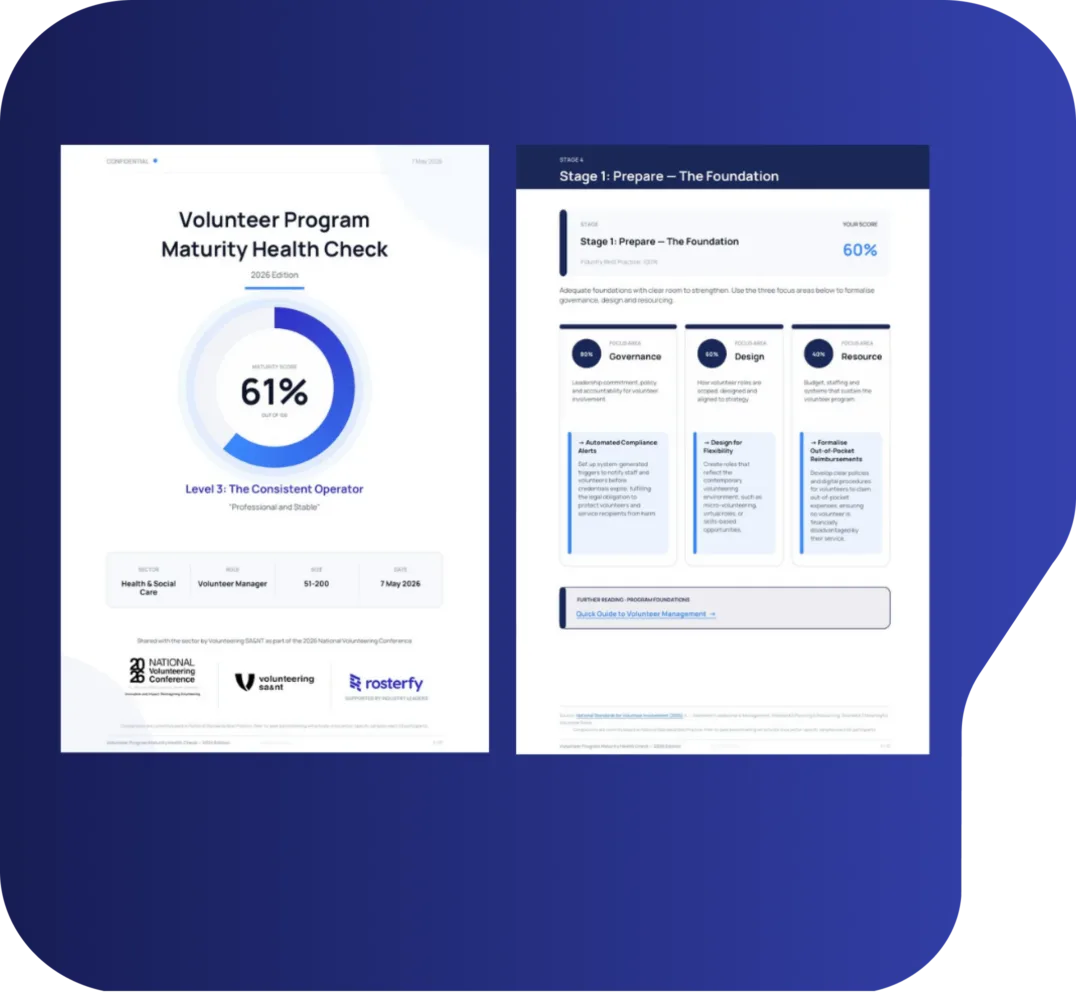
Free Tool: How Mature Is Your Volunteer Program?
Take Rosterfy's 5minute Volunteer Program Maturity Health Check to see how your organisation benchmarks against the National Standards for Volunteer Involvement and get an instant, PDF report with board ready next steps