Successful volunteer recruitment in Australia: The definitive guide
Successful volunteer recruitment in Australia means filling the right roles with the right people, then getting them from application to first shift before their interest fades. Fewer Australians volunteer through organisations than a decade ago, but those who do are giving more hours. The organisations that win are the ones that make saying yes easy.
How many Australians volunteer, and is the number falling?
Around 9.5 million Australians (42.8% of people aged 15 and over) volunteered formally, informally or both in 2025. Formal volunteering through an organisation has held steady at about 5 million people since 2020, but the rate has fallen from 36.2% in 2010 to 22.6%. Over the same period from 2020, hours rose from 490 million to 618 million.
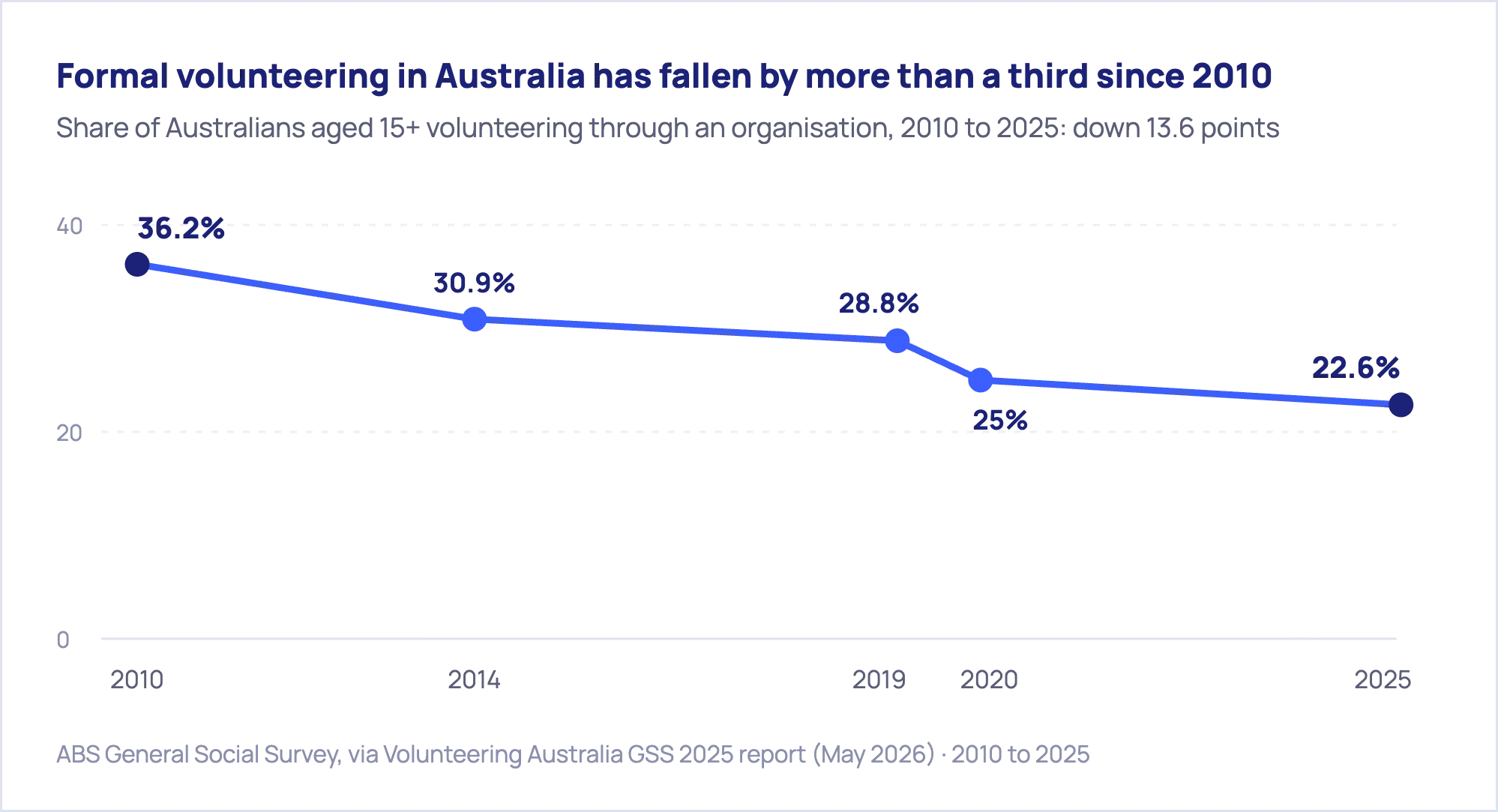
Four findings from the same survey shape how large programs should recruit:
- New recruits are a small slice. Only 11.5% of formal volunteers started for the first time in 2025. Most programs rely on a long-serving core, so converting every new applicant matters.
- Short commitments are the norm. The most common formal commitment is 1 to 20 hours a year, so one-off and event-based roles are a legitimate entry point, not a lesser one. At the other end, 31.3% of formal volunteers gave 100+ hours.
- Cost is a real barrier. Over half of volunteers (54.4%) paid out of pocket to volunteer in 2025, most often for transport, and 15.6% paid for memberships, licences or screening checks. Almost half were not reimbursed.
- Location and age matter. Formal volunteering is highest in remote areas (34%) and lowest in major cities (20.9%). Adults aged 35 to 54 are the most likely to volunteer, and sport and recreation organisations attract a third of all formal volunteers.
Volunteering Australia also notes that the 2026 fuel crisis has put further pressure on transport-dependent organisations, which is likely to show up in the next survey.
Source: ABS General Social Survey 2025, via Volunteering Australia, May 2026.
What does a smaller volunteer pool mean for recruitment?
The pool is smaller, but the people in it are committed. With fewer new entrants, losing someone to a slow or confusing process costs more than it used to. The programs that recruit well offer flexible roles, remove hidden costs and get applicants to their first shift quickly.
- Every applicant is more valuable. With fewer new entrants, losing someone to a slow or confusing process costs more than it used to.
- Flexibility and short commitments open the door. One-off and event-based roles give people a low-risk way in, and many stay on.
- Remove hidden costs where you can. Covering screening check fees, offering transport support or rostering close to home all reduce the barriers people weigh before saying yes.
The National Strategy for Volunteering 2023–2033 sets the sector-wide direction for addressing these challenges and is worth reading alongside this guide.
What volunteer recruitment strategies work best for large programs?
The strategies that work best are specific, not general. Define each role clearly, tell people why your cause matters, reach them where they already are, and make applying quick. For large programs, the biggest gains usually come from your existing database and from removing friction, rather than from new advertising.
Eight strategies the strongest Australian programs use:
- Define each role. Every role has a clear purpose, time commitment, location and any checks required.
- Sell the cause, not the vacancy. Lead with the impact the volunteer will make in their own community.
- Re-engage your database. Offer new roles to past and current volunteers before going to market.
- Use every channel. Website, social, community groups, local media and volunteer centres in each state.
- Partner with employers. Corporate volunteering programs bring groups of skilled volunteers at once.
- Offer flexibility. One-off, short-shift and event-based roles alongside regular commitments.
- Say thank you, often. Recognised volunteers stay longer and refer friends. Half of all formal volunteers (50.3%) first got involved because someone they knew asked them.
- Measure and improve. Track which roles are hardest to fill and where applicants drop out.

How do you recruit younger volunteers in Australia?
Recruit younger Australians with short, flexible roles they can find and apply for on their phone, and make the benefits clear: skills, experience for their CV and connection with their community. Younger people volunteer through organisations at lower rates than older Australians, and they expect the experience to be as easy as any other app they use.
In 2025, 16.4% of Australians aged 15 to 24 volunteered through an organisation. People currently studying volunteered formally at 24.3%, above the national average. Younger volunteers tend to give fewer hours, are more likely to give time online or in the field, and are more likely to choose areas such as animal welfare and health.
- Lead with the benefit to them. Skills, references and work experience matter to a generation entering a competitive job market.
- Offer short and flexible commitments. Young volunteers tend to give fewer hours, so one-off and event roles are a natural first step.
- Make it mobile. Discovery, application, rostering and shift updates should all work on a phone. A volunteer app removes the friction that loses younger applicants.
- Be clear about your mission and values. Younger volunteers want to know what you stand for before they commit.
Source: ABS General Social Survey 2025, via Volunteering Australia, May 2026.
For detailed tactics, see our guide to engaging younger volunteers.
How do you make volunteer recruitment more inclusive?
Inclusive recruitment means making sure people from every community can see themselves in your program, understand how to join and afford to take part. In Australia that includes culturally and linguistically diverse (CALD) communities, First Nations people, people with disability and people living outside major cities.
The 2025 GSS shows a gap worth closing. 24.1% of people born in Australia volunteered formally, compared with 20.8% of migrants. Yet 32.7% of people who speak a language other than English volunteered informally. The willingness is there. Formal programs are not always reaching it.
Five practical steps:
- Remove language barriers. Offer role descriptions, applications and key communications in the languages your community speaks. Rosterfy is available in nine languages.
- Partner with community organisations. Settlement services, multicultural councils and Aboriginal Community Controlled Organisations can co-design roles and recruit through trusted networks.
- Reduce out-of-pocket costs. Covering screening fees and transport helps people for whom cost is the deciding factor.
- Show diversity in your brand. Your website, social channels and recruitment campaigns should reflect the communities you serve.
- Measure it. You cannot improve what you cannot see. Capture optional demographic data at application so you can report on who is joining, and who is dropping out, by group.
Being able to report on equity, diversity and inclusion is an increasingly common request from boards, funders and government partners. A volunteer management system that captures this data at the point of application makes that reporting routine rather than a manual exercise.
How can corporate partnerships help you recruit volunteers?
Corporate partnerships give you access to groups of motivated, often skilled volunteers at once, and they work best as long-term relationships with clear mutual benefit. Employers want meaningful activities for their people and reportable impact for their ESG and social investment commitments. You want reliable volunteers. Design the partnership around both.
There is capacity to tap. Employed Australians volunteered formally at above-average rates in 2025 (23.4% of full-time and 25% of part-time workers). Volunteering Australia’s 2019 corporate volunteering snapshot found most surveyed companies ran a volunteering program and intended to grow participation, yet significant corporate volunteering capacity went unused each year.
Mutually beneficial
"A corporate relationship is exactly that, a relationship. It's about providing mutual value and those relationships really need to be nurtured."
A strong partnership needs five things:
- Aligned values. Employees engage more when the cause fits their company’s culture and community focus.
- Clear goals on both sides. Agree on hours, roles, skills and outcomes before the first activity.
- Easy group sign-up. Team leaders should be able to register a group, not 20 individuals one by one.
- Visible impact reporting. Hours, activities and outcomes your partner can include in their ESG and community reporting.
- Skilled roles. Marketing, finance and technology volunteers can add value well beyond a single day.
The benefits run both ways: a steady pipeline of volunteers, new skills, wider awareness of your cause, and networks that can open doors to funding. For a step-by-step approach, see how to build a successful corporate volunteering program.
What is a good volunteer application conversion rate?
Most large volunteer programs Rosterfy works with aim to convert 30 to 40% of applicants into volunteers who attend a shift, and many fall well short without a structured application process. Your conversion rate is the clearest measure of whether your recruitment is working, because it shows how many interested people you lose along the way.
How to calculate it: Conversion rate (%) = (Attended shifts ÷ Total applications) × 100
What counts as good depends on your program. Rates are naturally lower where roles require:
- a Working with Children Check or police check
- an extensive onboarding or training process
- interviews or specialist skills
- significant cost to the volunteer
Where do volunteer applicants drop out?
Most programs lose applicants at the same five points: discovery, application, waiting, onboarding and first shift. Screening is where recruitment most often stalls, as days or weeks pass with no update while checks are processed manually. The fix is visibility and speed at every stage.
- Discovery. Roles are hard to find or poorly described.
- Application. Long forms, repeated questions or no mobile option.
- Waiting. Days or weeks pass with no update while checks and references are processed manually.
- Onboarding. Training and compliance steps are unclear or out of order.
- First shift. No reminder, unclear location or no confirmation.
Build a distinct application journey for each role, track how many people move through each stage, and send automated updates so no one waits without hearing from you. Rosterfy’s automated recruitment and onboarding does this, and a branded volunteer portal lets applicants check their own progress instead of calling your team.
The reward is twofold: more recruits reach their first shift, and coordinators spend their time with volunteers instead of chasing paperwork. Rosterfy customers automate up to 75% of the end-to-end volunteer journey.
How are Australian organisations improving volunteer recruitment?
Australian organisations across charities, food rescue, sport and major events are recruiting faster by automating screening, onboarding and communications. The common result: applicants reach their first shift sooner, and coordinators process far more applications in the same time.
- Lifeline Australia cut application admin by 50%. Its recruitment office now processes 10 to 12 applications an hour, up from 3 to 5, across more than 5,000 active volunteers, with automated Working with Children Check screening and renewal reminders.
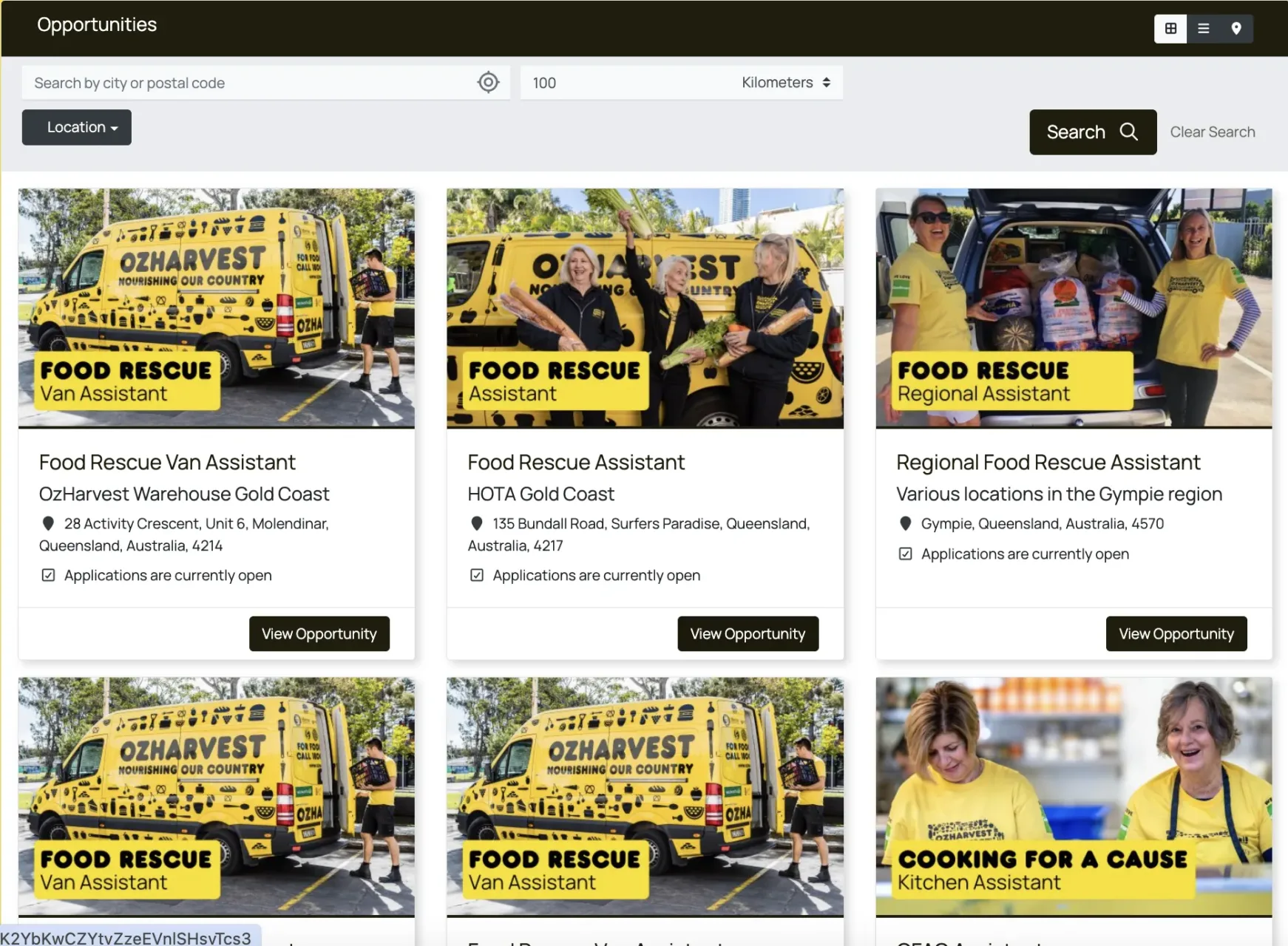
- OzHarvest moved from managing volunteers in Salesforce to Rosterfy and cut onboarding time by 80%, from up to six weeks to around one. Coordinators save 30 hours a week on manual admin, and volunteers completed 120,000 hours in 2025.
- SecondBite / FareShare reduced the time spent onboarding volunteers from 10 weeks to 4 weeks using automations.
- TCS Sydney Marathon operator Pont3 created a central volunteer management program for its national events calendar and grew the program by 500%.
- Spark Event Group recruited large numbers of workforce for the Australian Open with a 99% attendance rate.
- Golf Australia established a national volunteer program for its events calendar, using automated onboarding to reduce manual administration by 75%.
Cut admin by 50%
"After one week of using Rosterfy, our Recruitment Office can process 10-12 volunteer applications per hour, as opposed to 3-5 volunteers per hour, through our previous system."
What these programs have in common:
- A single front door. Every role is listed in one branded portal, so applicants know where to go.
- Role-specific journeys. Each role has its own checks, training and approvals, so no one does steps they do not need.
- Compliance built in, not bolted on. Screening checks are triggered and tracked automatically before anyone is rostered.
- Automated updates. Applicants hear from the program at every stage without a coordinator sending each message.
- Integrated data. Volunteer records connect to the CRM and screening providers already in use.
Less time chasing paperwork. More time talking to our volunteers!
"Rosterfy has meant our coordinators spend less time chasing paperwork and more time actually talking to our volunteers, and that personal interaction is so much more meaningful."
What screening and compliance checks do Australian volunteers need?
The checks depend on the role and the state or territory. Volunteers working with children usually need a Working with Children Check, and many roles involving vulnerable people, money or sensitive information require a National Police Check. Each state and territory runs its own WWCC scheme, so national programs must manage several sets of rules at once.
Screening is where recruitment most often stalls. Checks take time, applicants forget to upload documents, and coordinators chase paperwork by email. Handled well, compliance protects your volunteers and the people they support without becoming a bottleneck.
- Working with Children Check. Check the scheme for each state or territory you operate in, record card numbers and expiry dates, and remind volunteers before renewal.
- National Police Check. Integrate with your screening provider so checks are requested and results recorded automatically.
- Role-specific training. Make training a required step before rostering for roles that need it, such as food safety or first aid.
- Privacy and data handling. Collect only what you need, store it securely and meet your obligations under the Privacy Act 1988.
- Data hosting. For many government and health organisations, Australian-hosted data is a procurement requirement.
The most effective programs make each check a gate in the role’s application journey. A volunteer simply cannot be rostered until their checks and training are complete, which removes the risk of manual oversight.
This is general information, not legal advice. Confirm your obligations with the relevant state or territory screening body.
See which screening providers Rosterfy connects to
Rosterfy hosts Australian customer data in Australia and integrates with screening providers including National Crime Check.
What trends will shape volunteer recruitment in Australia?
Four trends are reshaping recruitment: shorter and more flexible volunteering, AI-assisted administration, recognition that keeps people coming back, and growing pressure to report impact. Programs that adapt will recruit from a wider pool and keep coordinators focused on people rather than paperwork.
- Flexible and episodic volunteering. With most formal volunteers giving 1 to 20 hours a year, one-off, event and micro-volunteering roles are becoming a core recruitment channel rather than a side option.
- AI in volunteer management. AI can help draft role descriptions, tailor messaging to different audiences and match volunteers to roles based on skills, availability and location. The mission and voice should still be your own.
- Recognition that keeps people coming back. Milestones, badges and personal thank-yous turn first-time volunteers into repeat volunteers and advocates who recruit their friends.
- Impact reporting. Boards, funders, government partners and corporate sponsors increasingly expect hours, outcomes and diversity data. Programs that capture this from the first application can report without a scramble at year end.
Want to share this with your team?
Download the free white paper and share it with your team to see how Australian programs recruit more volunteers and get them to their first shift faster.

Frequently Asked Questions
About 9.5 million Australians, or 42.8% of people aged 15 and over, volunteered formally, informally or both in 2025. Around 5 million of them volunteered through an organisation, according to the ABS General Social Survey.
The rate of formal volunteering has fallen from 36.2% in 2010 to 22.6% in 2025, but it has held steady since 2020. Total hours volunteered through organisations rose to 618 million in 2025, up from 490 million in 2020.
Cost and time are major barriers. Over half of Australian volunteers paid out of pocket to volunteer in 2025. Within programs, slow or manual application and screening processes lose many recruits before their first shift.
Most large volunteer programs Rosterfy works with aim to convert 30 to 40% of applicants into volunteers who attend a shift. Programs requiring checks, interviews or extensive training will typically sit lower.
Volunteers in child-related roles usually need a Working with Children Check. Each state and territory runs its own scheme with its own rules and exemptions, so check the requirements wherever your volunteers work.