How to build a successful corporate volunteering program for your nonprofit
Corporate volunteering gives nonprofits access to more volunteers, specialist skills and new funding partners at a time when volunteer numbers are declining. This guide shows nonprofits, charities and event organisers how to attract corporate partners, structure a corporate volunteering program, engage corporate teams and measure the impact.

Key topics covered:
What is corporate volunteering?
How companies support employee volunteering, and the five common types.
What are the benefits of corporate volunteering for nonprofits?
Extra volunteers, specialist skills, funding, visibility and long-term partnerships.
How do you build a corporate volunteering strategy for your nonprofit?
Seven steps, from setting goals to measuring impact.
How does technology help manage corporate volunteers?
Invitation links, group leaders, restricted roles, branding and reporting.

What is corporate volunteering?
Corporate volunteering, also known as employee or workplace volunteering, is when businesses support their employees to volunteer their time and skills for charitable, social or environmental causes, either through one-off activities or ongoing nonprofit partnerships.
Companies usually support it in three ways:
- Volunteering during regular working hours
- Paid time off for volunteering
- Company-sponsored volunteer events
A company can run these activities directly or in partnership with a nonprofit. Either way, the impact reaches the company and its employees, the nonprofit and the wider community.
What types of corporate volunteering are there?
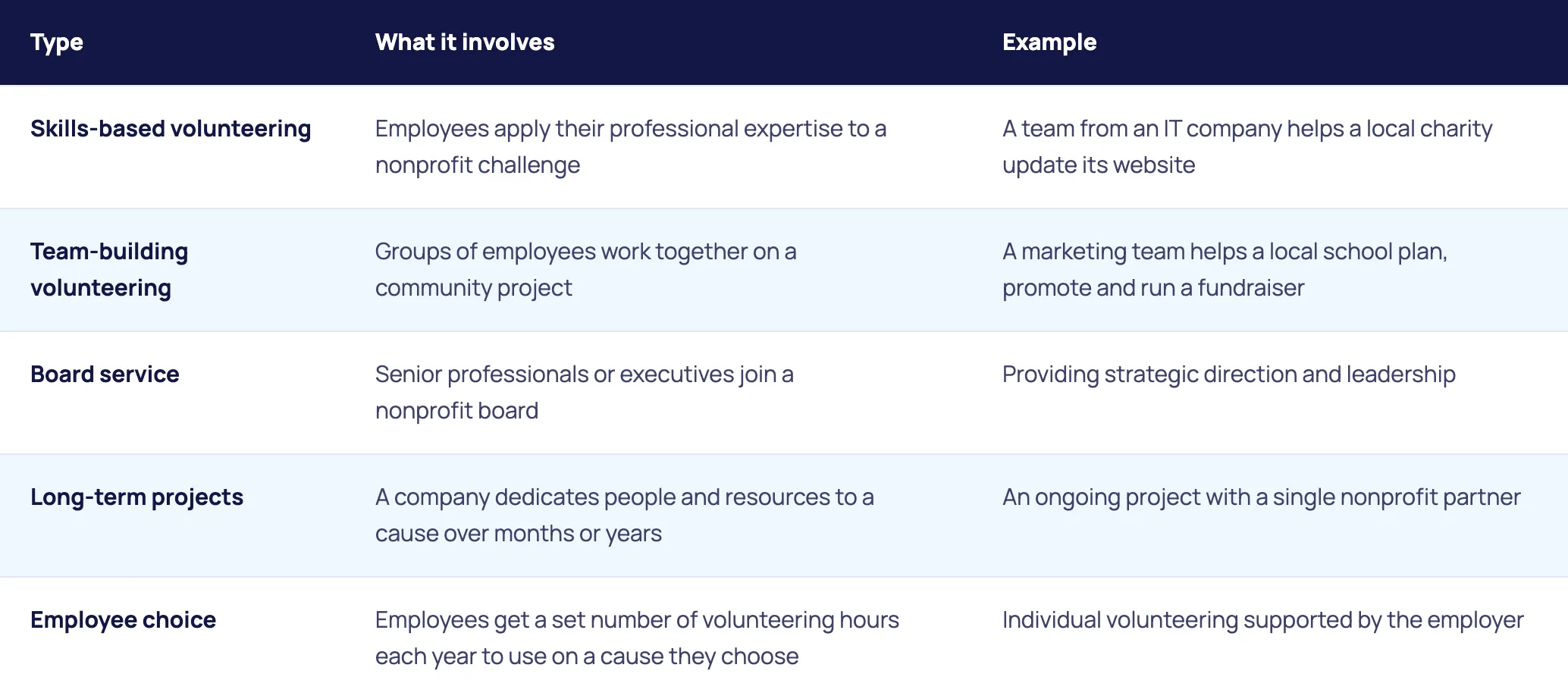
There are five common types of corporate volunteering: skills-based volunteering, team-building volunteering, board service, long-term projects and employee choice programs. Each suits a different partner and a different need, so most nonprofits offer a mix, from one-off group days to ongoing skilled support.
What are the benefits of corporate volunteering partnerships for nonprofits?
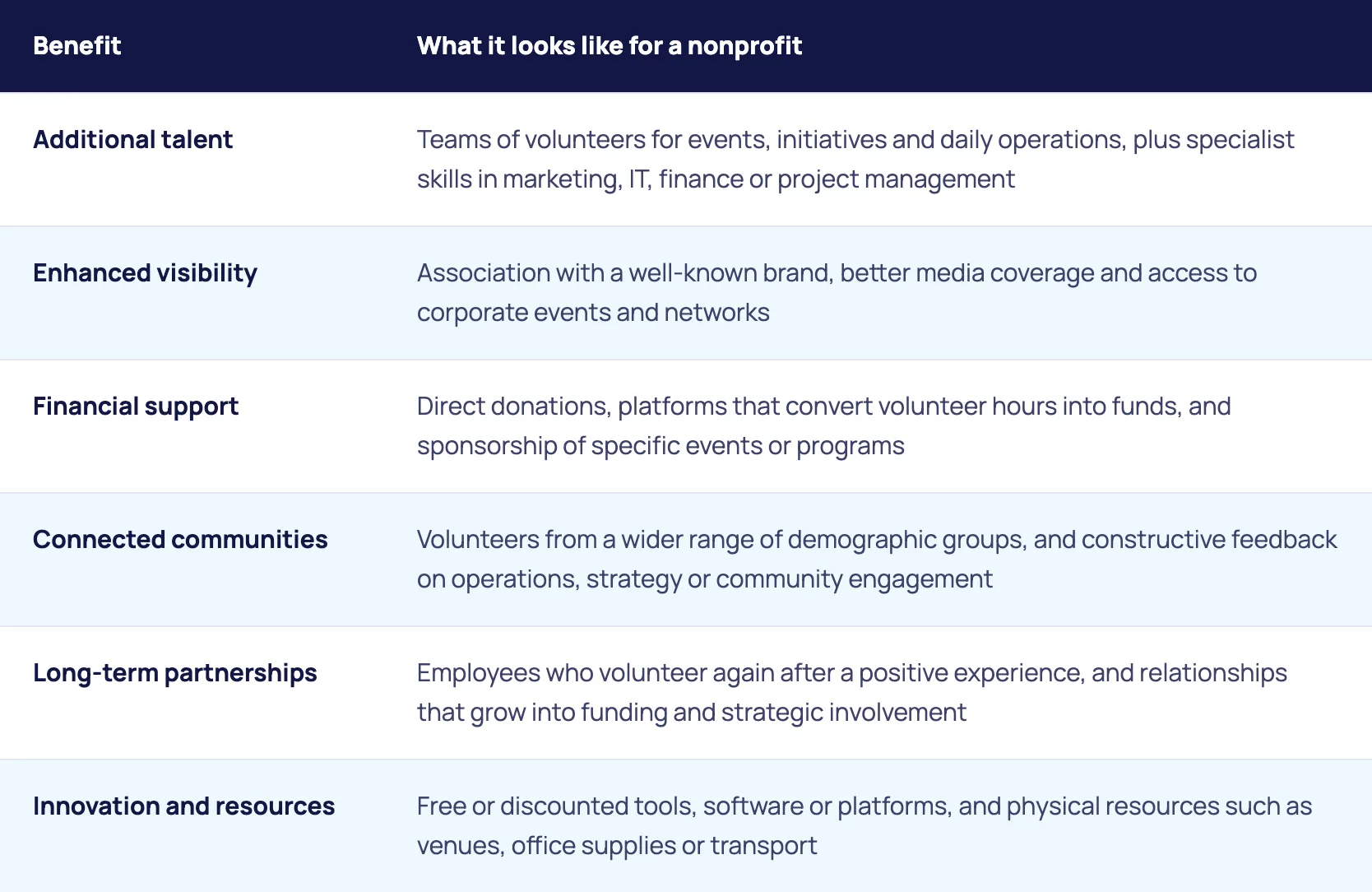
Corporate volunteering partnerships give nonprofits access to additional volunteers, specialist skills and potential funding. They can also raise a nonprofit’s profile through brand association, bring in a more diverse volunteer workforce, and grow into long-term partnerships that extend to sponsorship, technology and infrastructure support.
What do companies gain from corporate volunteering?
Companies use corporate volunteering to strengthen employee engagement, put organisational support behind social causes, align their activity with their mission and values, and show measurable community impact. Understanding these goals helps nonprofits design opportunities that corporate partners can justify internally and report on.
- Employee engagement: employee participation is central, whether it is a single day of community service or a long-term project.
- Organisational support: the whole organisation backs the program with logistical support, financial resources and strategic guidance.
- Alignment with values: the program fits the company’s mission and its broader commitment to social responsibility.
- Measurable outcomes: the program delivers tangible, quantifiable results for the community.
Why does corporate volunteering matter as volunteer numbers decline?
Volunteer participation has declined globally because of time constraints, changing social structures, economic pressure, low awareness of opportunities and bureaucratic barriers. Corporate volunteering helps reverse this: companies can run awareness campaigns, connect their people with causes, and give nonprofits access to larger groups of volunteers with less recruitment work.
The five main reasons for the decline in volunteering:
- Time constraints: long working hours and more responsibilities leave less free time.
- Shifting social dynamics: urbanisation and changing family structures reduce community engagement.
- Economic pressure: financial strain pushes personal and family needs ahead of volunteering.
- Lack of awareness: many people do not know what opportunities exist or how to get involved.
- Bureaucratic barriers: complex processes and unclear guidelines discourage potential volunteers.
Nonprofits and event teams that build long-term relationships with corporate partners can improve volunteer recruitment and retention through better recognition, smoother processes for out-of-pocket expenses and clearer visibility of program impact.
How do you build a corporate volunteering strategy for your nonprofit?
A corporate volunteering strategy for a nonprofit should set clear goals, identify corporate partners with aligned values, structure the program with a committee, database and guidelines, match employee skills to the right opportunities, and track outcomes such as volunteer hours, engagement and community impact. Review the program every year to keep it relevant.
Set goals
- Partner with companies that share your values and objectives
- Encourage employee participation that connects people to your cause
- Use corporate volunteers’ existing skills, such as leadership, project management and teamwork
- Make a tangible difference in the communities you serve
Structure the program
- Form a corporate volunteering committee with representatives from across your organisation to oversee delivery and evaluation
- Build long-term partnerships with companies aligned to your values and goals
- Set up a volunteer database to manage volunteer information, track hours and match volunteers to opportunities by skills and interests
- Write clear guidelines that explain the volunteering process for corporate employees
Engage corporate volunteers
- Keep corporate partners updated on the significance of their contribution
- Recognise corporate volunteers through awards, certificates or public acknowledgement
- Design activities that mix your regular volunteers with corporate teams
Harness corporate skills
- Run skills-based workshops where corporate volunteers train your team in areas such as project management or fundraising
- Set up peer mentoring between experienced corporate volunteers and your staff or volunteers
Measure impact (see the next section)
Resource the program
- Budget for partnership outreach, volunteer orientation and recognition events
- Assign dedicated staff or program coordinators for volunteer management, project coordination and partner communication
Improve continuously
- Review and refine the program every year
- Evaluate community impact and corporate volunteer involvement on an ongoing basis
- Share learnings and success stories across your organisation and with partners
How do you measure the impact of a corporate volunteering program?
Measure corporate volunteering impact by setting KPIs tied to your program goals, such as volunteer participation rates, skills transferred and community outreach. Track them through regular reporting, and run periodic surveys with corporate volunteers and your own team to check effectiveness, guide improvements and keep the program aligned with community needs.
- KPIs: volunteer participation rates, skills transferred and community outreach impact
- Regular reporting: a consistent way to track and analyse program performance
- Feedback and surveys: periodic input from corporate volunteers and your team
Reporting also matters to your partners. Sharing volunteer hours and outcomes shows corporate partners the tangible contribution their people made. For a full measurement framework, see [What should you measure from your volunteer program?](URL TBC) and Insights & Impact.
How does technology help manage corporate volunteers?
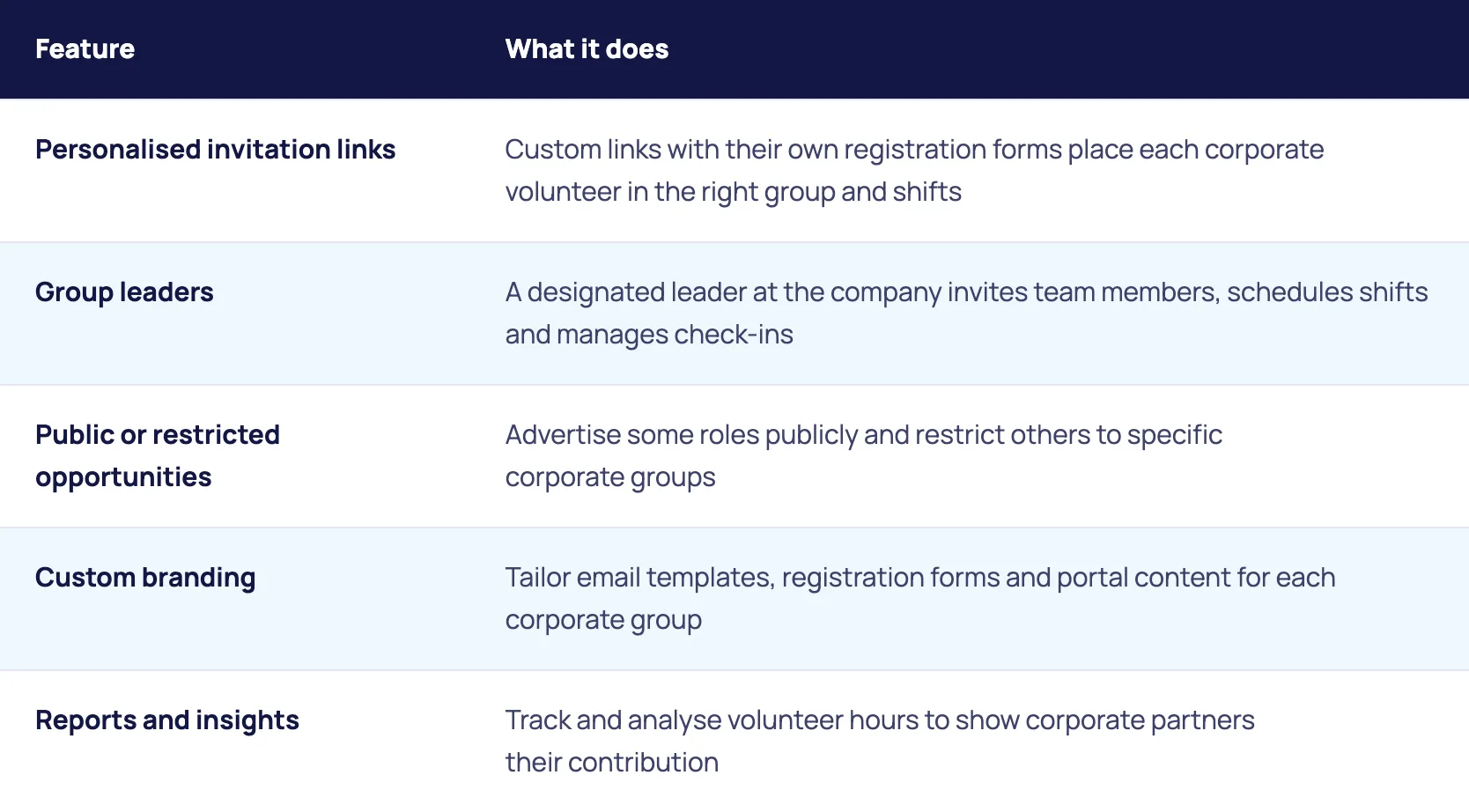
Volunteer management software centralises and automates recruitment, training, scheduling, communication and feedback, which saves time and improves the volunteer experience. For corporate programs, the most useful features are group invitation links, group leaders who manage their own teams, restricted opportunities, partner-specific branding and reporting on volunteer hours.
How Rosterfy supports corporate volunteering programs:
Learn more about Rosterfy for corporate volunteering.

How does The Common Good manage corporate volunteers at the EKKA?
The Common Good, an initiative of The Prince Charles Hospital Foundation, runs its EKKA event with around 1,700 volunteers, almost 30% of them from corporate partnerships, all managed through Rosterfy. Its main challenge is coordination rather than recruitment, so it automates onboarding and scheduling to keep the corporate volunteer experience consistent.
Stat block:
- ~1,700 volunteers at the EKKA
- Almost 30% of volunteers come from corporate partnerships
- Close to 400,000 EKKA attendees
Source: The Common Good, Rosterfy corporate volunteering white paper.
The Common Good raises funds for medical research in Australia. At the EKKA, its corporate volunteering focus is to create a smooth experience for volunteers while maximising fundraising. Corporate volunteers contribute to the community and receive tangible benefits in return, such as free event tickets.
Managing that many corporate volunteers at one event takes careful communication and organisation. Rosterfy automates volunteer management from onboarding to scheduling, so the team can focus on the partner relationships.
"A corporate relationship is exactly that, a relationship. It's about providing mutual value, and those relationships really need to be nurtured."
The key, according to Chloe, is making sure corporate partners understand the impact and significance of their contribution. By offering a strong volunteer experience and emphasising mutual benefit, The Common Good retains and grows its corporate partnerships.

How does London Youth Games manage corporate volunteering?
London Youth Games uses Rosterfy Groups and Group Leaders so each corporate partner can assign shifts to its own staff. Corporate groups get their own registration processes and dashboards, and can also access general volunteering opportunities. London Youth Games has recorded a 48% increase in corporate participation.
Source: London Youth Games customer story.
Ellie Reid, Youth and Workforce Development Manager at London Youth Games, explains how the program works.
"Rosterfy helps through being able to create Groups and assign a Group Leader. This means we can provide the organisation with autonomy in assigning shifts to their staff."
How do corporate volunteers get involved with London Youth Games?
There is a tailored approach to recruiting corporate volunteers, as every organisation integrates volunteering differently. Usually, a staff lead at an organisation reaches out through our website to learn more about opportunities. I’ll set up a meeting to discuss how our corporate volunteering works, the opportunities available, and find the best process for both sides to recruit and fill volunteering positions.
What are the benefits of having corporate volunteers?
- Scale with less work: access to larger groups of volunteers, especially for bigger events
- Reliability: corporate volunteers are, on average, more reliable because they come as a group through their work
- A more representative workforce: corporate volunteers reach a different audience and tend to be younger than individual volunteers
- Weekday cover: corporate volunteers can fill weekday positions, while most individuals can only volunteer on weekends
- Energy: groups bring a different dynamic, often with a lot of enthusiasm
Does corporate volunteering help with fundraising?
Corporate volunteering supports mutually beneficial partnerships with sponsors and suppliers. A couple of organisations support London Youth Games through Benevity, which provides donations when their staff volunteer.
How does Rosterfy help manage corporate volunteering?
- Groups and Group Leaders: corporate partners assign shifts to their own staff
- Tailored registration and dashboards: different group members get different registration processes and dashboards
- Access to general opportunities: corporate volunteers can also volunteer outside their organisation’s group
Want to share this with your team?
Get the complete guide as a PDF, including the full strategy framework, The Common Good case study and the full London Youth Games interview.