How to future-proof your volunteer program
Updated October 2026.
Future-proofing your volunteer program starts with reducing admin, speeding up onboarding and making volunteering more flexible. It also means planning for busy periods and being able to demonstrate your impact when needed. This guide explores each step, backed by the latest data from the UK, US and Australia.

Key topics covered:
Volunteers are scarcer and busier.
Regular formal volunteering in England sits at 17%, down from 27% in 2013/14. In Australia it is 22.6%, down from 36.2% in 2010. The US has bounced back to 28.3%, but remains below pre-pandemic levels.
Your core volunteers are carrying more.
Australians gave 618 million formal volunteer hours in 2025, up from 490 million in 2020, from a similar number of people.
Coordinator time is the real constraint.
In most programs, the first thing to run out is the time to process, onboard, roster and support the people who do say yes.
Onboarding is where you win or lose.
The gap between "yes, I'd love to help" and a first shift is where interest fades fastest, and where automation saves the most time.
Retention and proof go together.
Volunteers stay when they can see their impact, and boards fund programs that can show it.
What is happening to volunteering?
Formal volunteering is below its long-term peak in the UK, US and Australia, and the reasons are practical. People have less time to give, they are less likely to be asked, and many pay their own way to volunteer. The result is a smaller, busier volunteer base, with long-serving volunteers quietly picking up the slack.
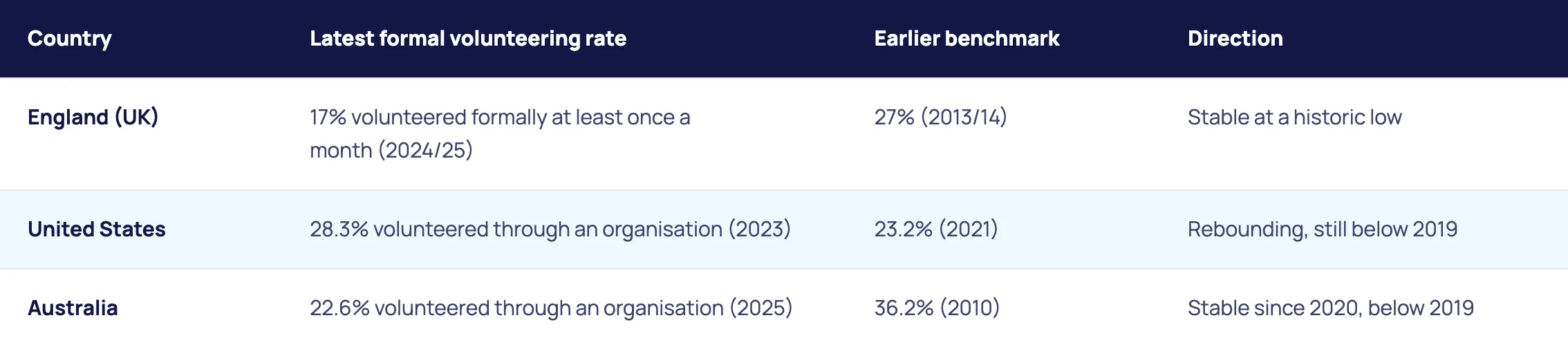
Source: DCMS Community Life Survey 2024/25 · AmeriCorps and US Census Bureau (2023 data) · ABS General Social Survey 2025, via Volunteering Australia. Each survey measures volunteering differently, so compare trends within a country rather than rates between countries.
Why do people say no to volunteering?
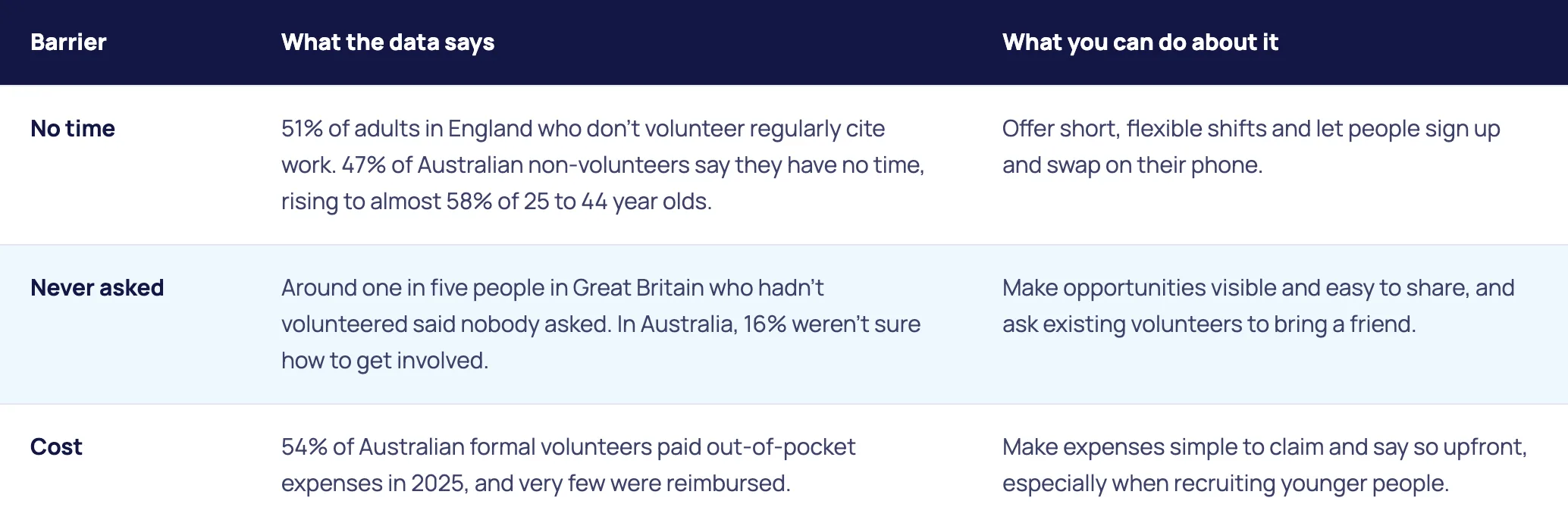
Source: DCMS Community Life Survey 2024/25 · ABS General Social Survey 2025, via Volunteering Australia · NCVO Time Well Spent 2023.
Who is carrying the load?
In every market, a small group of committed volunteers gives most of the hours. In Australia, 618 million formal hours came from a broadly similar number of volunteers as in 2020, and two in five volunteers have been involved for ten years or more. In the UK, 31% of the population provided 87% of formal volunteer hours, a group researchers called the “civic core”. That loyalty is worth celebrating, and it is also a concentration risk. If a handful of long-serving volunteers step back, many programs would feel it immediately.
Source: ABS General Social Survey 2025, via Volunteering Australia · Third Sector Research Centre, Mapping the Big Society (2011).
Why is coordinator time the biggest constraint on a volunteer program?
In most programs, coordinator time runs out before volunteers do. Every hour spent manually processing applications, chasing compliance checks or updating rosters is an hour taken away from welcoming, supporting and engaging volunteers. Because admin is spread across dozens of small tasks, few teams know how much time it really takes until they audit it.
How to run a 30-minute coordinator time audit
List every recurring task in your volunteer journey. For each one, estimate the minutes it takes and how often it happens in a year, then multiply them out. Start with these tasks:
- Reviewing and screening an application
- Requesting and chasing a background check
- Assigning and tracking training
- Building and filling the roster
- Sending reminders and last-minute changes
- Recording attendance and hours
- Pulling numbers together for a report
Circle the tasks that are repetitive, rule-based and high-volume. Those are your automation candidates, and they usually cluster around onboarding.
Less time chasing paperwork. More time talking to our volunteers.
"Rosterfy has meant our coordinators spend less time chasing paperwork and more time actually talking to our volunteers, and that personal interaction is so much more meaningful."
How do you get volunteers from "yes" to their first shift faster?
Automate the steps between application and first shift: screening, background checks, training and shift eligibility. Volunteers are most engaged when they first apply, and every manual handover gives that enthusiasm time to fade. Organisations that automate onboarding have cut it from weeks to days, so new volunteers start while they are still keen.
Measure your time to first shift
Track the average days between an application arriving and that volunteer’s first shift, broken into five stages:
- Application to first contact
- First contact to screening complete
- Screening to checks cleared
- Checks to training complete
- Training to first shift
The longest stage is your bottleneck. Fix that first.
What does a fast onboarding journey look like?
- A short, mobile-friendly application that asks only for what you need right now.
- An instant, personal acknowledgement, so applicants know what happens next.
- Automatic screening against role requirements.
- Background checks triggered automatically through your existing providers, with renewal reminders.
- Role-based online training that volunteers complete in their own time, tracked automatically.
- Instant shift eligibility the moment every requirement is met.
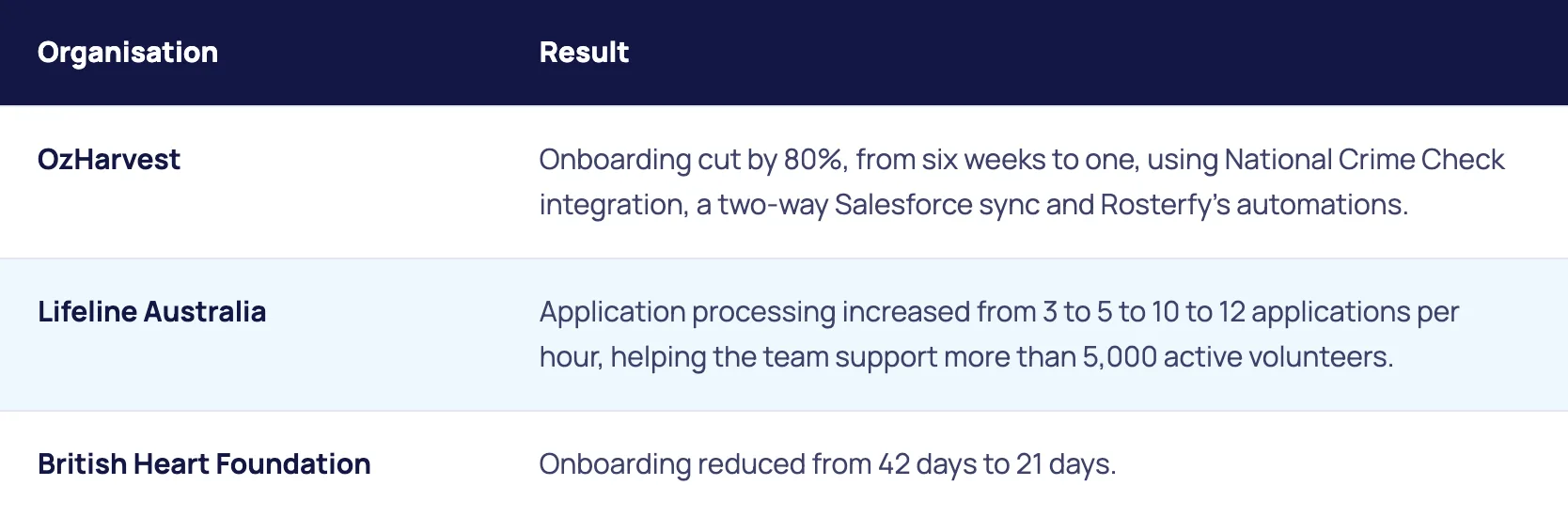
Source: Rosterfy customer results.
How do you keep the volunteers you have?
Volunteers stay when their time is respected, their contribution is noticed and they can see the difference they make. Retention starts with a smooth onboarding experience. After that it depends on flexible shifts, clear communication and genuine recognition, delivered consistently rather than whenever a coordinator has a spare minute.
The warning signs are already there. In Great Britain, the share of recent volunteers likely to continue slipped from 80% in 2018 to 77% in 2022, and satisfaction fell from 96% to 92%.
- 26% of volunteers felt their role was becoming too much like paid work, up from 19%.
- 24% felt their organisation expected too much of them, up from 17%.
- 82% of 18 to 24 year old volunteers were satisfied, the lowest of any age group (96% for over-55s).
Source: NCVO Time Well Spent 2023 (7,006 adults in Great Britain, fieldwork November to December 2022).
Five habits of programs volunteers stay with
- They make it flexible. Volunteers choose shifts that fit their lives and swap without a phone call.
- They never leave volunteers guessing. Expectations, contacts and shift details arrive before the shift.
- They say thank you properly. Recognition is specific, timely and automatic for milestones.
- They close the loop on impact. Volunteers hear what their time achieved.
- They listen early. Short feedback after shifts surfaces problems before a volunteer drifts away.
At the Australian Open, Rosterfy helped Spark achieve 99% volunteer attendance across more than 4,000 shifts.
Source: Rosterfy customer results.

Direct correlation between volunteer experience and fundraising effectiveness
"We know there is a direct correlation between volunteer experience and fundraising effectiveness. If our volunteers feel engaged and well supported then they'll keep coming back and raise more funds."
Is your volunteer program ready for a surge?
A future-proof program can scale up quickly without falling over. Major events, emergencies, seasonal peaks and new campaigns all need more volunteers, faster, with no drop in safety or compliance. Programs that cope have their processes, data and communication ready before the surge arrives, rather than building them under pressure.
Five questions to test your surge readiness
- Could you process ten times your usual number of applications in a week without hiring temporary admin staff?
- Can volunteers check in on the day in seconds, by QR code or kiosk?
- Can you message every volunteer on a site, or in a role, within minutes when plans change?
- Do you have an approved, trained reserve pool you can call on?
- If you work across sites, states or entities, can local teams run their own volunteers while you keep the national view?
If any answer is no, start planning there, well before your next peak. Rosterfy managed 50,000 volunteer applications in 72 hours for Expo 2023 Doha.
Source: Rosterfy customer results.
How do you prove your volunteer program's impact?
You prove impact by tracking a small set of metrics consistently and connecting them to the outcomes your board and funders care about. Hours and their economic value are the starting point. Retention, time to first shift and mission outcomes make the story credible. When reporting is automatic, impact is something you can show on demand.
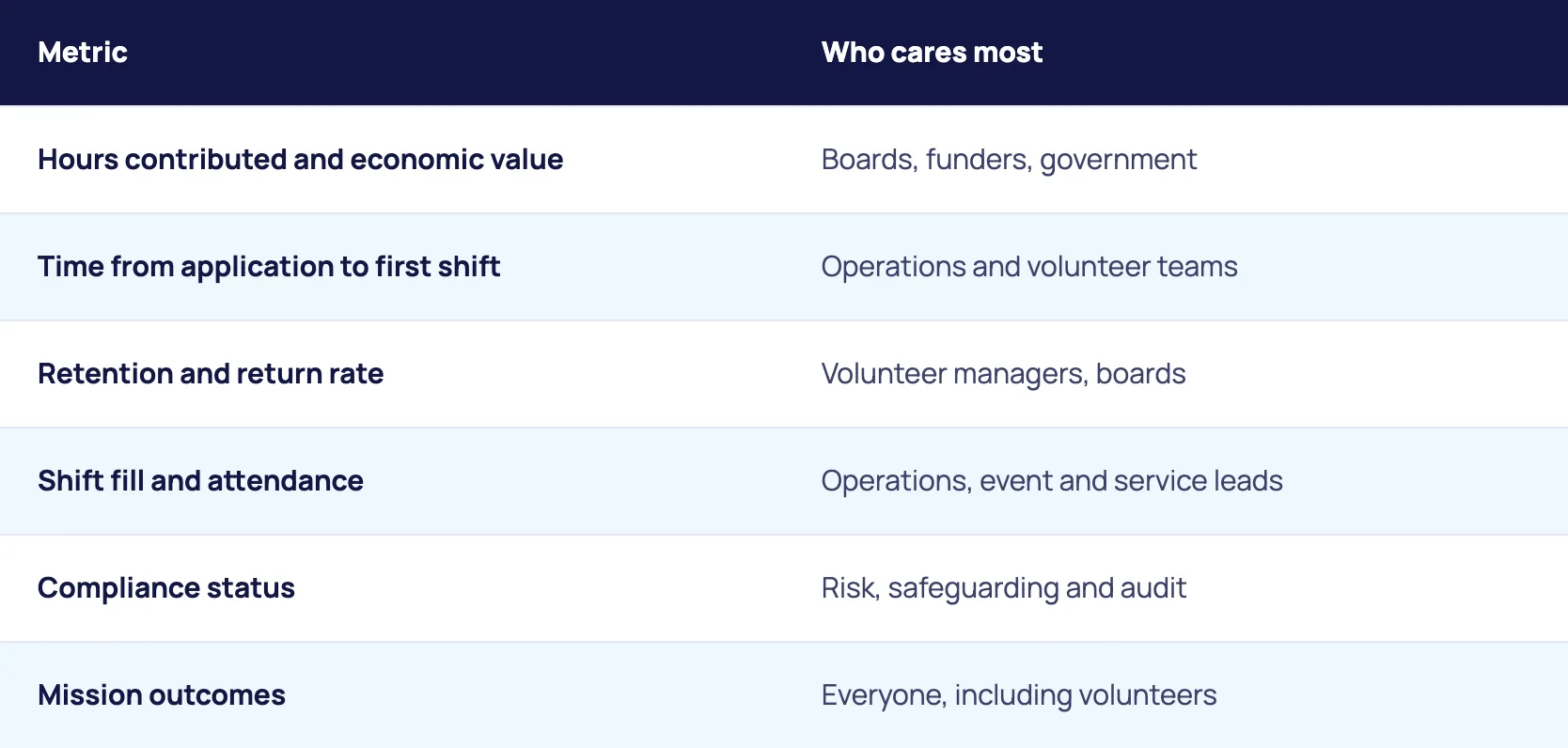
For a full breakdown, read What should you measure from your volunteer program?
Where should you start?
Start with an honest look at where your program is today, then fix the bottleneck that costs you the most time and the most volunteers. For most organisations that is onboarding. The ten-minute self-assessment below works best as a team conversation, because coordinators, managers and leaders often see different parts of the picture.
Score each statement: 0 = not yet, 1 = partly, 2 = yes.
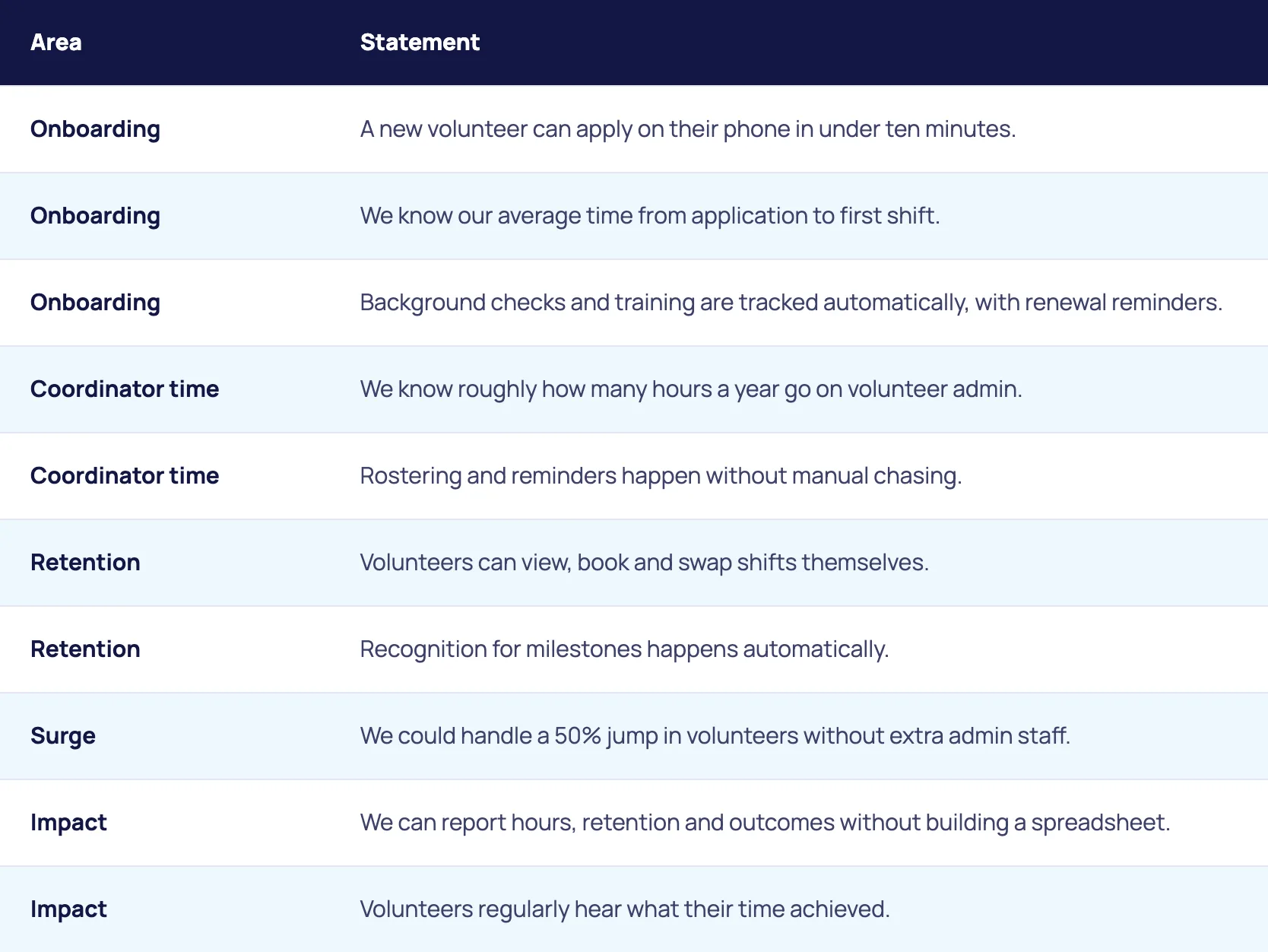
- 0 to 8, running on goodwill: start with a coordinator time audit and your time to first shift.
- 9 to 15, ready to scale: connect the gaps between onboarding, rostering and reporting.
- 16 to 20, future-ready: focus on impact storytelling, surge planning and keeping the experience fresh for long-serving volunteers.
How does Rosterfy help?
Rosterfy is built for organisations whose volunteer programs are too complex for spreadsheets and lightweight scheduling tools: thousands of volunteers, multiple roles and sites, strict compliance and stakeholders who expect proof of impact. It manages the full volunteer journey in one secure platform, from the first application to day-of-event check-in and the board report afterwards. Rosterfy has powered over 180 million volunteer hours across 77 countries, in 9 languages.
Want to share this with your team?
Download the free white paper and share it with your team to ensure your volunteer program is future ready!

Frequently Asked Questions
It means building a program that keeps working when things change: fewer volunteers, a sudden surge, new compliance rules or a key coordinator leaving. In practice, that comes down to fast onboarding, low admin, a volunteer experience people want to stay for, and impact data you can share on demand.
Mostly time. Work commitments are the top barrier for 51% of non-volunteers in England, and 47% of Australian non-volunteers say they have no time. Many people have also never been asked, and rising out-of-pocket costs are putting some off.
There is no single benchmark, because roles with background checks or clinical training naturally take longer. The useful step is to measure your own and shorten it. OzHarvest cut onboarding from six weeks to one by automating checks and data sync.
Make volunteering flexible, never leave volunteers guessing about their shifts, recognise milestones automatically and show people the difference their time made. Short feedback after shifts helps you spot problems before volunteers quietly drift away.
Start with hours contributed and their economic value, then add time to first shift, retention, attendance, compliance status and mission outcomes. Volunteer management software can report these automatically for boards and funders.
Usually when spreadsheets and email stop keeping up, such as hundreds or thousands of volunteers, several roles or sites, mandatory checks and training, or stakeholders asking for impact reporting. Rosterfy is built for programs at that level of complexity.