What should you measure from your volunteer program?
Australia's volunteer workforce is shrinking in headcount but growing in effort. This guide shows volunteer leaders which metrics to track, how to set targets and how to report impact to boards, funders and government, using the latest Australian data.

Key topics covered:
The five-layer framework
Organise your metrics by reach, experience, operations, compliance and impact, so every stakeholder gets the answer they need from one data set.
Targets and reporting
Turn broad goals into SMART targets, and match the right metrics to boards, funders, government and volunteers.
Compliance and proof
See which safeguarding metrics boards expect, and how British Heart Foundation, SecondBite and Spark Event Group moved theirs.
Key takeaways
- Fewer volunteers, more hours. Formal volunteering fell from 36.2% of Australians in 2010 to 22.6% in 2025, while formal hours rose from 490 million in 2020 to 618 million in 2025. Retention and workload metrics now matter as much as recruitment numbers.
- Leaders are asking for evidence. 45.5% of Australian volunteer managers rate impact measurement, evaluation and reporting as very important, rising to 50.9% among paid managers.
- Different audiences need different metrics. Boards want value and risk, funders want outcomes, operations teams want fill rates and attendance. A five-layer framework (reach, experience, operations, compliance, impact) gives each stakeholder its answer from one data set.
- Manual reporting is the bottleneck. When data lives in spreadsheets, inboxes and paper forms, reporting happens once a year. A volunteer management platform of record turns the same data into live dashboards, so leaders can act within the season, not after it.
Sources: ABS General Social Survey 2025, via Volunteering Australia, May 2026. A Snapshot of Volunteering in Australia, State and Territory Volunteering Peak Bodies, 2023 data.
Why does measuring your volunteer program matter more in 2026?
Measuring your volunteer program matters more now because Australian volunteering has become more concentrated. Fewer people volunteer formally, but each gives more time, so losing one volunteer costs more than it used to. Leaders need data to retain those people, justify investment to boards and funders, and show the return volunteering delivers to the community.
Key stats
- 36.2% of Australians volunteered through an organisation in 2010
- 22.6% in 2025, down from 28.8% in 2019
- 618M formal volunteering hours in 2025, up from 490 million in 2020
The workforce is smaller and working harder. The ABS General Social Survey 2025 shows 22.6% of Australians aged 15 and over volunteered through an organisation, down from 28.8% in 2019 and 36.2% in 2010. Over the same period, total formal volunteering hours climbed to 618 million, up from 490 million in 2020.
Volunteer managers feel the squeeze. In the national Snapshot of Volunteering survey of 3,948 volunteer managers, the three biggest changes reported since 2020 were that volunteers need more training, people want to give fewer hours, and fewer people want to volunteer at all.
Cost pressure is real on both sides. 54.4% of volunteers incurred out-of-pocket expenses in 2025, mostly for transport. Organisations spend an average of $6.06 for every formal volunteer hour they support. Both numbers belong in your reporting.
The value case is strong, if you can show it. The same national study estimates that every $1 invested in volunteering returns $5 to the community. Your board and funders will believe that figure for your organisation only when your own data backs it up.
Sources: ABS General Social Survey 2025, via Volunteering Australia, May 2026. A Snapshot of Volunteering in Australia, State and Territory Volunteering Peak Bodies, 2023 data.
What this means for you: Recruitment counts alone no longer tell leadership whether a program is healthy. Retention, workload per volunteer, cost per hour and outcome data now carry the story.
What metrics should you track in a volunteer program?
The most useful volunteer program metrics fall into five layers: reach, experience, operations, compliance and impact. Each layer answers a different stakeholder’s question. Tracking a small set from every layer, rather than a long list from one, gives you a balanced picture of program health and lets you report to any audience from a single data set.
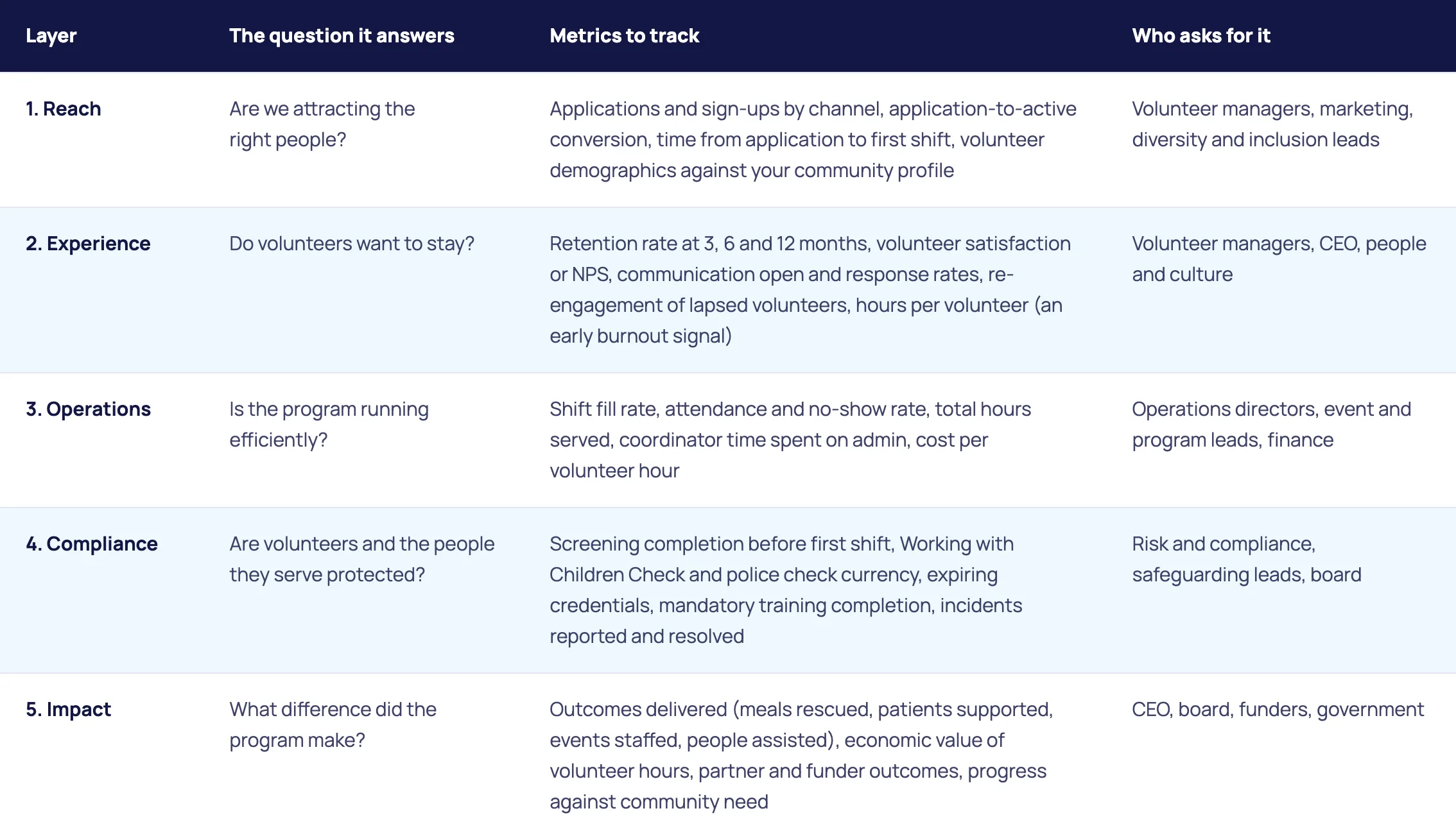
Start with outcomes, then work backwards. Hours served is an output. Meals delivered, patients visited or races completed safely are outcomes. Funders and boards increasingly want the second, so define your impact metrics first and make sure the data to support them is captured at the point of activity, such as at check-in or shift completion.
Keep the list short. Three to five metrics per layer is plenty. A dashboard with 60 numbers gets ignored. A dashboard with 15 that each answer a real question gets used.
Capture once, report many times. If every application, induction, shift and check-in sits in one platform, the same record can feed a coordinator’s weekly view, an operations dashboard and a board report. Rosterfy’s Insights & Impact dashboards are built on this principle, so leaders see live numbers rather than waiting for a quarterly export. See the Volunteer Insight Dashboard
How do you turn volunteer metrics into targets?
Turn volunteer metrics into targets by rewriting each broad goal as a SMART objective: specific, measurable, achievable, relevant and time-bound. A SMART target names the metric, the baseline, the goal and the deadline. That gives every coordinator a clear job to do and gives leadership a number to track throughout the year, not only at reporting time.
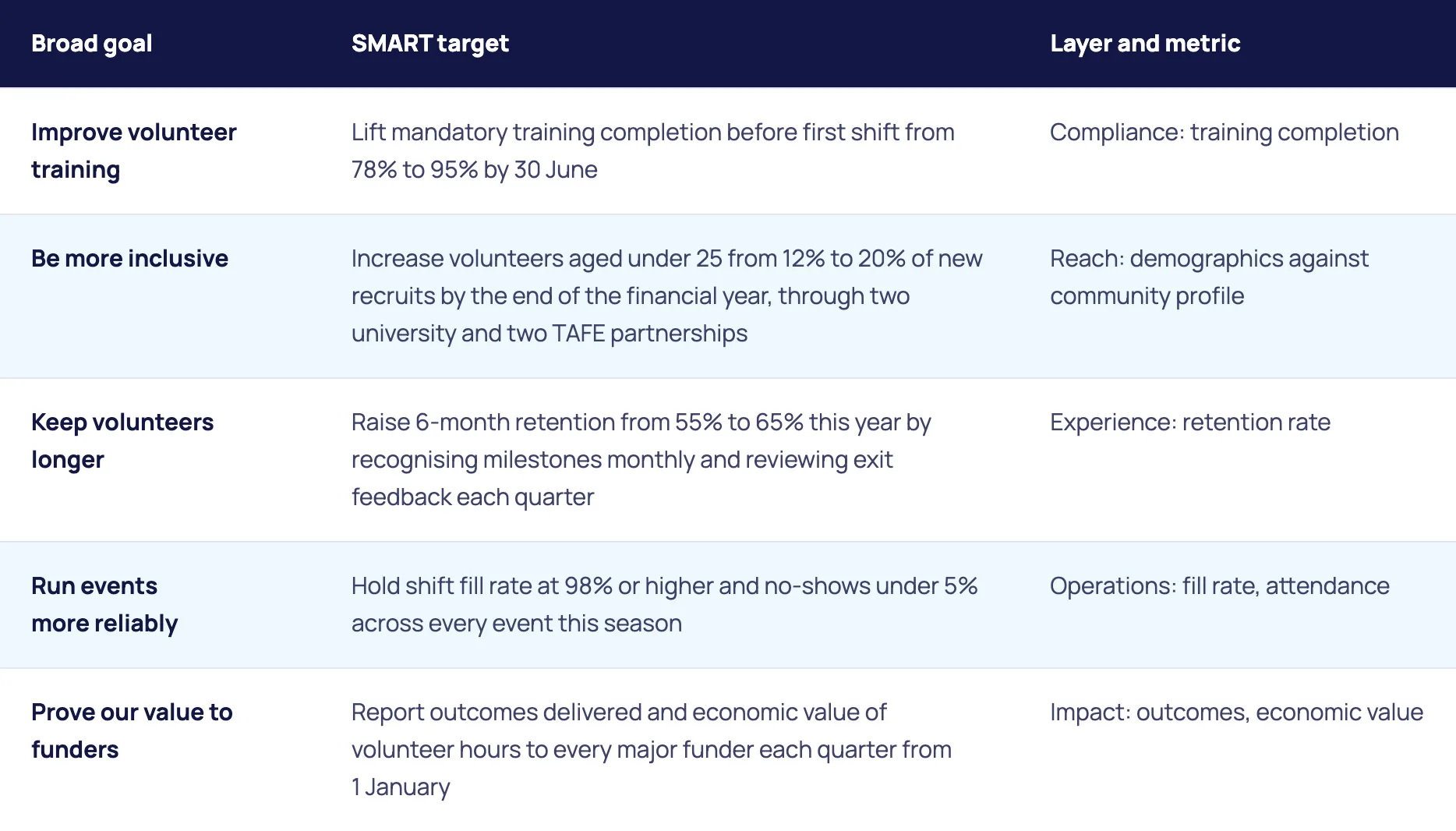
The percentages above are illustrative. Set your own baselines from your current data before committing to a target.
What this means for you: Once targets are set, review them monthly. A target checked only at year end is a report, not a management tool.

Which compliance metrics should volunteer leaders report to the board?
Boards should see compliance metrics that show volunteers are screened, trained and protected before they start, and stay that way. The essentials are screening completion before first shift, Working with Children Check and police check currency, upcoming credential expiries, mandatory training completion, and incidents logged and resolved. These numbers turn safeguarding from an assumption into evidence.
Callout: 84.8%. Volunteer health and safety is the issue Australian volunteer managers rate most important, with 84.8% calling it very important, ahead of retention and recruitment. Yet in many programs, compliance status lives in a spreadsheet that is only checked when something goes wrong.
Source: A Snapshot of Volunteering in Australia, State and Territory Volunteering Peak Bodies, 2023 data.
Metrics that give a board confidence
- Percentage of active volunteers with a current, verified Working with Children Check where their role requires one
- Percentage of volunteers screened before their first shift (the target should be 100%)
- Number of credentials expiring in the next 30, 60 and 90 days
- Mandatory and role-specific training completion rates
- Incidents reported, time to resolution, and any trends by role or location
Enforce, don’t just report. The strongest compliance programs stop an unscreened or untrained volunteer from being rostered in the first place. When screening and training rules are built into scheduling, your compliance metrics stay healthy by design, and your reports become a record of control rather than a list of gaps.
Protect the data itself. Volunteer records include personal information, screening results and sometimes health details, so how that data is stored is part of your compliance story. Most large Australian organisations, including charities above the Privacy Act’s turnover threshold, must handle personal information in line with the Privacy Act 1988 and the Australian Privacy Principles. Rosterfy is certified to ISO 27001:2022 and SOC 2 Type II, and offers data hosting in Australia, so volunteer data stays onshore. Read about Rosterfy data security
How should you report volunteer impact to senior leadership, funders and government?
Report volunteer impact by matching the metric to the audience. Boards want value, risk and trend. Funders want outcomes against what they paid for. Government wants reach, compliance and community benefit. Build every report on four elements, the need, the vision, the result and the future, and refresh the numbers from live data rather than rebuilding them each time.
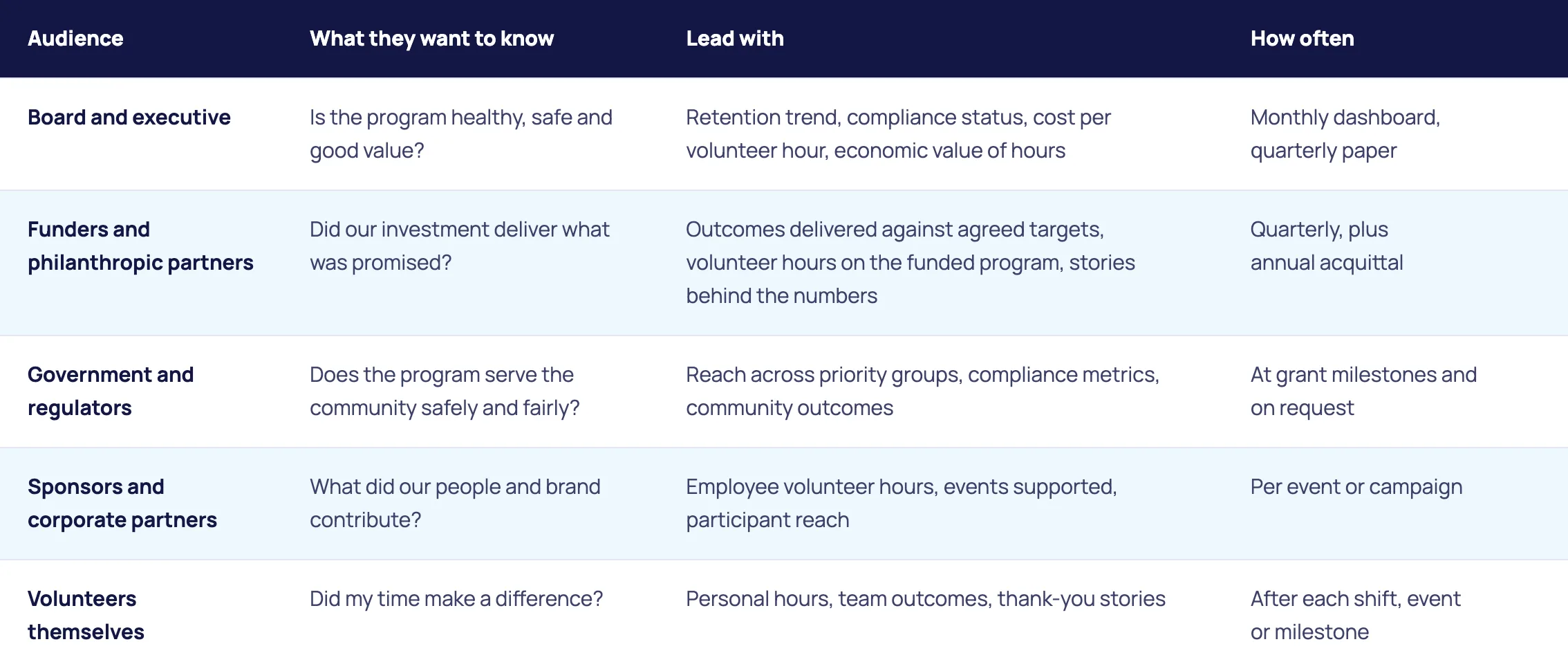
Four things every impact report needs
- The need. What happens in your community if this work does not get done. This creates urgency.
- The vision. Why your organisation is the one to meet that need, and how volunteers make it possible.
- The result. What you achieved, the milestones you reached and the targets you beat, backed by your own data.
- The future. What more you could do with continued or increased support.
Show the dollar value of volunteer time. Multiply total volunteer hours by a replacement cost rate to express contribution in terms a CFO or funder recognises. The national Snapshot of Volunteering study uses age-based median wages plus 15% for on-costs, ranging from about $20 to $57 per hour. State your method so the figure stands up to scrutiny. Rosterfy’s free ROI Calculator can help you model this for your own program. Try the ROI Calculator
Source: A Snapshot of Volunteering in Australia, State and Territory Volunteering Peak Bodies, 2023 data.
Move from annual to always-on. The biggest gain comes when reporting stops being a once-a-year project. With live dashboards, a volunteer leader can answer a board question in the meeting, not a fortnight later.
How are leading organisations using volunteer data?
Leading volunteer organisations use their data to remove admin, protect attendance and show measurable results. The examples below come from a national health charity, a food rescue network and one of Australia’s largest sporting events. Each moved key program metrics once their volunteer data lived in one platform instead of spreadsheets and inboxes.
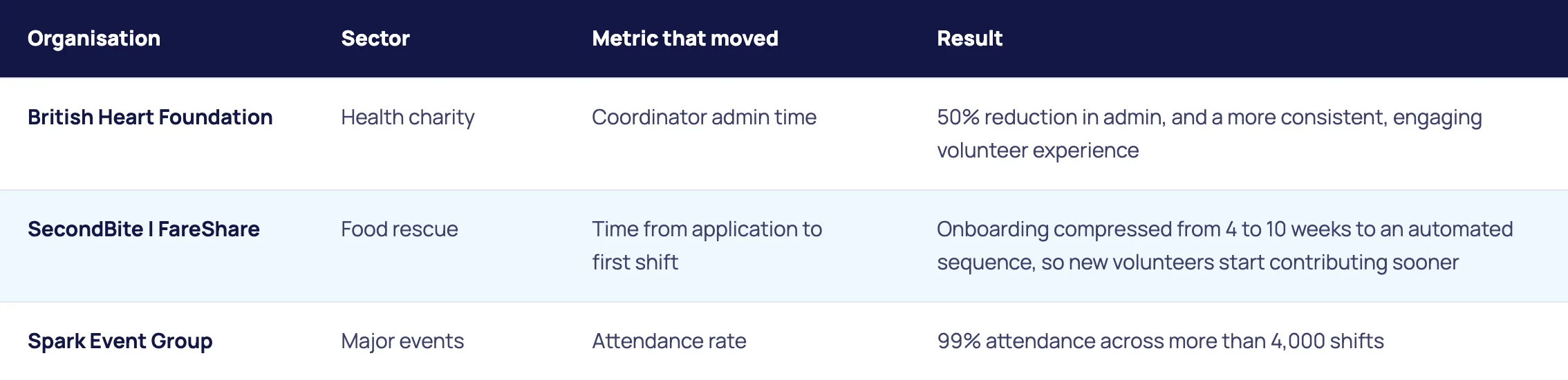
What they have in common. None of these results came from collecting more data. They came from capturing the right data once, at the point of activity, and putting it in front of the people who could act on it.
Where should you start measuring your volunteer program?
Start by auditing where your volunteer data lives today, then pick three to five metrics that answer your leadership’s most pressing question. Get those flowing reliably from one system before adding more. The right sequence depends on scale: multi-site and federated organisations need consistent definitions across entities first, while single-entity programs can move straight to live dashboards.
If you run a large, multi-site or federated program (for example a national charity, sport federation, council or major event)
- Agree one set of metric definitions across every state, site or entity, so “active volunteer” and “retention” mean the same thing everywhere.
- Set permission levels so each site sees its own data and national leadership sees the roll-up.
- Connect your volunteer platform to your CRM, HR or finance systems so impact and cost data are not reconciled by hand.
- Build a board-level dashboard covering all five layers, refreshed automatically.
- Bring IT, risk and finance in early. They will ask about data residency, security certification and integration before signing off.
If you run a single-entity program growing past a few hundred volunteers
- Move volunteer records out of spreadsheets and into one platform, starting with applications, onboarding and scheduling.
- Track three core metrics from day one: retention rate, shift fill rate and training completion.
- Add one impact metric tied to your mission, such as meals delivered or events staffed.
- Share a simple monthly dashboard with your CEO and use it to build the case for further investment.
What this means for you: Whichever path fits, the goal is the same. One trusted source of volunteer data that any leader can rely on.
Want to share this with your team?
Download the free white paper and share it with your team to see how Australian programs are demonstrating their impact.

Frequently Asked Questions
The most important volunteer program KPIs are retention rate, shift fill rate, attendance, training and screening completion, hours served and outcomes delivered. Together they cover whether you attract, keep, deploy and protect volunteers, and what difference they make. Most organisations need only three to five metrics per area to report well.
Measure volunteer impact by tracking outcomes, not just activity. Record what volunteers delivered, such as meals rescued, patients supported or events staffed, at the point of activity. Then add the economic value of volunteer hours using a stated replacement cost method, and report both against the targets agreed with your board or funders.
Multiply total volunteer hours by an hourly replacement cost, which is what it would cost to pay someone to do the same work. The national Snapshot of Volunteering study uses age-based median wages plus 15% for on-costs. Always state the rate and method you used so the figure holds up to scrutiny.
There is no single benchmark, because retention varies widely by sector and program type. Ongoing programs such as hospital or food rescue roles should track 6 and 12 month retention. Event programs should track how many volunteers return for the next event. Set a baseline from your own data and aim to improve it each year.
Boards typically want a short set of metrics covering value, risk and trend. These include volunteer numbers and retention, compliance status such as screening and Working with Children Check currency, cost per volunteer hour, the economic value of hours, and outcomes delivered against strategy. A monthly dashboard with a quarterly written summary works well.
Yes. When applications, onboarding, scheduling, check-in and surveys all run through one volunteer management platform, the data needed for reporting is captured automatically. Rosterfy’s Insights & Impact dashboards turn that data into live reports, so leaders no longer have to rebuild figures from spreadsheets each quarter.