HR system or volunteer management software? How to decide for your volunteer program
For most Australian organisations with more than a few hundred volunteers, purpose-built volunteer management software (VMS) is the better choice. HR systems are designed for predictable, paid employment. Volunteer programs need flexible rostering, self-service sign-up, screening that varies by role and state, and recognition that keeps unpaid people engaged.

Key topics covered:
Where HR systems fall short
Rigid rosters, volunteer-scale turnover and role-specific screening that HR tools weren't built for.
The hidden cost of making it fit
Coordinator hours, lower retention and compliance gaps that don't show up on a software invoice.
HR system vs VMS at a glance
A side-by-side comparison, including when an HR system is enough and when to run both.
Building the case and choosing a VMS
A five-step business case, selection criteria for Australian organisations, and how Lifeline Australia sped up volunteer recruitment.
What is volunteer management software?
Volunteer management software is a platform built to recruit, screen, onboard, roster, communicate with, recognise and report on volunteers. Unlike an HR system, which manages paid employees through contracts and payroll, a VMS is designed for large, fluctuating volunteer workforces with irregular availability and role-specific checks such as Working with Children Checks.
Key takeaways
- Volunteering is growing in hours, not headcount. Australians gave 618 million formal volunteer hours in 2025, up from 490 million in 2020, while formal participation has not returned to pre-COVID levels.
- HR systems suit some programs, not most at scale. They work for small, stable programs and employee volunteering. Programs built on one-off shifts, events and high turnover quickly outgrow them, and many large organisations run both, connected.
- The hidden cost is coordinator time. Manual rostering, chasing screening checks and email follow-up pull volunteer managers away from the work that retains volunteers.
- A VMS pays back in time and retention. Lifeline Australia’s recruitment team went from processing 3 to 5 volunteer applications an hour to 10 to 12 after moving to Rosterfy.
Why does this decision matter for Australian not-for-profits?
Volunteers deliver a large share of Australia’s community services, yet the tools used to manage them often get less investment than the systems built for paid staff. Choosing between an existing HR system and a dedicated VMS shapes how easily people can volunteer, how much time coordinators lose to admin, and how well you can prove impact.
This white paper explains where HR systems fall short for volunteers, the hidden costs of making them fit, and what a purpose-built platform changes. It also gives you a practical framework for building a business case and choosing the right VMS for your organisation.
What is the state of volunteering in Australia in 2026?
Australians are volunteering more hours, but organisations still need more people. In 2025, 9.5 million Australians volunteered formally or informally, and formal volunteer hours rose to 618 million, up from 490 million in 2020. Yet formal participation has not recovered to pre-COVID levels, and most volunteer-involving organisations say they need more volunteers.
- 9.5M people volunteered in 2025, equal to 42.8% of Australians aged 15 and over. [1]
- 5M+ of them volunteered formally through an organisation. [1]
- 618M formal volunteer hours were given by Australians in 2025, up from 490 million in 2020. [1]
Households reported more financial stress across every indicator in the 2025 survey than in 2020, adding pressure on both volunteers and the services they support. [1]
Volunteer expectations are shifting too. People want flexible, digital-first ways to give their time: quick sign-up from a phone, instant updates, and roles that fit around work and family.
Source 1: Volunteering Australia, General Social Survey 2025, interpreting Australian Bureau of Statistics General Social Survey 2025 data.
Why don't HR systems work well for managing volunteers?
HR systems are built for paid employees on predictable schedules, contracts and payroll. Volunteer programs work differently: thousands of people, irregular and event-based shifts, high turnover, and role-specific screening. Stretching an HR system to cover volunteers usually means workarounds, spreadsheets on the side, and a poorer experience for the people giving their time.
Rigid scheduling. HR rostering assumes regular full-time or part-time hours. Volunteer programs run on one-off shifts, events and changing availability, which HR tools struggle to handle.
Limited scale for volunteer volumes. Volunteer bases often run into the hundreds or thousands, with people joining and leaving constantly. That needs high-frequency data updates, many role types and fluctuating participation.
Screening that doesn’t match volunteer roles. Australian volunteers may need a Working with Children Check, police check or role-specific training, and requirements differ between states and territories. Most HR systems aren’t set up to enforce these before someone is rostered.
Few engagement features. Self-service portals, recognition and progress tracking keep volunteers motivated. They are rarely part of a traditional HR system.
- 83% of Australian volunteer-involving organisations said they need more volunteers now or in the near future. [2]
- 60% expect to need more in five years. [2]
Source 2: Volunteering Australia, Volunteering in Australia: The Organisation Perspective (2022).
6 → 1 weeks to onboard
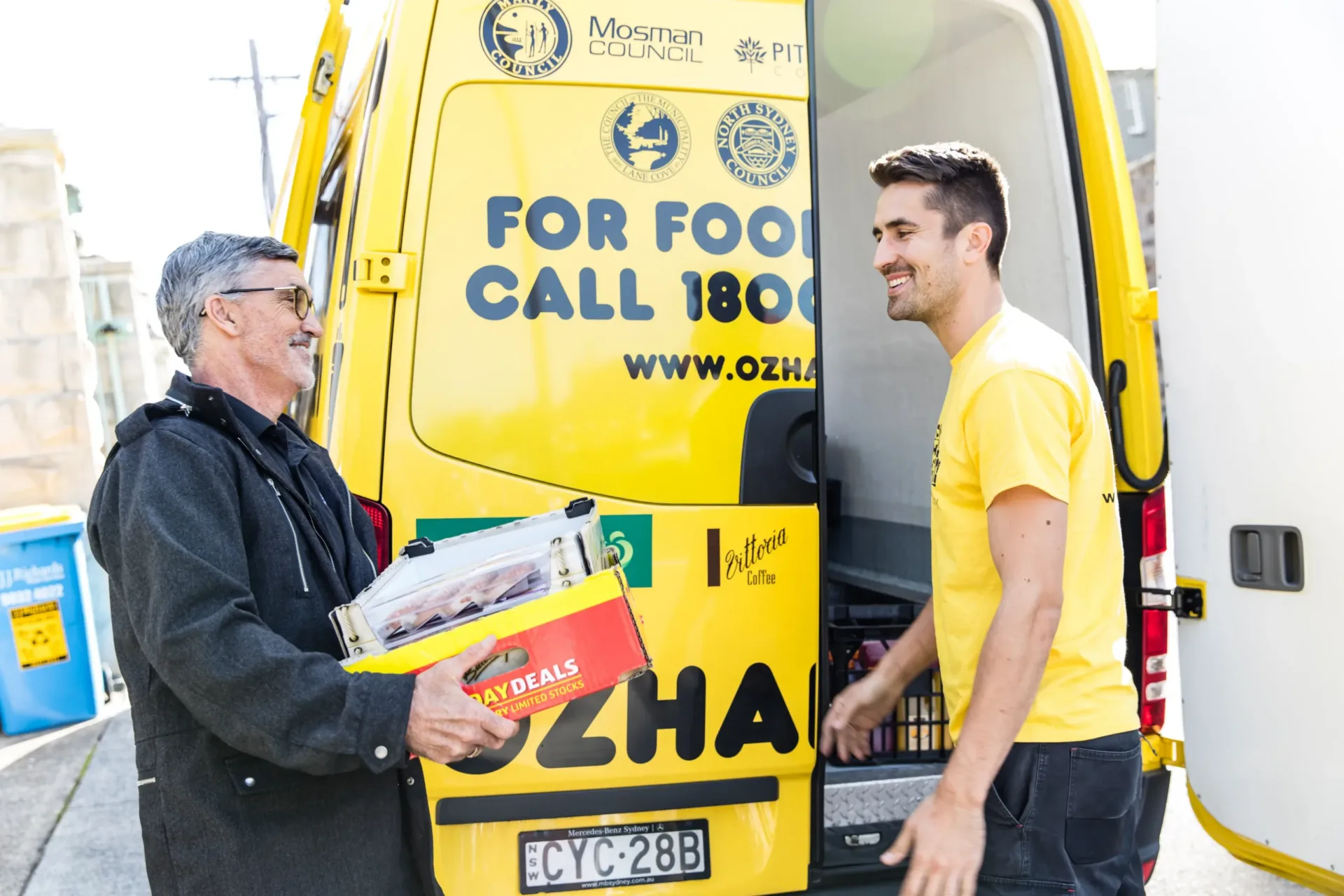
At OzHarvest, Rosterfy’s integrated crime check and two-way Salesforce sync cut volunteer onboarding from six weeks to one.
How does an HR system compare with volunteer management software?
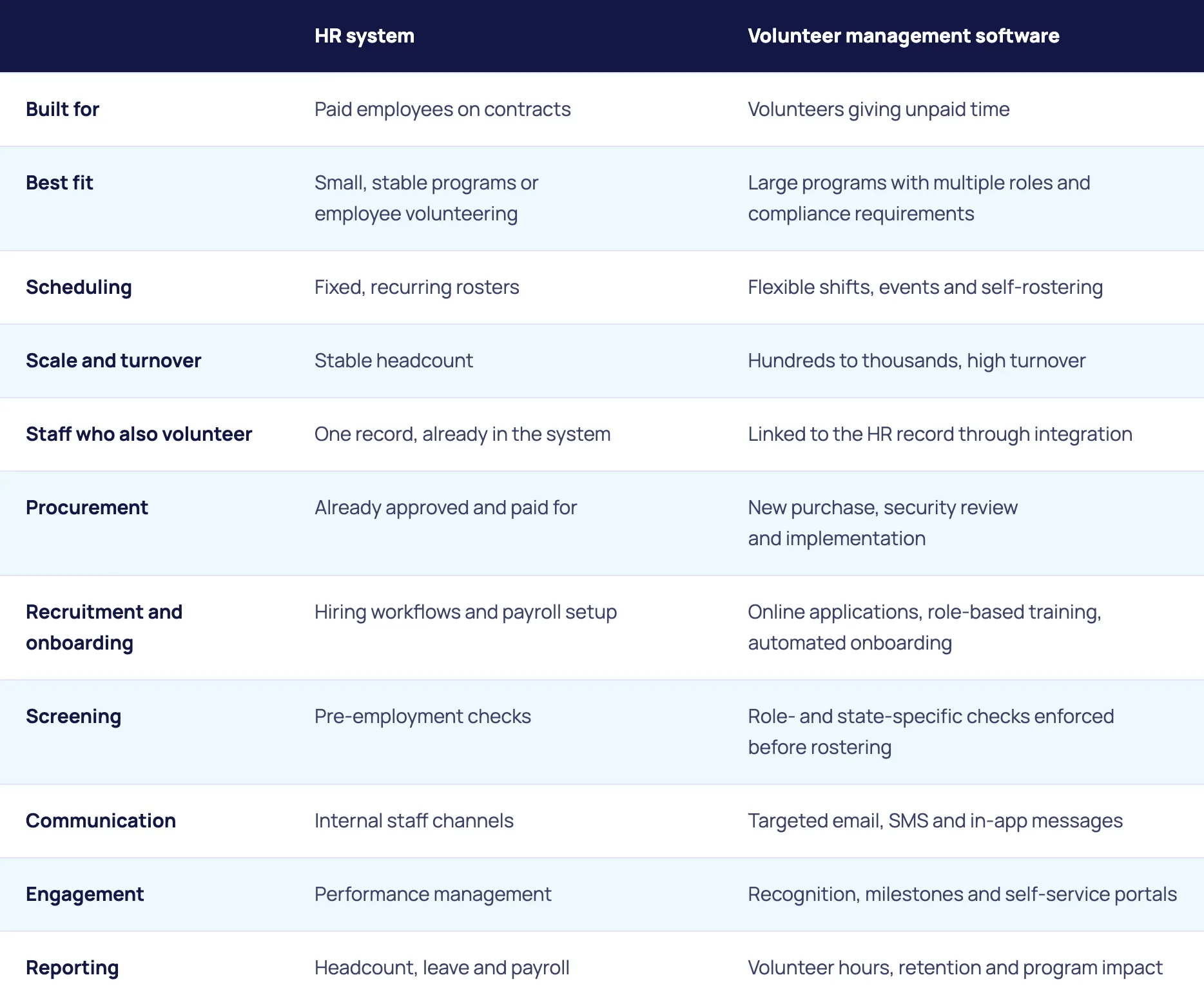
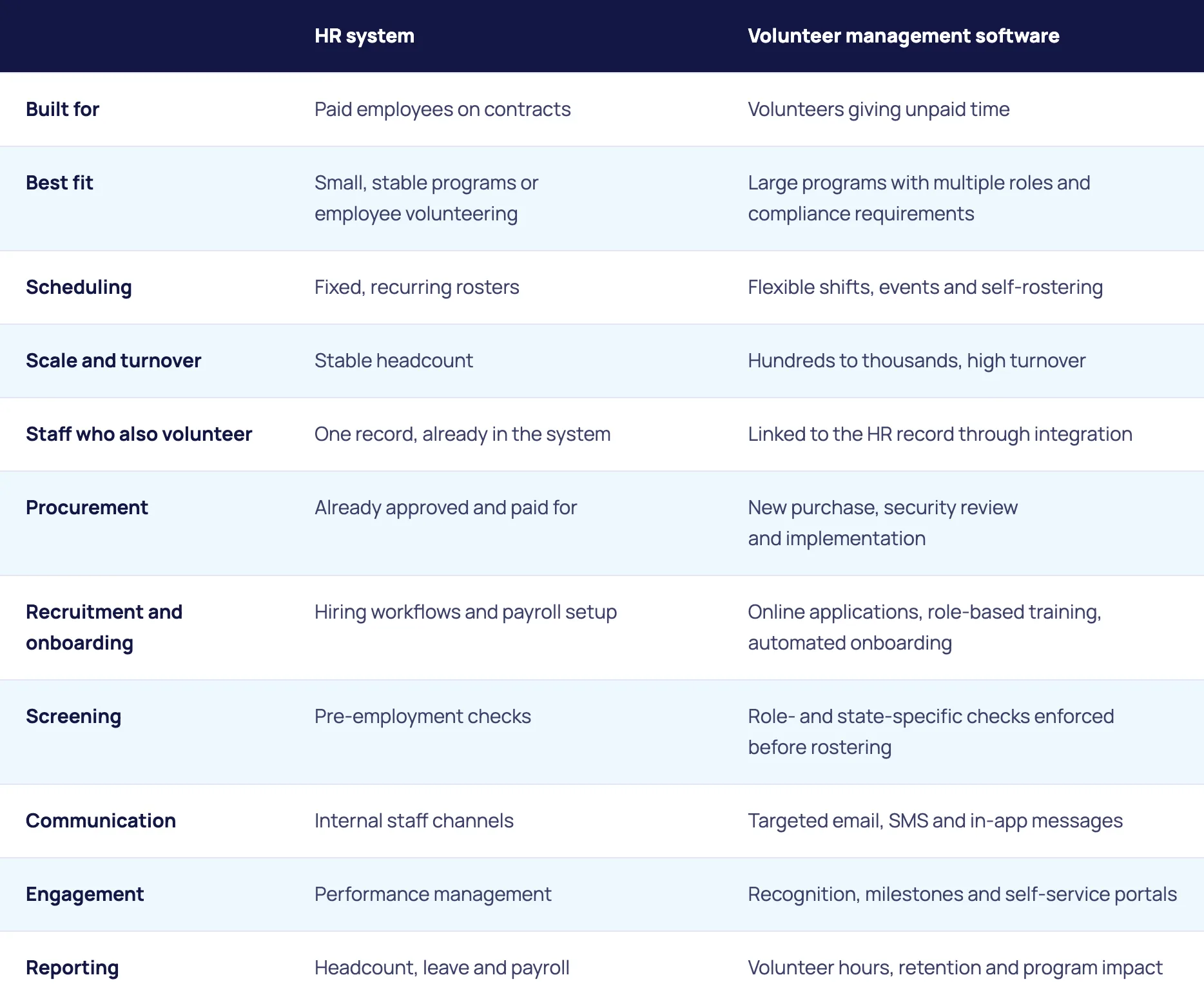
The core difference is who the system is built for. An HR system manages a stable workforce of paid employees. A VMS manages a large, changing community of volunteers who choose when and how to give their time.
When is an HR system enough for managing volunteers?
An HR system can work if your volunteer program is small, stable and low risk: a few dozen regular volunteers on recurring shifts, little turnover, no event-based rostering and simple screening. It can also suit corporate volunteering, where every volunteer is already an employee with a record in the system.
Signs you’ve outgrown it
- Volunteer numbers in the hundreds, or swinging sharply around events and seasons.
- Coordinators keeping spreadsheets alongside the HR system to manage shifts or checks.
- Screening requirements that differ by role, site or state.
- Leaders asking for volunteer hours and impact the HR system can’t report.
Can you use an HR system and volunteer management software together?
Yes, and many larger organisations do. The HR system stays the record for paid staff, payroll and employment compliance. The VMS handles volunteer recruitment, screening, rostering, engagement and impact reporting. Connecting the two keeps records in sync for people who are both employees and volunteers, without forcing either system to do the other’s job.
- HR system: paid staff, payroll and employment compliance.
- Volunteer management software: volunteer recruitment, screening, rostering, engagement and impact reporting.
Rosterfy connects with CRM, payroll, background check and other systems through more than 50 integrations, so volunteer data doesn’t sit in a silo.
What are the benefits of volunteer management software?
Volunteer management software automates the work that eats coordinator time and gives volunteers control of their own experience. It brings scheduling, onboarding, screening, communication, recognition and reporting into one platform, so organisations can manage more volunteers without adding admin, keep people engaged, and show funders the impact of every hour given.
- Flexible scheduling: match volunteer availability to shifts, whether it’s a one-day event or an ongoing program.
- Self-service for volunteers: let people sign up for shifts, update availability and find resources themselves.
- Automated onboarding and screening: online applications, check tracking and role-specific training, so new volunteers are ready from day one.
- Targeted communication: send updates by email, SMS or in-app notification to the right group at the right time.
- Recognition: milestones, certificates and progress tracking that help volunteers feel valued and keep coming back.
- Data and reporting: track hours, engagement and outcomes to support decisions and report to boards, donors and funders.
$5 for every $1 invested
Volunteering delivered an estimated $566 billion in financial benefit to Australia, a return of about $5 for every $1 invested. [3]
Source 3: State and territory volunteering peak bodies, A Snapshot of Volunteering in Australia, based on 2023 State of Volunteering surveys.
Why are Australian not-for-profits investing in volunteer technology?
Not-for-profits are under pressure to deliver more with limited funding, and manual volunteer processes don’t scale. More organisations now plan their technology deliberately, but cost and time remain the biggest barriers to upgrading systems. A strong business case helps leaders see a VMS as an investment in capacity, not just another software cost.
- 55% of not-for-profits in Australia and New Zealand now have an IT plan in place, up 13% on 2024. [4]
- 31% cite implementation cost as a main barrier to upgrading systems. [4]
- 23% cite lack of time as a main barrier to upgrading systems. [4]
Those barriers are exactly what a business case needs to address: what the system costs, how long it takes to implement, and how much time it gives back.
Source 4: Infoxchange, Digital Technology in the Not-for-Profit Sector Report 2025, November 2025.
How do you build a business case for volunteer management software?
A strong business case shows decision-makers the cost of staying as you are, the benefits of change, and how the investment supports your mission. Start with the hours your team spends on admin today, show what automation would free up, then address cost and disruption concerns with evidence from comparable organisations.
- Define the problem: hours spent on rostering, onboarding and screening; volunteer turnover; compliance gaps.
- Show the benefits: better volunteer experience, less admin, room to grow without adding complexity.
- Estimate the return: coordinator hours saved, lower re-recruitment costs, reduced compliance risk.
- Address concerns: long-term savings for cost worries; implementation support and training for disruption worries.
- Link it to your mission: how the time saved goes back into services and communities.
For a full template and worked examples, see Rosterfy’s guide to building a business case for volunteer management software. Read the business case guide.

How did Lifeline Australia speed up volunteer recruitment with a VMS?
Lifeline Australia moved volunteer recruitment onto Rosterfy to cut the admin behind every application. Within a week, its recruitment office was processing 10 to 12 volunteer applications an hour instead of 3 to 5, cutting application administration by 50% and supporting more than 5,000 active volunteers.
- 10–12 applications processed per hour, up from 3 to 5.
- 50% volunteer application administration cut.
- 5,000+ active volunteers on one platform.
Background: Lifeline Australia provides 24/7 crisis support and suicide prevention services, delivered with the help of thousands of trained volunteers.
Challenge: Every application involved manual handling, screening and follow-up. As demand for crisis support grew, the recruitment team needed to process volunteers faster without lowering screening standards.
Solution: Rosterfy centralised applications and automated screening workflows, including Working with Children Check tracking and renewal reminders.
"After one week of using Rosterfy, our Recruitment Office can process 10-12 volunteer applications per hour, as opposed to 3-5 volunteers per hour, through our previous system."
How do you choose the right volunteer management software?
Start with your volunteer roles, compliance obligations and growth plans, then test each vendor against them. For Australian organisations, check screening support for Working with Children and police checks, local data hosting, and integrations with the CRM and HR tools you already use. Ask how the vendor will implement and support the platform.
Tip: involve stakeholders, including volunteers, in the selection process so the system works for everyone who will use it and check out our guide to Choosing Volunteer Management Software.
What is Rosterfy?
Rosterfy is volunteer management software founded in Melbourne in 2014. It helps charities, sporting bodies, events and government organisations recruit, screen, roster, communicate with and report on large volunteer programs. Rosterfy offers Australian data hosting, integrations including Salesforce and SEEK Volunteer, and supports organisations such as Lifeline Australia, OzHarvest and Golf Australia.
- 6 → 1 OzHarvest: volunteer onboarding cut from six weeks to one with integrated crime checks and two-way Salesforce sync.
- 75% Golf Australia: volunteer admin reduced by 75%.
- 99% Australian Open: 99% volunteer attendance across more than 4,000 shifts.
Scale: 160 million volunteer hours worldwide in 77 countries
Is volunteer management software worth the investment?
For organisations running volunteer programs at scale, usually yes. A small, stable program can manage in an HR system, but larger programs rarely get the flexibility, recognition and easy experience volunteers expect from one, and coordinators pay for the gap in lost hours. A purpose-built VMS automates admin, supports compliance, keeps volunteers engaged and gives leaders the data to show impact.
Australians are giving more hours than ever through organisations, while most of those organisations still need more volunteers. Investing in the tools that make volunteering easy is one of the most direct ways to protect that contribution and grow it.
Frequently Asked Questions
Yes, if your program is small and stable. HR systems are designed for paid employees with fixed hours, contracts and payroll. Once a volunteer program needs flexible shifts, self-service sign-up, role-specific screening and recognition, organisations often end up running spreadsheets alongside the HR system, which adds admin and makes reporting harder.
An HR system manages a stable workforce of paid employees. Volunteer management software manages a large, changing community of volunteers who choose when to give their time. A VMS adds flexible rostering, self-service portals, automated onboarding and screening, targeted messaging, recognition and impact reporting built around volunteer hours.
It’s usually time when coordinators spend more hours on admin than on supporting volunteers, when screening checks are tracked in spreadsheets, or when you can’t easily report volunteer hours and impact. Organisations with several hundred volunteers, multiple sites or event-based rosters typically see the biggest gains from a purpose-built platform.
Yes. Most enterprise volunteer management platforms connect with existing systems so data doesn’t sit in silos. Rosterfy integrates with tools including Salesforce and SEEK Volunteer, so volunteer records, screening status and hours can flow between your VMS and the systems your organisation already relies on.
A VMS records each volunteer’s check details and expiry dates, flags missing or expiring checks, and can stop someone being rostered into a role until requirements are met. This matters in Australia, where each state and territory runs its own Working with Children Check scheme.
Not always. Small, stable volunteer programs can run in an HR system, and some organisations only need a VMS for volunteers. Larger organisations usually keep both: the HR system for paid staff and payroll, and a VMS for volunteers, connected so people who are both employees and volunteers have one consistent record.
Take the full guide with you
Download the PDF to share with your leadership team or board.