Strategies to improve volunteer engagement in Australian hospitals and healthcare charities
Australian hospitals and healthcare charities don't have a volunteer goodwill problem, they have a capacity problem. Every patient-facing volunteer must be screened, credentialed, trained and tracked, and when that runs through inboxes and spreadsheets, coordinator time runs out first. Centralising screening, onboarding, scheduling and reporting is how leading Australian health organisations get that capacity back.

Why are Australian health volunteer programs under pressure?
Australia’s formal volunteer pool is shrinking while the volunteers who remain do more. Formal volunteering fell from 36.2% of Australians aged 15 and over in 2010 to 22.6% in 2025. Over 2020 to 2025, hours volunteered through organisations rose from 490 million to 618 million. Fewer people are carrying more of the load.
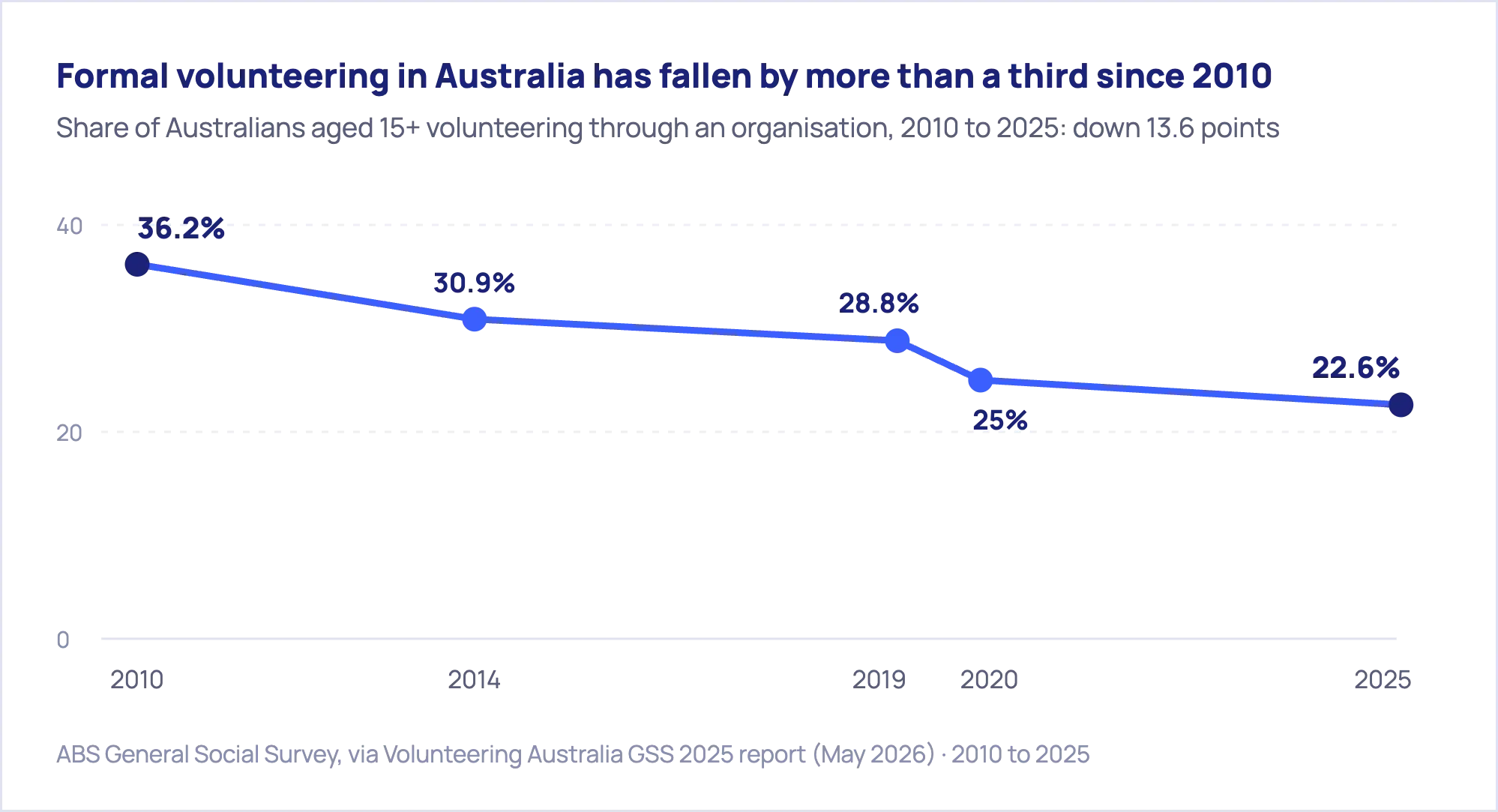
Three findings from the same survey matter most for health organisations:
- Health competes for a small slice. Only 4.3% of formal volunteers give their time to health or mental health organisations, against 33.3% for sport and recreation.
- Time is the main barrier. Among Australians who don’t volunteer formally, 47% say they have no time. That rises to 57.7% for people aged 25 to 44.
- Compliance costs volunteers too. 15.6% of formal volunteers paid out of pocket for memberships, licences or mandatory checks, and most expenses go unreimbursed.
Source: ABS General Social Survey 2025, via Volunteering Australia, May 2026.
What compliance checks do hospital volunteers need in Australia?
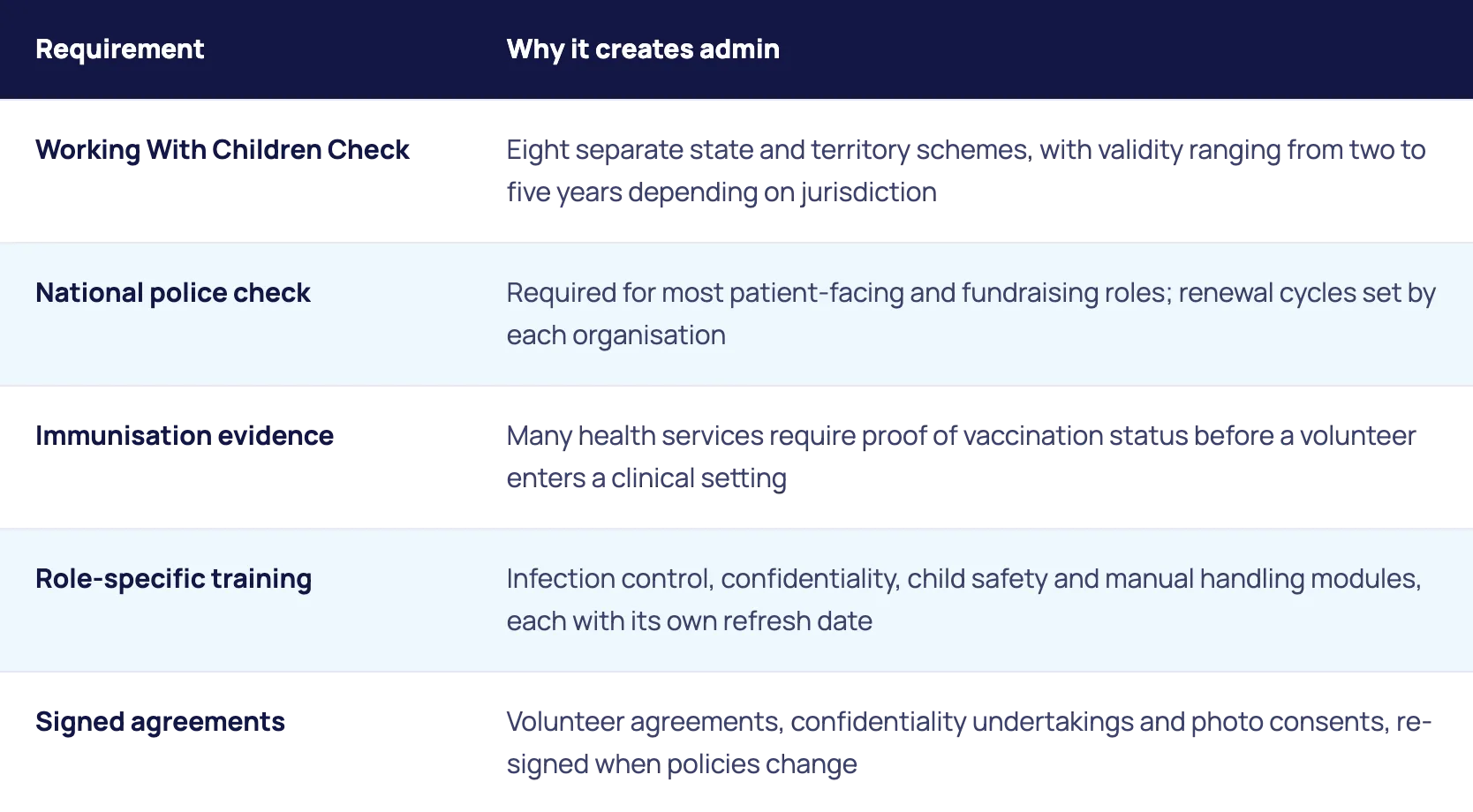
A patient-facing volunteer in a hospital or health charity typically carries several time-limited credentials, each tracked separately: a Working With Children Check, a national police check, immunisation evidence, role-specific training and signed agreements. In most programs, coordinator hours go to proving a volunteer is safe to place, not to placing them.
Is there a national Working With Children Check in Australia?
No. Australia has eight separate state and territory Working With Children Check schemes, with validity ranging from two to five years. National reform improves consistency but doesn’t create a single national card, so organisations working across state lines will still verify against each jurisdiction’s scheme.
Where reform stands:
- November 2025: all Australian governments endorsed an agreement to deliver national WWCC reform.
- July 2026: attorneys-general agreed on nationally consistent baseline offences and assessment criteria, with implementation expected by late 2026.
- Continuous checking: the Commonwealth has committed $37 million to a National Continuous Checking Capability that will monitor check holders’ criminal history in near-real time. A volunteer’s status can change between shifts.
Sources: Attorney-General’s Department, 31 July 2026; House of Representatives Hansard, 20 August 2026.
How have privacy reforms changed the risk around volunteer records?
Since 10 June 2025, individuals in Australia have been able to sue for serious invasions of privacy under a new statutory tort, without first going through the privacy regulator. Draft legislation for the next tranche of Privacy Act reform was released in August 2026. Volunteer records hold exactly the identity, health and screening data these reforms target.
Four questions to ask about any system that holds volunteer data:
- Where is the data stored? Check whether it is hosted in Australia.
- How is it certified? Ask for current security certifications, not a description of security culture.
- Who can see what? Role-based permissions should limit screening and health data to the staff who need it, across every site.
- Can you prove it? Audit trails should show who checked a credential, when, and what changed.
How does Rosterfy keep volunteer data safe?
Navigating data compliance can be complex. Rosterfy makes it simpler, helping you protect volunteer data and manage compliance with confidence.
How should health organisations onboard volunteers without losing them?
Move each applicant through a fixed set of checkpoints so nobody reaches a ward or a child without every requirement met and recorded, and keep the gap between applying and starting short. Every extra week between applying and starting is a week for an applicant to lose interest.
- Apply once, online. A short, mobile-friendly application captures identity, availability and role preferences, and routes applicants to the right role.
- Screen and interview. Shortlist against clear rules and book interviews without email back-and-forth.
- Verify checks and credentials. Record WWCC, police check and immunisation evidence against the volunteer’s profile, with expiry dates.
- Train and induct. Assign infection control, confidentiality and child safety modules by role, and track completion.
- Sign and approve. Collect volunteer agreements and consents digitally and store them with the record.
- Stay compliant after day one. Send reminders before any credential expires, and stop a volunteer booking shifts until it is renewed.
Step 6 is where most manual programs fail. Initial screening gets done; renewals get missed. With continuous checking coming, compliance has to be monitored, not just collected.
Lifeline Australia cut volunteer application admin by 50% and now processes applications three times faster. If you’re evaluating tools for this, see volunteer management software for hospitals and healthcare charities.

How do you keep health volunteers once they're cleared?
Retention depends on three things a health organisation controls: matching each person to the right shift, keeping communication two-way between shifts, and recognising contribution visibly. A compliant volunteer who drifts away after three shifts is the most expensive kind, because every hour spent screening them is lost.
- Match the person to the shift. Capture skills, credentials, availability and preferences at onboarding, then use them. Let cleared volunteers book only the shifts they are eligible for.
- Keep the conversation two-way. Shift reminders, two-way messaging and a volunteer portal keep people informed between shifts. Ask for feedback after placements, not just in an annual survey.
- Recognise contribution visibly. Hours milestones, service anniversaries and certificates cost little and are easy to automate once hours are tracked in one place.
How can hospitals recruit younger volunteers?
Only 16.4% of Australians aged 15 to 24 and 13.1% of those aged 25 to 34 volunteered through an organisation in 2025. Half of all formal volunteers (50.3%) first got involved because someone they knew asked them. Shorter commitments, mobile sign-up and peer referral answer both facts.
- Offer shorter commitments. Event, project and campaign roles let time-poor people contribute without a weekly ward shift.
- Make it mobile. Finding, booking, checking in and completing training from a phone is now the baseline expectation.
- Frame the skills on offer. For students and early-career health workers, patient-facing volunteering is experience worth putting on a CV. Say so.
- Turn volunteers into recruiters. Make it easy for existing volunteers to share roles with friends.
Source: ABS General Social Survey 2025, via Volunteering Australia, May 2026.
Why should volunteering and fundraising data sit together?
In Australian health charities, volunteers power the fundraising that pays for care. Daffodil Day, Starlight Day and hospital foundation appeals depend on thousands of volunteers working across hundreds of sites on a single day. When volunteer and fundraising systems are separate, records duplicate, recognition gets lost and reporting understates the contribution.
See which CRM and fundraising platforms Rosterfy connects to
Rosterfy integrates with Salesforce, Blackbaud, HubSpot and Microsoft Dynamics, connecting volunteer management and fundraising teams through a single source of truth.
What should a health volunteer program measure?
Volunteer programs win investment when they report like any other part of the organisation: a small set of measures, tracked continuously rather than rebuilt by hand each quarter. Seven measures cover it, from time to first shift and compliance currency to funds raised and the coordinator hours still spent on admin.
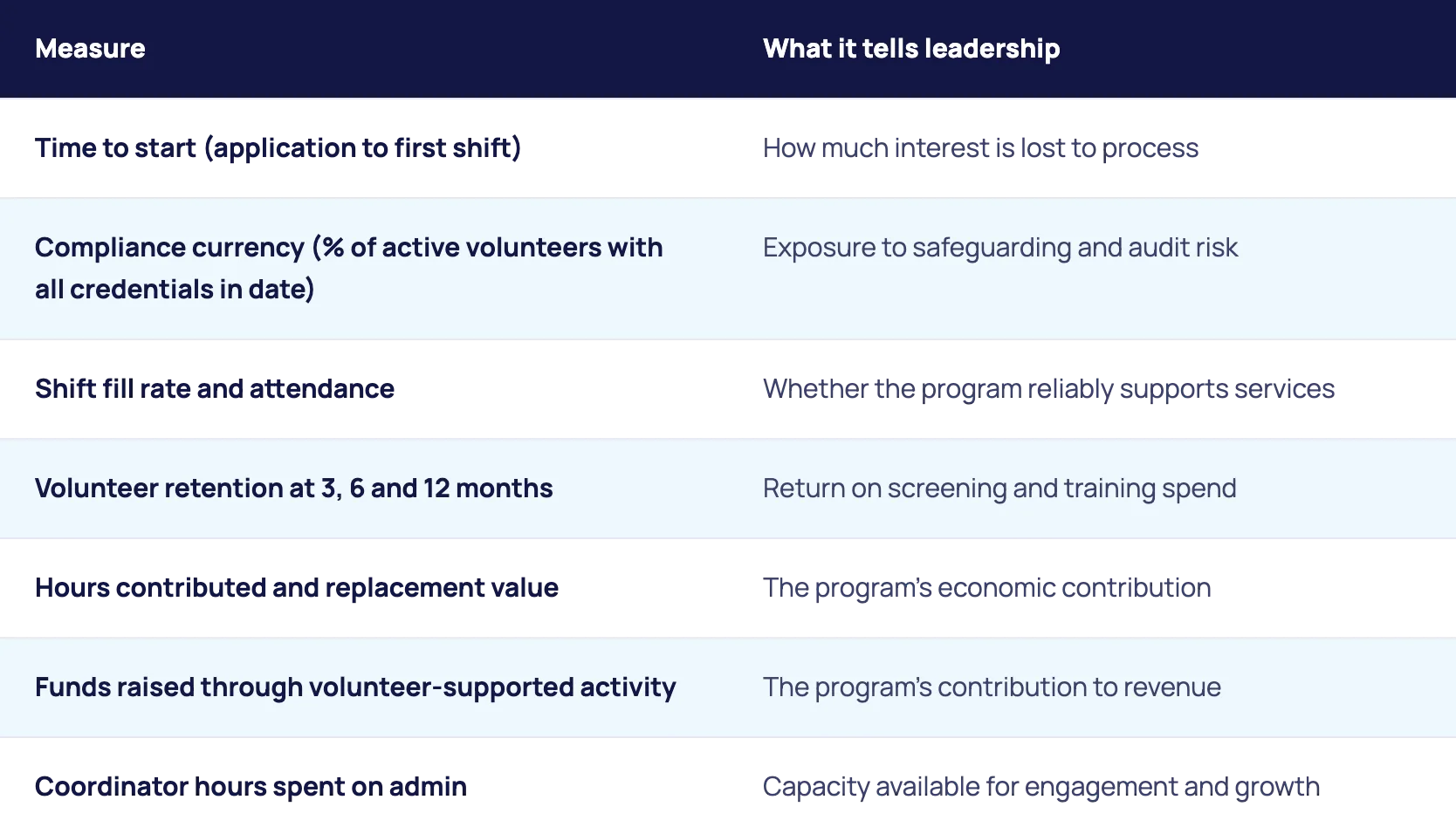
To put numbers to coordinator time and compliance risk, use the ROI calculator and the business case guide.
Where should hospitals and health charities start?
The right first step depends on how the organisation is structured. Hospitals and health services usually start with compliance, hospital foundations and national charities with their highest-volume moment, and smaller single-site charities with the application-to-first-shift journey, where admin hours are easiest to measure.
- Hospitals and health services: map every credential each volunteer role requires and where it’s tracked today. Bring IT, privacy and procurement in early, and pilot one site before rolling out across a network.
- Hospital foundations and national health charities: start with an appeal day, flagship event or peak onboarding period. Connect volunteering and fundraising data from day one, and standardise onboarding across states while allowing for each jurisdiction’s WWCC scheme.
- Smaller and single-site health charities: automate the application-to-first-shift journey first, then put the time saved into recognition and retention, not just recruitment.
Want to share this with your team?
Download the free white paper and share it with your team to learn how Australian hospitals and healthcare charities can better manage, engage and support their volunteers.

Frequently Asked Questions
Health volunteers who work near children need a Working With Children Check under their state or territory’s scheme. Australia has eight separate schemes, with validity ranging from two to five years depending on jurisdiction.
No. National reform improves consistency but doesn’t create a single national card. Organisations working across state lines will still verify against each jurisdiction’s scheme.
In July 2026, attorneys-general agreed on nationally consistent baseline offences and assessment criteria, with implementation expected by late 2026. The Commonwealth has also committed $37 million to a National Continuous Checking Capability that will monitor check holders’ criminal history in near-real time.
22.6% of Australians aged 15 and over volunteered through an organisation in 2025, down from 36.2% in 2010, according to the ABS General Social Survey 2025 reported by Volunteering Australia in May 2026.