Leaving a legacy: what major events can learn from city-wide volunteer programs
How to build a volunteer legacy that outlasts the event. Lessons from London 2012, Birmingham 2022 and Bradford 2025 for event organisers and sport federations.

Key topics covered:
Plan legacy from the bid
Legacy works best when it is written into the bid, funded before the event and supported by contact consent collected at registration.
Avoid the gap after the event
Keep volunteers engaged by publishing post-event opportunities before the event ends and securing funding beyond a two or three year cycle.
Build a representative volunteer team
How Bradford 2025 used community partnerships, in-person outreach and an accessible volunteer platform to reach more communities.
Use data to prove your impact
Track six diversity and inclusion metrics and use platform reporting to strengthen funding and impact reports.
In partnership with:


What is a volunteer legacy program?
A volunteer legacy program keeps people volunteering after a major event ends. The most effective ones are planned from the bid stage, funded for several years, and supported by a volunteer platform that keeps contact consent, data and engagement intact once the event is over. Without that planning, most of the goodwill an event creates is lost within months.
Organising committees, sport federations and host cities make volunteer decisions years before their event, and those decisions shape what is left behind long after the closing ceremony.
Rosterfy has spent a decade working with major events and city-wide volunteer programs. This guide draws on three of the most influential legacy programs it has powered:
- Spirit of 2012, the legacy organisation of the London 2012 Olympic and Paralympic Games
- United by 2022, the legacy charity of the Birmingham 2022 Commonwealth Games
- Bradford 2025, the UK City of Culture program
Inside, you will find the common challenges legacy programs face, results from each program, advice from the people who delivered them, and practical steps for organisers planning their own.
H2: Why do volunteer programs lose momentum after a major event?
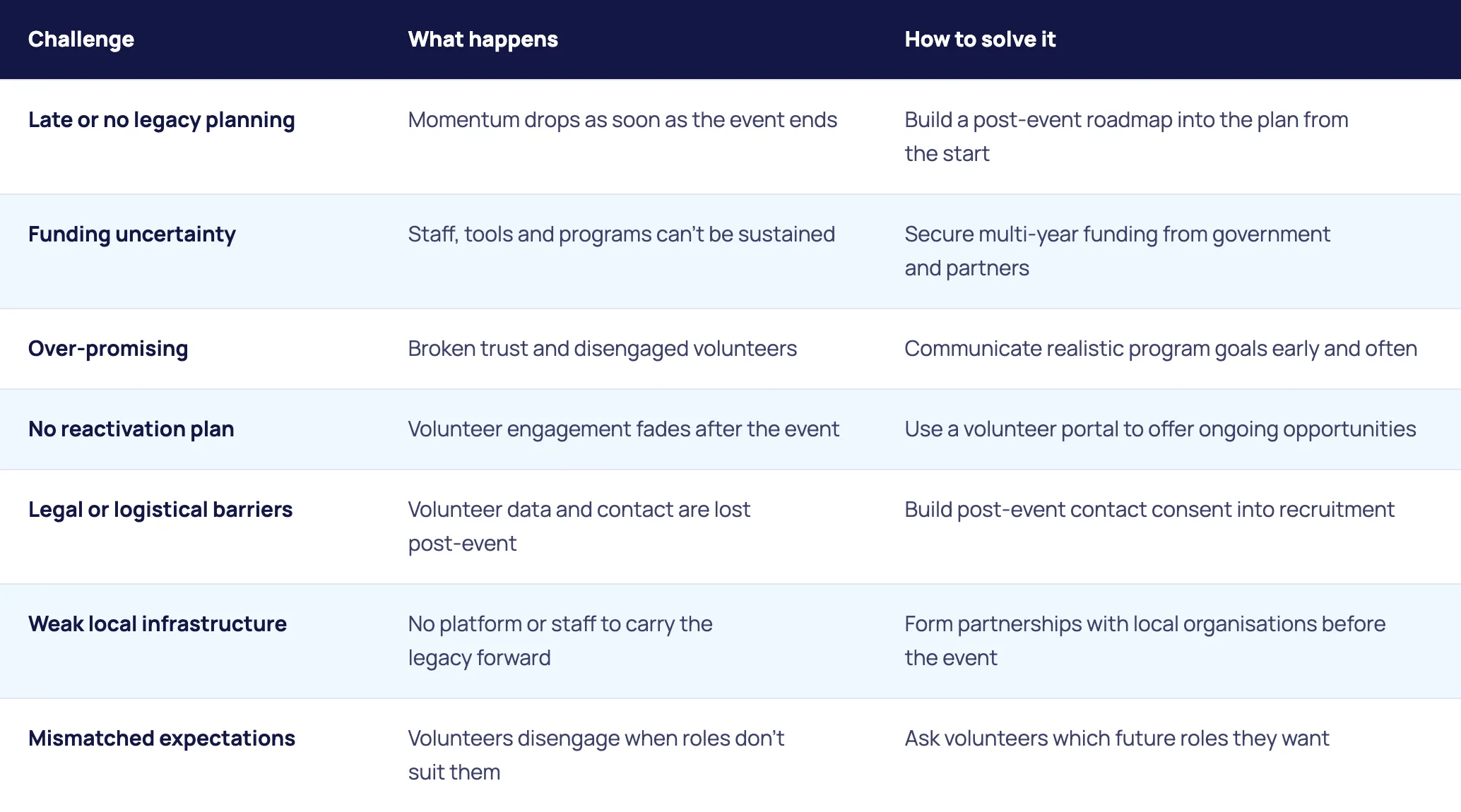
Most volunteer programs lose momentum because legacy is planned too late, funding ends with the event, and volunteers are left without a next opportunity. Contact consent that only covers the event itself can also stop organisers from reaching volunteers afterwards. Each of these problems has a known fix, and most need to be solved before the event begins.
What have major volunteer legacy programs achieved?
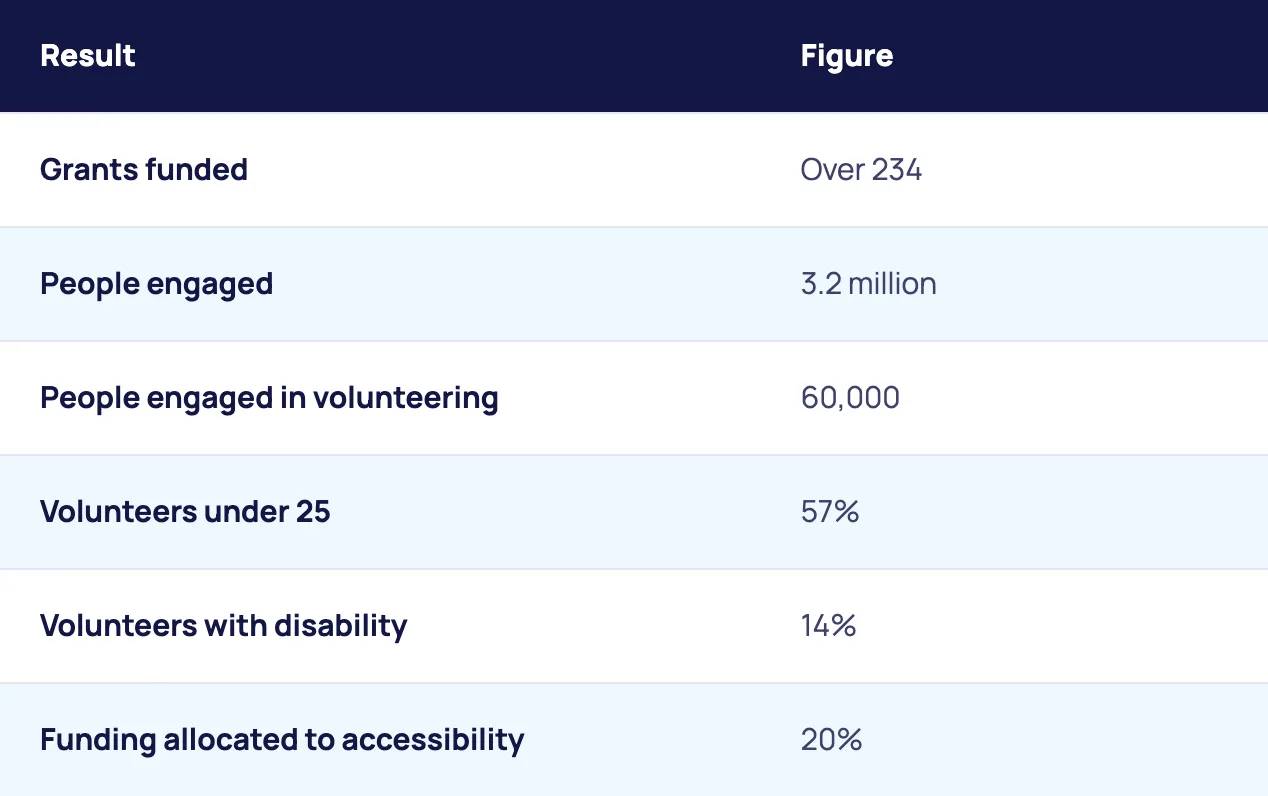
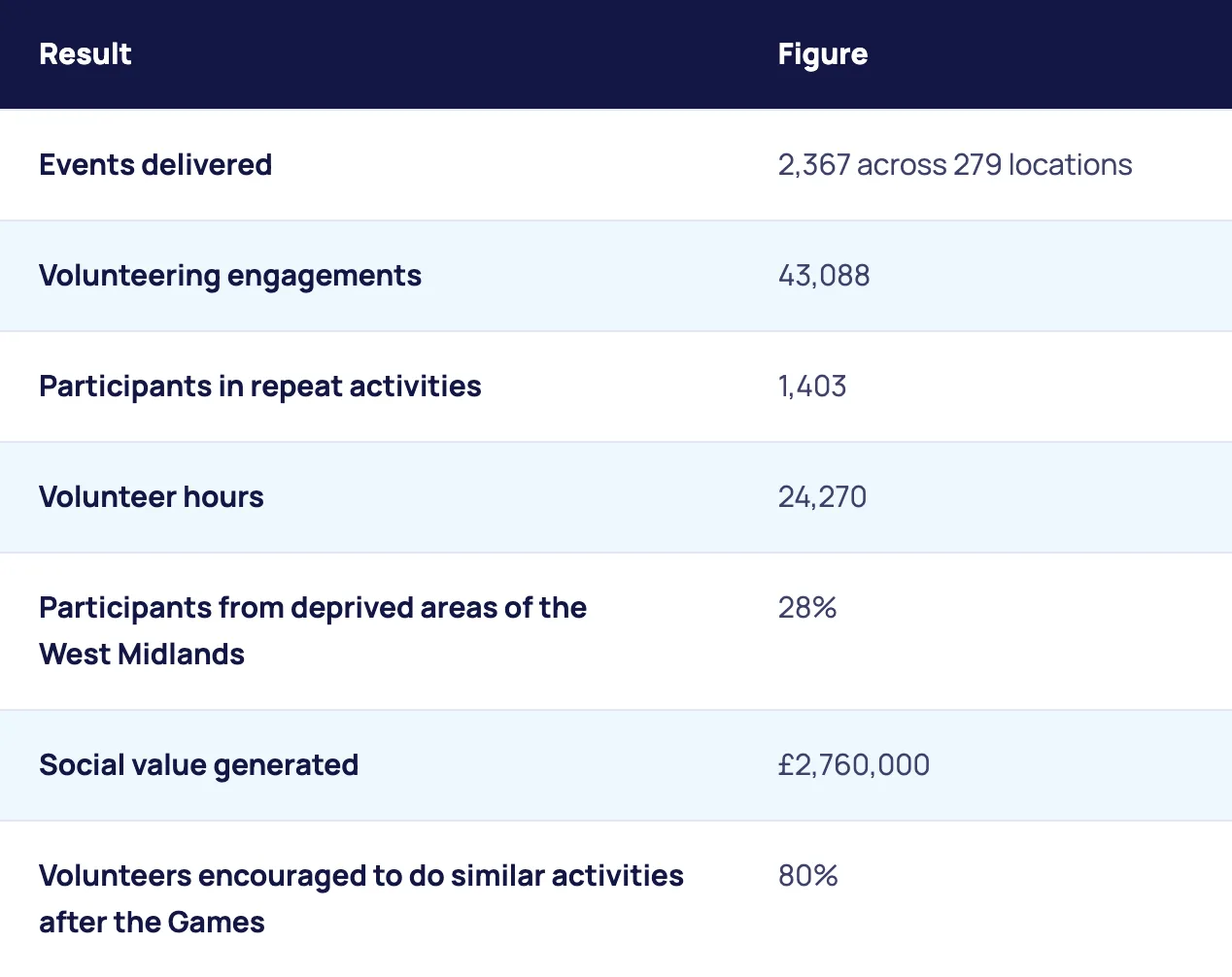
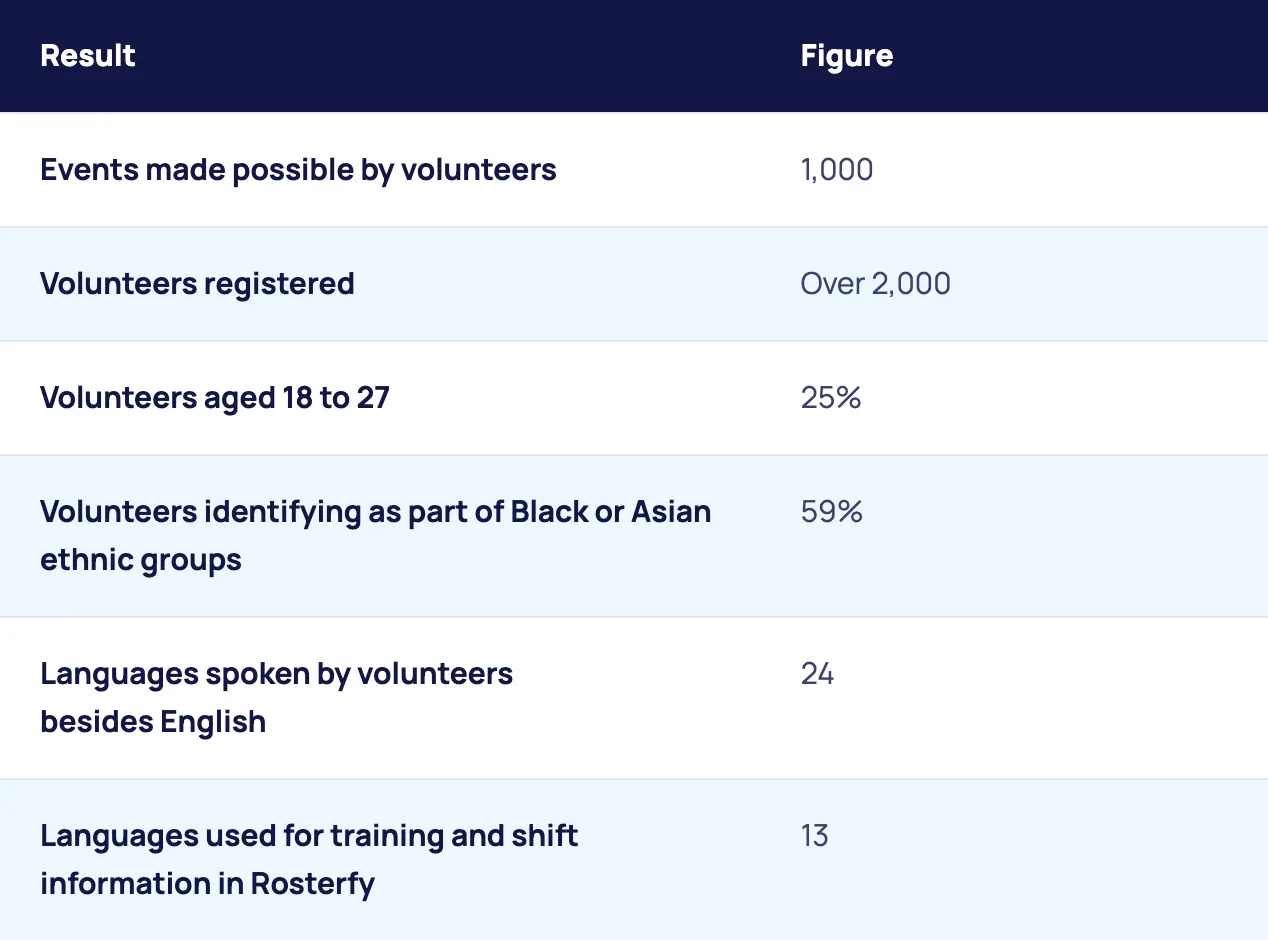
Three programs show what a planned legacy can deliver. Spirit of 2012 engaged 60,000 people in volunteering after London 2012. United by 2022 recorded 43,088 volunteering engagements across the West Midlands after the Birmingham Commonwealth Games. Bradford 2025 registered over 2,000 volunteers who made 1,000 events possible.
Spirit of 2012: how did London 2012 shape the idea of an event legacy?
Spirit of 2012 was founded in 2013 with a £47 million endowment from the National Lottery Community Fund. It is widely credited with changing how the UK thinks about legacy: an event should be the start of a longer program that builds pride, wellbeing and lasting community impact. Its vision was “Happier People, Happier Places”.
Source: Spirit of 2012
“The recent reports we’ve published show it is crucial that event organisers build on lessons learned, planning for volunteering legacy from the very beginning, and the importance of long-term investment in volunteering beyond the event itself.”
Ruth Hollis OBE, Chief Executive, Spirit of 2012
United by 2022: how did Birmingham keep Commonwealth Games volunteers engaged?
United by 2022, the legacy charity of the Birmingham 2022 Commonwealth Games, kept volunteers engaged by committing to ongoing volunteering before the Games began. Its Volunteers Collective launched in June 2023 to deliver on that pledge, engaging over 2,000 people and contributing more than 24,000 volunteer hours.
Source: United by 2022
Bradford 2025: how did a UK City of Culture build a representative volunteer team?
Bradford 2025 built a representative volunteer team through community partnerships, in-person outreach and an accessible volunteer platform.
Running across 141 square miles of West Yorkshire, the program was funded with £15 million from HM Government, £10 million from Bradford Metropolitan District Council and £5 million from National Lottery funding. It partnered with local organisations, including the Race Equality Network, to reach more communities.
At the time of reporting:
Source: Bradford 2025
Every shift description in the Rosterfy volunteer portal included detailed access information.
“I think the most important thing to help you recruit more of a diverse group of people is word of mouth, going in person to community groups and adult classes, that’s been the best way we can reach people and help them know about our programme.”
John Strawson-Rooney, Volunteer Programme Lead, Bradford 2025

How do you set a volunteer program up for success after the event?
Set a volunteer program up for success by sharing one vision across event and host city volunteers, avoiding any gap between the event and the next opportunity, and securing funding beyond a two or three year cycle. Pair a volunteer portal with real people so the program can improve while it runs.
Share one vision from the bid
Birmingham integrated host city and event volunteers from the outset.
“There were some things that were done during the [Commonwealth] Games which set us up for success and one of those things was they integrated the host city and event volunteers. We had a shared vision in the bid document, the Games was for everyone.”
Nicola Turner, United by 2022
Mind the gap
A long gap between the end of an event and the next opportunity is one of the biggest causes of volunteer drop-off. United by 2022 avoided this by publishing a full calendar of events before the Games ended.
Combine a portal with people
Feedback gathered by Spirit of 2012 found that a “Portal + Person” model, combining a volunteer portal with direct human contact, allowed programs to improve while they were running.
Fund beyond the short term
“Having the funding through the years was critical. Working in a two or three year cycle doesn’t build confidence. With a lasting funding commitment the volunteers will have the confidence the programme will have longevity.”
Anthony Yates, Visit Hull and Yorkshire
Five recommendations for event-focused volunteer programs
- Be clear and realistic about your objectives.
- Build on what previous events have already learned.
- Plan legacy from the beginning and set its strategic aims.
- Follow the best practice of modern volunteer programs.
- Capture as much as you can to pass on to the next event.
What are the four pillars of a lasting volunteer program?
Volunteer programs built for lasting impact plan for four pillars: partnerships, accessibility, diversity and legacy. Each pillar has a clear objective and a proven result from an existing program.
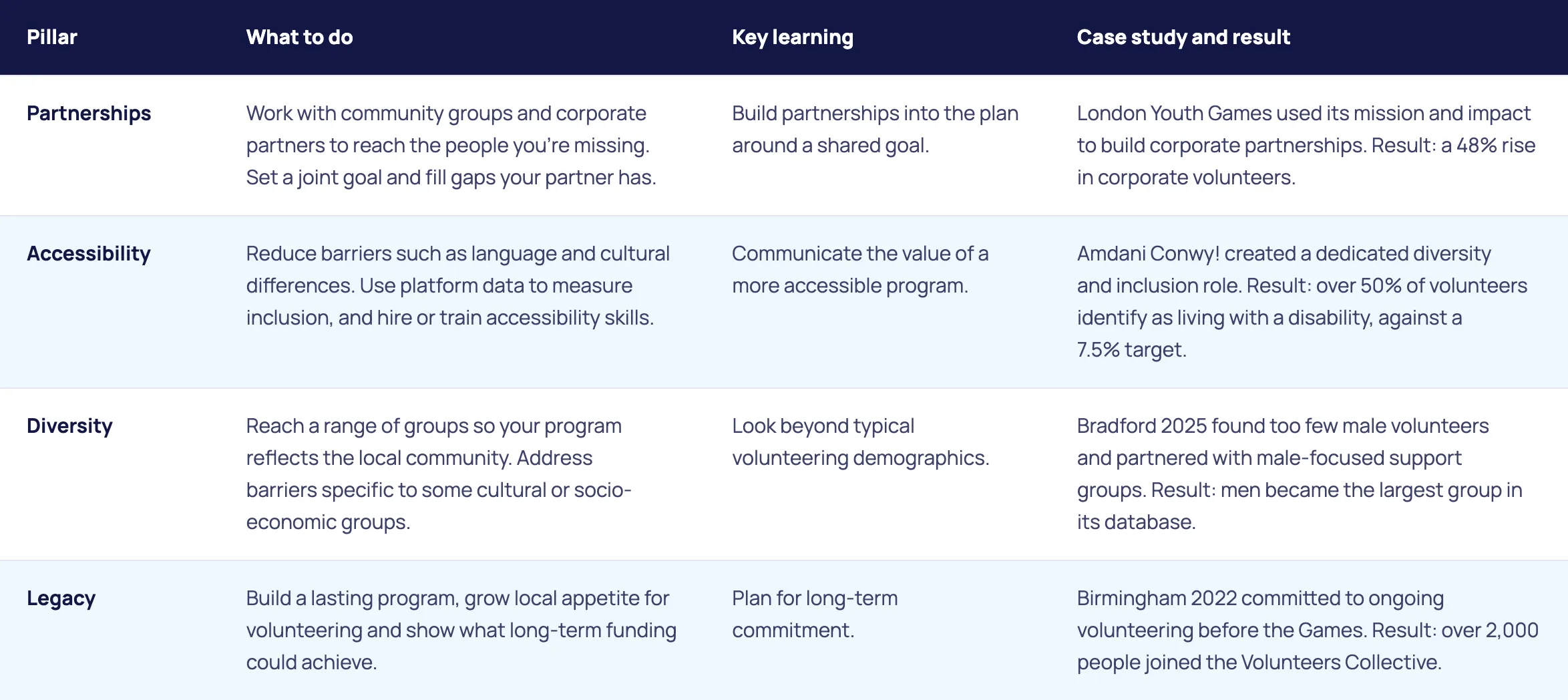
Source: NeighbourlyLab, Building Inclusive Infrastructure for Cultural Volunteering
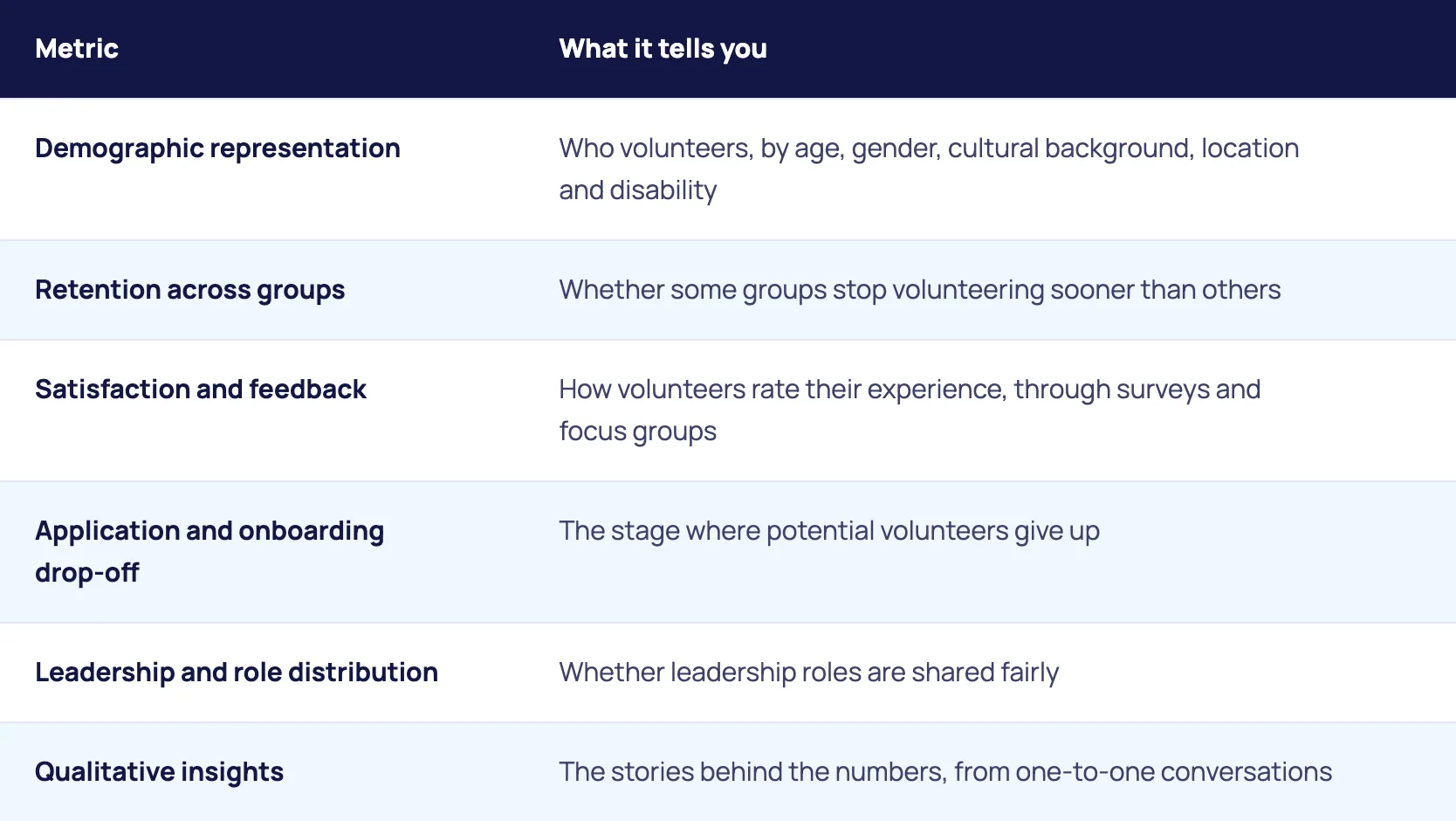
Which diversity and inclusion metrics should volunteer programs track?
Volunteer programs should track six diversity and inclusion metrics: demographic representation, retention across groups, satisfaction and feedback, application and onboarding drop-off, leadership and role distribution, and qualitative insights. Without this data, programs can exclude groups without realising it.
What role does technology play in a volunteer legacy?
A volunteer management platform makes a legacy possible by keeping volunteer data, consent and communication in one place after the event ends. It automates screening, training and shift allocation for thousands of volunteers across many locations, and its reporting gives organisers the evidence they need for funding and impact reports.
A platform supports a city-wide program in three ways:
- Automated workflows for application screening, training distribution and shift allocation
- Centralised communication so every volunteer receives timely updates and role information
- Real-time tracking of attendance, hours, retention and post-event activity
That data does more than run the event. It shows where volunteers go next, and it strengthens the funding case for the legacy program that follows.
What should event organisers do now to plan a lasting volunteer legacy?
Event organisers should plan volunteer legacy now, years before their event, because the decisions that shape it are made early. That means writing legacy into the bid, securing multi-year funding, building post-event consent into recruitment and choosing a volunteer platform that can carry the program beyond the closing ceremony.
- Write volunteer legacy into the bid or event strategy, with named partners
- Plan a calendar of post-event opportunities before the event starts
- Secure funding beyond a two or three year cycle
- Collect consent for post-event contact at registration
- Set diversity and inclusion targets and track them from day one
- Choose a platform that keeps data and engagement after the event
Why do city-wide programs choose Rosterfy?
City-wide programs choose Rosterfy for its focus on the volunteer experience and the adaptability of the platform. Rosterfy powered the volunteer programs behind Spirit of 2012, United by 2022 and Bradford 2025.
- Manage a mix of volunteer roles across multiple locations
- Recruit more effectively
- See program data and diversity reporting in one place
- Build stronger grant and bid applications
- Protect volunteer data with SOC 2 and ISO 27001 compliance
“They’ve loved it, they’ve really loved it. A lot of our volunteers haven’t been involved in a volunteer programme that’s so well organised. Rosterfy helped us do that.”
John Strawson-Rooney, Volunteer Programme Lead, Bradford 2025
Frequently Asked Questions
A volunteer legacy program keeps people volunteering after a major event ends. It turns the volunteers, skills and community goodwill an event creates into ongoing opportunities, usually through a legacy organisation, local partners and a volunteer platform that holds contact consent and data beyond the event.
Volunteer legacy planning should start at the bid stage. The programs in this guide show that legacy works best when it is written into the bid, funded before the event and supported by consent and partnerships set up during recruitment.
Keep volunteers engaged by avoiding a gap between the event and the next opportunity. Publish a calendar of post-event opportunities before the event ends, ask volunteers which roles they want, and use a volunteer portal alongside personal contact to keep them involved.
Legacy funding should last longer than a two or three year cycle. Program leaders found that short-term funding undermines volunteer confidence, while a lasting commitment shows volunteers the program will continue.
Future major events can learn to plan legacy early, fund it for the long term, collect post-event consent at registration and track diversity and inclusion from day one. London 2012, Birmingham 2022 and Bradford 2025 each show the results of this approach.
Rosterfy’s volunteer management platform has supported Spirit of 2012, the legacy organisation of the London 2012 Games, United by 2022, the legacy charity of the Birmingham 2022 Commonwealth Games, and Bradford 2025 UK City of Culture.
Plan a volunteer legacy that lasts
Talk to our team about building a volunteer program that keeps going long after the event ends.